11 Shopify Black Friday Statistics
Last modified: February 2, 2026

Black Friday is one of the biggest shopping days in the US and across the Western world. It is when lots of offline and online stores offer great deals for customers. Shopify is a big part of Black Friday as it is an e-commerce platform. In this article, we look at the most important statistics for Shopify sales on Black Friday and general Black Friday statistics. With these, you can learn a lot that can help you with your campaigns.
What Is Black Friday?
Black Friday is a colloquial term for the Friday after the US Thanksgiving. Traditionally, it is the start of the holiday shopping season and is marked by brands offering lots of discounts on products and services.
Black Friday is often followed by a Cyber Monday where there are online deals. However, both of these days have been amalgamated into one online discount. As a result, Black Friday deals are often stated as starting on the Friday (sometimes before) and going for about a week afternoon.
The date for Black Friday does change every year as it is based on when Thanksgiving is, but it is usually the last Friday in November.
There is some debate on why the date is known as Black Friday. One suggestion is that it is because this is the date in the financial year when retail stores start to make a profit over the year, as most profits are made during the holiday season.
One of the reasons why Black Friday is so important is that in many states within the US, the Friday after Thanksgiving is a day off. There is also a tradition of the Santa Claus parades. This is where parades on Thanksgiving would include an appearance of Santa towards the end of the parade as a way to signal that Christmas is on the way. Retailers would use this as a symbol that the Christmas retail season is going to start.
So here are the best statistics for Shopify sales for Black Friday.
1. Shopify Black Friday 2025 Generated $6.2 Billion in a Single Day
In 2025, Black Friday was worth $6.2 billion in sales for brands on Shopify. In comparison, this is more than Black Friday sales were across the world, for all brands in 2013 when Black Friday was only worth $1.93 billion for online brands.
All the sales on Black Friday in 2025 were $79 billion across the world (online sales only). Therefore, Shopify is responsible for nearly 8 cents out of every dollar that was spent on Black Friday 2025 ($6.2B out of $79B = 7.8%). In contrast, Amazon now has 37.6% of all US e-commerce sales and approximately 10% of total US retail sales (up from just 5% in 2021).
Shopify is a great platform for Black Friday because there are apps that allow merchants to market them as Black Friday. For instance, there are limited-time discounts that can be automated. Merchants could set a time for Black Friday and then reset the prices to their pre-Black Friday levels at a set time on Tuesday.
Another factor is that Shopify is incredibly fast. Shopify has one of the best loading times of any e-commerce platform. The average website takes about 4.2 seconds to load, with some Shopify e-commerce stores taking less than a second. Other website platforms can take 10.3 seconds to load.
Finally, Shopify is also connected to social media, email marketing, and other platforms for better promotion. Therefore, retailers can take advantage of the platform to earn a lot of revenue on the day.
2. Shopify Achieved Record Peak Sales of $5.1 Million Per Minute
Shopify Payments had a very busy day on Black Friday in 2025. At their peak period, more than $5.1 million worth of sales were processed every minute on a Shopify store. This made Shopify a great day for merchants, and Shopify takes a transaction fee for processing the orders for the merchant.
At the same time, it shows that Shopify has one of the best infrastructures across the world, as they were able to take a high level of transactions in one sitting. Therefore, if you want a stable platform, then you can rely on Shopify as it can handle large amounts of data across the domain.
During the whole day, Shopify had more than 81+ million consumers purchased on a Shopify-powered website and their system Shopify Payments. That doesn’t include the number of people who were on the website and didn’t convert. These figures haven’t been officially released by Shopify, but based on the conversion statistics and the 81+ million purchases during the BFCM weekend, we can estimate the traffic. Using the average Shopify conversion rate of 1.4% to 3.2% (normal to above-average), the total traffic to all Shopify-powered websites during the BFCM weekend would be approximately 2.5 billion to 5.8 billion visits.
This is a good sign as it shows that Shopify can handle lots of traffic at the same time. Therefore, Shopify merchants should be in good stead when traffic spikes at natural times throughout the year, whereas other e-commerce sites can sometimes suffer from downtimes.
3. Conversion Rates Shoot up on Black Friday
Shopify monitors all their conversion rates across the stores that they power. Last recorded conversion rates were released in 2021, showing an average of about 1.5%. This is fairly low when it comes to e-commerce, with the average website often achieving conversion rates of between 2.5% and 3.%. However, the majority of Shopify users don’t have experience with digital marketing. Therefore, they are often individuals who with a little more training could achieve better conversion rates.
During Black Friday, the conversion rates of Shopify websites were much higher. According to statistics collected by the company, on Desktop, conversion rates were as high as 6.9%. Tablets recorded a record conversion of 4.8% and mobile devices 2.9%.
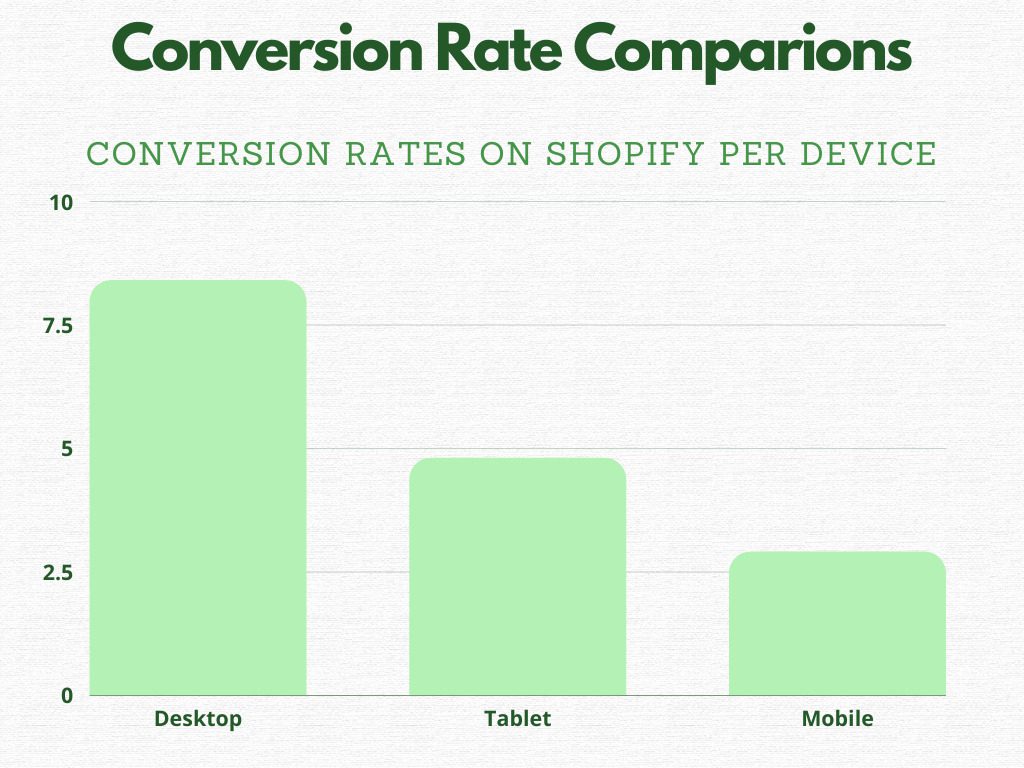
Mobile devices, for comparison, normally have a conversion rate of about 0.84% normally. However, 79% of traffic to Shopify websites normally comes from users on their mobiles. Part of the reason for this is that themes sold for Shopify sites are usually designed for mobile devices, so they generally perform better on mobile searches.
Still, the results show that Black Friday deals are something that is actively sought by consumers and that many brands can take advantage of this time and get more revenue. A good marketing plan for Black Friday might allow users to plan their purchases and therefore brands can see higher rewards on the day, similar to what can be observed on payday.
Or perhaps a good advertising strategy on the day might bring in more customers.
4. Free Shipping Is Still a Major Influence
When it comes to what customers are looking for when buying on Black Friday, specific discounts are not the option that they tend to look for. Free shipping is still the number one influence in the purchasing decision of customers. Nearly half of customers (49%) will purchase with a brand if they offer a free shipping option. Only 36% of customers will purchase because there is a special offer on the day.
Therefore, brands are better off dropping shipping charges on the day and offering free shipping. If you already offer free shipping, then the next best option would be a special Black Friday deal.
After these elements, you need to look at your website. One in five customers (21%) want to buy from websites/apps that are easy to use and simplified. So, take a look at your website and ensure that it loads quickly, and has a clear infrastructure that allows the customer to search for a product with ease and move it to the cart.
You might want to consider investing in some good apps like instant buy or search apps that can help you retain audiences.
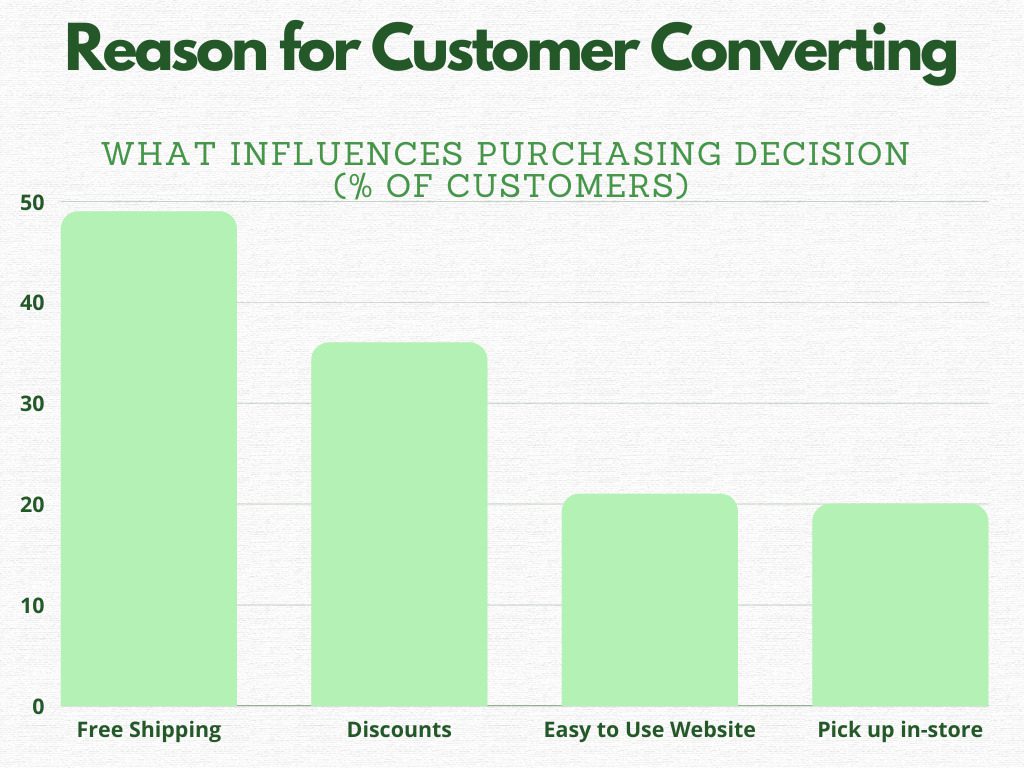
The final factor that is important for customers is the ability to purchase online and pick up in a store. Research has found that 20% of customers are looking for this option when they’re making a purchase online.
5. Price Is Still a Factor
While the final purchasing decision might be influenced by free shipping, price is still a factor when it comes to which brands a shopper will choose. According to some research, 86% of consumers will choose which brand they shop with based on the prices on their website. However, it is still offered, like free shipping, which is important for converting them, especially when operating on a zero budget.
The products you have on offer are also vital. 78% of consumers will buy from brands that have the specific products and product lines that they want. They need to see the brands they are used to or have seen advertised to trust a brand and use them. At the same time, 76% are looking for convenience.
Convenience could mean numerous aspects of the buying process, though there are ways that you can make this easier. For instance, you could have elements such as quick buy or skip to check out options. Or you could have speedy deliveries. It depends on your business model and where your consumers are.
6. Generation Z Is the Biggest Audience
Those who are shopping more on Black Friday tend to be the younger generations. Generation Z is the biggest Black Friday shoppers, about 58% of this generation rely heavily on Black Friday for their holiday shopping and stocking up on household goods that they need. Millennials are the next biggest audience, with about 54% of the audience relying on a special day to collect deals for various reasons.
However, other generations aren’t so reliant on the day. Only about 39% of Generation X and 37% of baby boomers rely on the day to make purchases. This could be because the hype around Black Friday is often on platforms the two groups frequent and started around the time that the millennials became more financially active.
Whatever the reason, these are certainly the audiences that you need to reach first before targeting other groups.
But it is also interesting that 31% of audiences all prefer to shop in-store because they find the excitement of the day a big lure. However, that does mean that 69% have no preference or prefer to shop online. So those who are online only might lose some audience, but they also have a large proportion that they can reach too.
When looking at the intentions of the audience, it is clear to see that many people are looking to buy something on Black Friday. Only about 31% of users are just ‘window shopping’. Therefore, 69% of the traffic on your website are looking to make a purchase.
7. Average Cart Value Increased to $114.70 on Shopify
Shopify recorded a large increase in the average cart price on Black Friday 2025. The price of the average cart was $114.70. This is up from $104.70 seen in 2020. Therefore, customers are spending more on Shopify websites than they were a year ago.
There are several ways that brands can improve the cart values of orders on their website. For one, you can use upsells and cross-sells. If you sell a product that requires batteries or bulbs to work, then sell those in addition. You can improve conversions by offering them at a discount when they’re bought at the same time.
Another option is to make bundles of products and have them as specific Black Friday bundles. For example, you could offer a bundle of bedsheets that include a bed cover, duvet, pillowcases, and other items in one package. For Black Friday, these could be offered at a discount.
There are also ways that you can use sale notification popups or FOMO elements like frequently bought together. Therefore, customers can see what others have bought and feel compelled to make the purchase.
The number of consumers who planned to shop during Black Friday-Cyber Monday week has increased to 82-88% in 2025, showing that while the traditional single-day Black Friday focus has declined, participation in the extended Cyber Week shopping period has actually grown significantly.
However, consumer spending behavior in 2025 tells a more complex story. While 87% of shoppers plan to spend the same or more in 2025, the reality shows significant bifurcation. 30% of consumers planned to spend less on the holiday season than last year, with 43% spending around the same. What appears to be budget growth is actually driven by inflation and wealthy consumers-middle-income Americans planned to cut back spending to $847 (down from $902 last year), while high-income consumers planned to ramp up holiday spending to $1,479 (up from $1,403 last year)
8. In 2021 15% of Sales were International
Black Friday isn’t just a US feature. The holiday has spread across the world, with Black Friday becoming popular in countries like the UK, Australia, and other places. And many shops can sell to these locations as well.
In 2021 15% of sales on Black Friday were across borders. This can include sales in the US that are for customers in Canada.
Numerous shipping apps can help you build a strong and efficient sales fulfillment system that can include shipping to other countries. These often offer more cost-effective solutions too.
Selling internationally does require you to take a few more steps. For instance, you might want to have a currency converter attached to your website. Most people prefer to buy in their own currency, as it is easier for them to see the price. And you might also want to use a translation app to help you build a better website for international audiences.
You will also need to check local regulations to ensure that you can deliver goods to certain countries. There are also ways that you can prevent shoppers from certain locations using geolocation apps.
9. Only 23% of Consumers Look for Something on Sale
The top five things that people are looking for when it comes to Black Friday include items being on sale (23%), the brand being local (18%), the best consumer reviews (17%), products recommended by friends/influencers (12%) and products that are new (11%). Therefore, it is vital that because of Black Friday that you consider what products you’re going to put on sale and perhaps ensure that they have lots of reviews and are recommended by community leaders/influencers.
Very few consumers are looking for products that are made in their country and remarkably only 7% of consumers are looking for a sustainable product. This might change in the future, but at the moment it is not a priority for shoppers. In addition to this, 5% of consumers are looking for environmentally friendly.
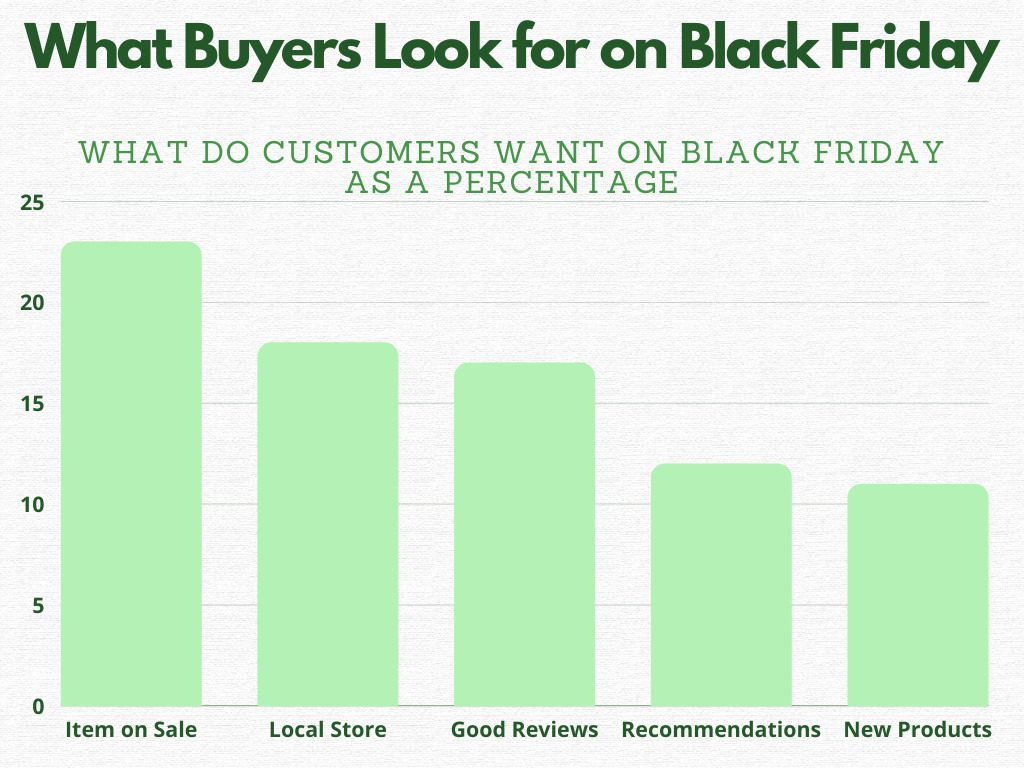
Charity and social justice supporting brands are also a low priority during Black Friday. Only about 5% and 4% of customers respectively look for these elements.
10. Cosmetics and Apparel Lead the Way
The shopping landscape has dramatically shifted in 2025. Cosmetics and apparel have replaced toys as the dominant Black Friday categories, with beauty and fashion driving consumer spending across major retailers.
11. Social Media a Big Driver of Traffic on Black Friday
Black Friday deals on social media have become an absolutely critical driver of traffic and revenue to stores. During the 2025 holiday season, social media drove approximately 10% of all global mobile traffic referrals, representing a 7% year-over-year increase. More importantly, social media generated 3.4% of all online sales on Black Friday 2025, marking a massive 54.5% year-over-year increase (compared to just 2.2% share and flat growth in 2024).
Instagram is also becoming a more popular social media shopping channel. Consumers are using Instagram 73% more now than they did in 2016 to find new products and brands to shop for using the social media channel.
And it does drive sales. One in five consumers has made a purchase based on a recommendation on Instagram from another user. Therefore, try to get influencers onboard for Black Friday and you can see a sale.
Social media activity during Black Friday 2025 reached unprecedented levels. Message volume on social media increased more than 200% compared to 2023, with over 73,000 posts on X (formerly Twitter) discussing Black Friday, holiday shopping, and holiday deals between August and September 2025 alone. More significantly, data from 2024 showed a 22% growth in email and SMS volumes compared to 2023, with all signs pointing to 2025 being even bigger
However, social media needs to be monitored closely by a team. Nearly four out of five consumers (79%) expect that a brand should respond within an hour to any question, message, or comment on social media.
Email marketing is also really important during this time. Open rates for emails increase by about 6% and click-through rates can increase by 4%.
| # | Name | Image | |
|---|---|---|---|
| 1 |
|
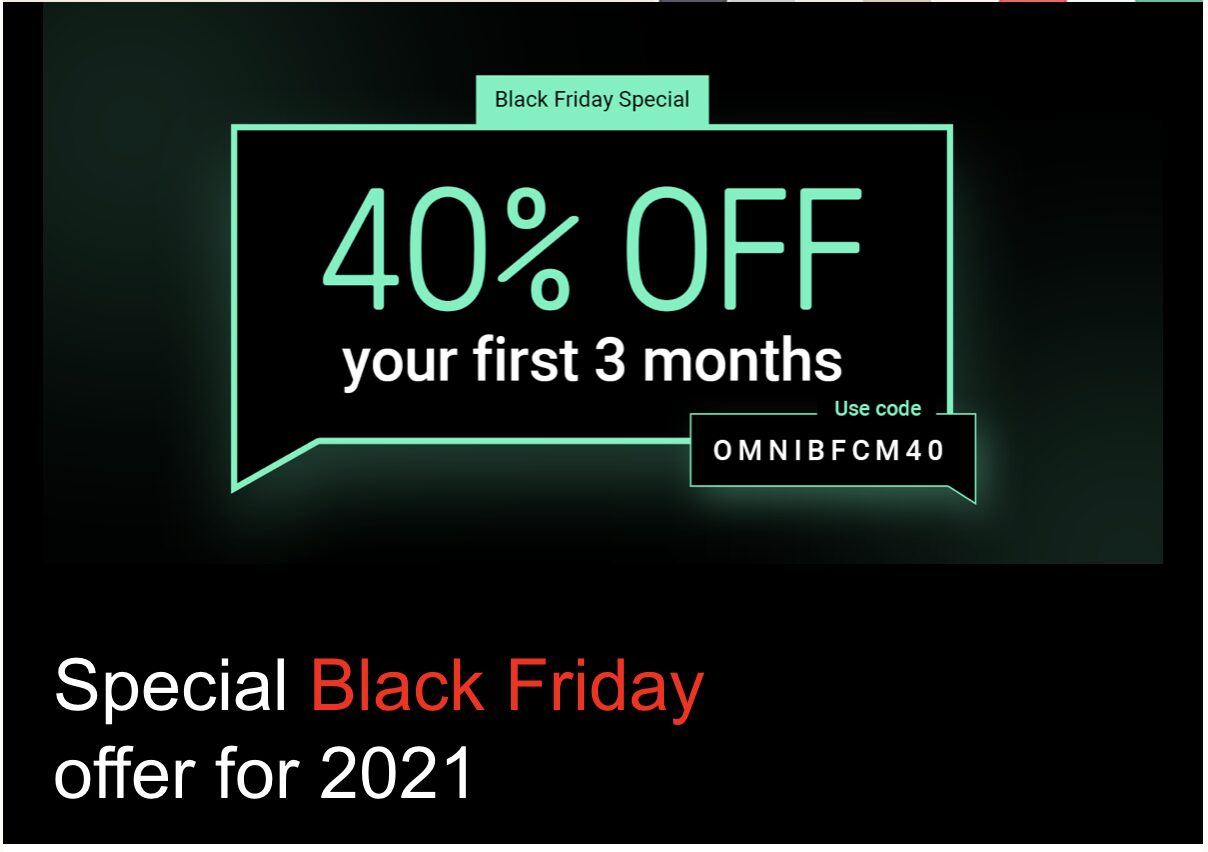
Omnisend BFCM Deal
|
|
| 2 |

|
Semrush BFCM 2022 Deal
|
|
| 3 |
|
Debutify BFCM 2022
|
|
| 4 |

|
Udemy BFCM Deal
|
|
| 5 |

|
ThemeForest BFCM 2020 Deal
|
|
| 6 |

|
Template Monster
|
|
|
Show More
|
|||
-
How long should Black Friday deals last?
Black Friday often starts at midnight on Black Friday and lasts throughout the day, the following weekend, and on Monday at least. Then you can run the Black Friday deals for the rest of the week or end them there. It can depend on your goals and whether you have a good marketing campaign.
-
Is Shopify a good platform for Black Friday?
Shopify is one of the most perfect platforms for Black Friday. They have a robust infrastructure that can handle a huge surge in traffic and transactions that allow you to have a stable website and make more sales. In addition, they have good apps that are designed to help you have a better sale period.
-
What Percentage of Discounts Should I Offer?
There are numerous theories about how much you should offer as a discount on the day. However, many brands are not offering discounts because free shipping, curbside deals, and other offers perform better than a discount.
-
When should you start marketing your Black Friday deals?
Numerous people think that Black Friday deals should be listed before the day and this is the best policy. This is because people like to plan and showing them what you’re going to have on offer might create a significant demand for the product and deal and the stock could run out earlier.
-
What is the best marketing platform for Black Friday?
Numerous platforms should be done for Black Friday deals. Social media is very important. Social media is a very popular method for customers to find new deals. But there is also the vital importance of email marketing that should be done at least once a day. You should also segment your marketing messages to appeal to certain audiences.
-
What is the average cart for Black Friday?
The average cart value on Black Fridays is larger than $100. This has seen a regular increase over the past few years and is due to increase in the next few years too. A good average cart value is great because it offers more profitability than you would expect from other sale times. There are some great ways you can also increase cart values using BOGO offers.
-
What is the top promotion to offer on Black Friday?
The best offer for Black Friday is not necessarily on the discounts that are on offer. Most customers are swayed more by free delivery than they are by the discount amount. In addition, you can be sure that you can build a better business by offering local delivery and curbside pick-up. The number of customers who are taking these options is increasing and their average cart values are often higher than national or international shopping levels.
-
What is the best theme for Black Friday?
There is no better theme for Shopify Black Friday. However, a good theme like Shoptimized or Booster will provide you with a website that is fast and has lots of features to help you sell more on your website. However, other themes are excellent for a website.
-
Can you start Black Friday before the day?
Yes, some brands have started Black Friday before the last Friday in November. Some have started the deals at 6 pm on Thursday or the Monday before. The biggest problem is that this is not matching the customer’s expectations and therefore sometimes the sales have been slow to get going.
-
What products do well on Black Friday?
Numerous product categories sell well on Black Friday. Electronics are not the most popular, though they get a lot of media attention. The most popular categories tend to be clothing and health/beauty products. If you sell in these niches, you can do well.
Conclusion: 11 Statistics for Shopify Sales on Black Friday
Shopify sales on Black Friday statistics aren’t just interesting. They are a way for Shopify merchants to find campaign ideas and marketing tactics to make the most from the sales day. Black Friday is still a popular shopping period. Part of this is because it is seen as the start of the Christmas shopping period. Another reason is that many brands offer employees the day off for Christmas shopping.
Using the above statistics, you can find that this Black Friday could be more successful.