Boost Shopify Theme Review 2026
Last modified: October 1, 2026
The Boost Shopify theme is a premium theme from Clean Canvas, a studio with more than a decade of Shopify work behind it, sold on the Shopify Theme Store at one of the higher one-time prices in the catalog. It is pitched at merchants who want to compete with big retailers on speed, product discovery, and promotions, and it ships with the filtering, merchandising, and conversion features to back that up. This review looks past the theme’s own preview at what Boost actually is, how the stores running it behave in our detection data, how fast it really loads, and whether it earns its price.
Our angle is the data. We detect the themes and apps running on millions of live Shopify stores, so instead of repeating a feature list we can show what Boost merchants really install, how their sites score on Google’s Core Web Vitals, and whether the name is marketing or fact. The short version: Boost is genuinely one of the faster premium themes we track, its build is quick, and the main thing standing between you and that speed is how many apps you pile on top.
View the Boost theme on the Shopify Theme Store
What Is the Boost Shopify Theme?
Boost is a premium theme built by Clean Canvas and listed on the Shopify Theme Store, so it runs on Online Store 2.0 with drag-and-drop sections, JSON templates, and app blocks. It comes with 4 styles (Boost, Flourish, Blossom, and Inspire) and a deep set of sections, and it holds a 87% positive score across 83 reviews on the Theme Store. That rating is solid, with a visible minority of critical reviews worth reading before you buy.
What you are paying for is a fast, conversion-focused storefront with strong merchandising. Boost bundles a mega-menu, advanced and swatch filtering, enhanced search, quick view, image galleries, product videos, promo popups, and a stock counter. Clean Canvas positions it for stores that want to look and perform like a bigger retailer, with SEO and speed treated as features rather than afterthoughts.
What Apps Do Boost Merchants Run?
Because we detect the apps on live stores, we can show the tools that most often sit alongside Boost rather than guess at them.
| Rank | App | % of stores | Category |
|---|---|---|---|
| 1 | Judge.me Product Reviews App | 45.5% | Product reviews |
| 2 | Klaviyo | 44.2% | Email Marketing |
| 3 | Loox ‑ Product Reviews App | 27.3% | Product reviews |
| 4 | Recharge | 25.1% | Subscriptions |
| 5 | PageFly ✦ AI Page Builder | 13.9% | Page builder |
| 6 | Rebuy Personalization Engine | 13.4% | Checkout - Other |
| 7 | Gorgias | 10.8% | Support - Other |
| 8 | Yotpo | 10.4% | Product reviews |
| 9 | Shopify Inbox | 10.0% | Support - Other |
| 10 | Triplewhale | 9.5% | Analytics |
The mix tells you who runs Boost. Product reviews and email marketing lead, then subscriptions, a personalization engine, a page builder, help desk, and analytics. This is a mature, retention-focused crowd that reinvests in its stack, which fits a premium theme and explains the subscription lean we see in Boost stores. It also means Boost buyers are comfortable spending on apps, not looking to avoid them.
Boost by the Numbers
Here is Boost’s footprint across the Shopify stores in our dataset, and how it compares with the typical store.
Two findings sit side by side here. Boost is genuinely fast, beating most themes we track on the share of real stores that pass Core Web Vitals. At the same time, Boost stores run well above the average number of apps. That is the whole story of this theme: a quick foundation carrying a heavy app load. The speed is real, but you protect it with app discipline. For the full breakdown, our Boost statistics page tracks its adoption and app usage across the dataset.
How Fast Is the Boost Theme?
Speed here is real-world Core Web Vitals from Google’s Chrome UX Report, measured across actual Boost stores rather than a clean preview.
| Theme | CWV pass rate | Few apps | Median LCP |
|---|---|---|---|
| Impulse | 78.5% | 84.9% | 1.6s |
| Boost | 77.2% | 80.9% | 1.9s |
| Dawn | 70.8% | 79.1% | 1.6s |
This is where Boost earns its name. Across all real stores it passes Core Web Vitals at a rate most premium themes do not reach, and once you strip out the heaviest app stacks the pass rate climbs well into the high eighties with a faster median load. The gap between those two figures is the app tax: Boost’s own audience runs a lot of apps, and that, not the theme’s code, is what holds the all-stores number back. Keep your app list lean and your images compressed and Boost is quick out of the box.
Boost Design and Layout
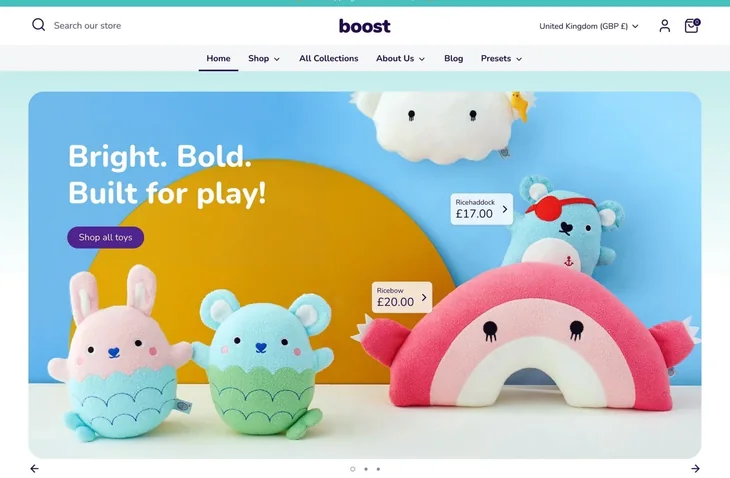
Boost’s design is bright, bold, and playful in its default style, with a full-width hero, a clear header and mega-menu, and shoppable product callouts layered over lifestyle imagery. The 4 styles stretch from that lively look to calmer, more editorial layouts, so Boost is not locked into one aesthetic. Product callouts, galleries, and promo blocks are built to move shoppers toward the cart quickly.
The strength is flexible merchandising with a fast base. You get a lot of sections and promo tools to build a busy, conversion-led homepage, but the same flexibility means a plan matters: it is easy to load the page with popups and blocks that undo the theme’s speed advantage. Build with restraint and Boost keeps both the look and the load time.
Boost Features Worth Knowing
Speed and SEO as first-class features
Clean Canvas treats performance as a headline feature, and our field data backs that up. Boost gives you a fast starting point and clean markup, which matters for both Core Web Vitals and search, provided you do not bury it under apps.
Product discovery for busy catalogs
Boost leans on a mega-menu, advanced and swatch filtering, enhanced search, and quick view. For apparel and toy stores with wide catalogs, that filtering does work merchants often bolt on with apps elsewhere.
Promotions and conversion tools
Promo popups, promo tiles, a stock counter, image galleries, and product videos give you conversion levers built in. Used sparingly they lift conversion; used all at once they slow the page, so treat them as a toolkit, not a checklist.
Boost Pricing
Boost is a one-time purchase on the Shopify Theme Store rather than a subscription, and the price sits at the higher end of the catalog.
$380Because it is a Theme Store theme, you can add Boost to an unpublished store and build with it free, then pay the one-time fee only when you publish. That try-before-you-buy path is the surest way to judge Boost’s speed and features on your own catalog and app stack before you commit. Shopify’s free themes still cover plenty of stores at no cost, so the fee makes sense mainly when you want Boost’s speed, merchandising, and promotion tools together.
Boost Pros and Cons
Pros
- Genuinely fast: real Boost stores pass Core Web Vitals more often than most themes we track
- Lean-app stores score even higher, with a quick median load time
- Strong product discovery: mega-menu, advanced and swatch filtering, enhanced search, quick view
- Built-in promotion and conversion tools (promo popups, stock counter, galleries, product videos)
- 4 styles and Online Store 2.0 sections for flexible, code-free layouts
- Made by an established studio, and a Theme Store theme you can try free before paying
- Clean markup that helps SEO as well as speed
Cons
- One of the more expensive Theme Store themes, a real commitment for a new store
- A visible minority of critical reviews worth reading before buying
- Boost stores run well above the average app count, and that app load pulls real-world speed down
- The promo and popup tools are easy to overuse, which undoes the speed advantage
- The built-in features do not remove app costs for its subscription-heavy audience
- Support and updates come from Clean Canvas through the Theme Store, not from a free Shopify theme
Who Should Use Boost?
Boost fits a specific kind of store better than others:
- Growing apparel, toy, and lifestyle brands that want a fast, conversion-led storefront
- Subscription and repeat-purchase stores that already run a mature app stack
- Merchants who care about Core Web Vitals and search and will keep their app list disciplined
- Store owners who want promotion and merchandising tools built in rather than rented
- Anyone who values trying a paid theme free before committing to a premium price
New stores testing an idea, tight budgets, or very small catalogs are usually better served by one of Shopify’s free themes until Boost’s speed and features clearly earn the premium.
Our Verdict on Boost
Boost is one of the few premium themes whose speed claim holds up in real-world data, and for a fast, promotion-ready storefront from an established studio it is a strong pick. Go in clear on two points: it is a higher-priced commitment, and its real-world speed depends on your app discipline, because Boost’s own audience runs a lot of apps. Use the Theme Store’s free trial to build a real page and test the load on your catalog before you pay. If speed and merchandising are your priorities, Boost delivers. For other premium options, our Aurora review covers a design-led fashion theme, our Impulse review looks at a conversion favourite, and you can browse the rest of our Shopify theme reviews for free and paid picks.
-
Is the Boost Shopify theme good?
Boost is a strong premium theme, especially on speed. Our detection data shows real Boost stores pass Google’s Core Web Vitals more often than most themes we track, and lean-app stores score even higher. It carries a solid Theme Store rating from an established studio. The main trade-offs are its high one-time price and a small share of critical reviews worth reading first.
-
Who makes the Boost Shopify theme?
Boost is built by Clean Canvas, a studio with more than a decade of Shopify theme experience, and it is sold on the official Shopify Theme Store. That means it runs on Online Store 2.0 and meets Shopify’s theme standards, with support and updates through the Theme Store. It ships with 4 styles and a deep set of sections.
-
Is Boost a fast Shopify theme?
Yes, and the field data supports it. Across all real Boost stores it passes Core Web Vitals more often than most themes, and on stores running only a few apps the pass rate climbs into the high eighties with a fast median load. The all-stores figure is lower mainly because Boost’s audience runs a lot of apps. Keep your app list lean and Boost stays quick.
-
How much does Boost cost and can I try it first?
Boost is a one-time purchase on the Shopify Theme Store at a premium price, not a subscription. Because it is a Theme Store theme, you can add it to an unpublished store and build with it free, then pay only when you publish. That try-before-you-buy path lets you test its speed and features on your own catalog before committing.
-
What kind of stores use Boost?
Boost skews toward apparel, toys and games, and food brands, and a large share of its stores sell on subscription. Our detection data shows Boost merchants lean on product reviews, email marketing, subscriptions, and personalization apps, so it draws mature, retention-focused stores. It suits growing catalogs more than tiny ones.
-
Does Boost work with Shopify Online Store 2.0?
Yes. Boost is an Online Store 2.0 theme, so every page uses drag-and-drop sections, JSON templates, and app blocks. You can rearrange sections and build layouts in the theme editor without touching code. It ships with 4 styles and a deep section library to start from.