Rebuy Personalization Engine Review 2026
Last modified: September 29, 2026
Rebuy Personalization Engine is an AI personalization and upsell app for Shopify, the tool a store adds when it wants every step of the shopping journey, the cart, the checkout, and the thank-you page, to recommend the right next product. Made by Rebuy, it combines a customizable smart cart, AI product recommendations, and cart, checkout, and post-purchase upsells into one engine aimed at lifting average order value and lifetime value. In our detection data it is the most-used cart app on Shopify, and the stores that run it carry app stacks nearly double the average, the mark of established, revenue-focused brands. The verdict upfront: for a store with real traffic and repeat buyers, Rebuy turns existing visits into bigger orders, which is exactly why higher-volume brands adopt it. The honest catch is that it is built for that volume. It rewards stores with enough orders to personalize and enough margin to upsell into, and its cost and setup scale with you.
If you run a growing store where raising average order value moves real money, Rebuy earns its place, and it is rated accordingly with a 4.7 out of 5 across more than 700 reviews. If you are a small store still finding your first customers, its personalization has little to work with yet. The sections below use live detection data to show how widely Rebuy is used, what it does, what it costs, and the kind of store that actually needs it.
What is Rebuy Personalization Engine?
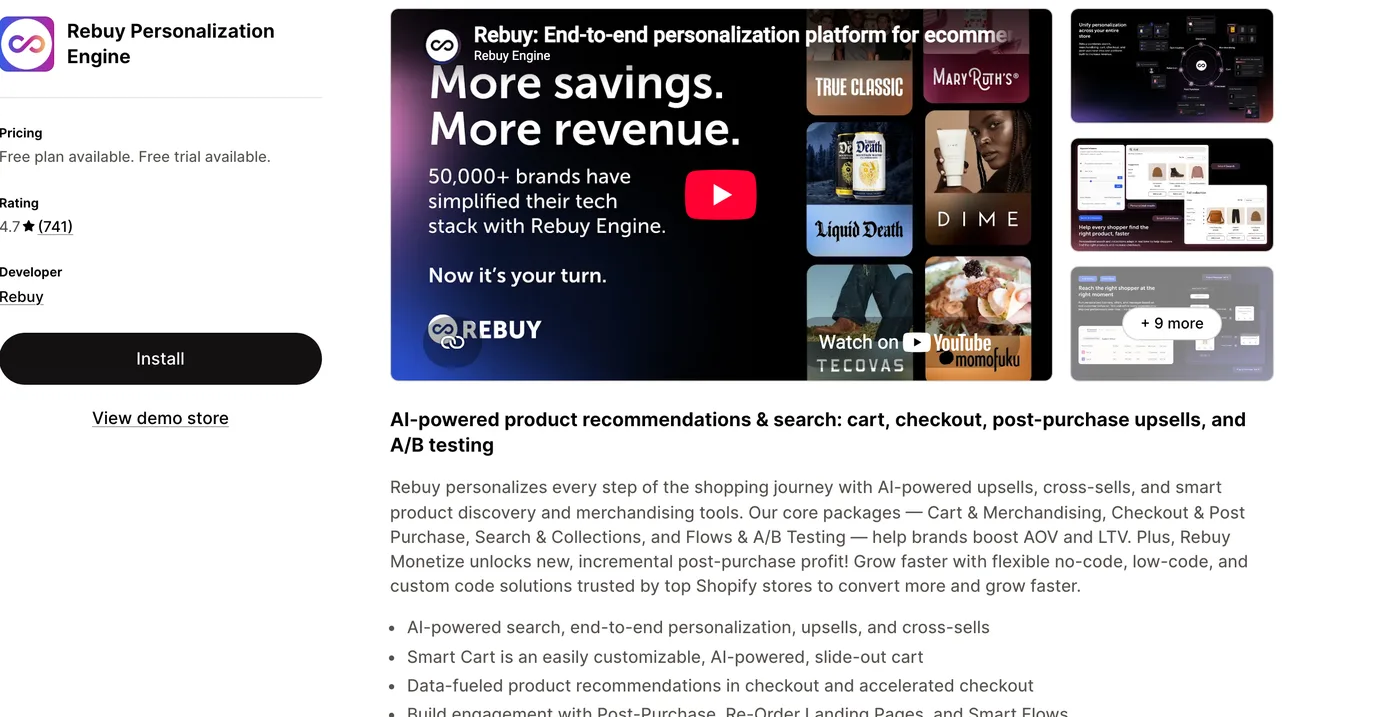
Rebuy Personalization Engine is an app made by Rebuy that adds AI-driven recommendations and upsells across a Shopify store. Its pieces fit the shopping journey: a smart cart that slides out with personalized add-ons, product recommendations on product and collection pages, one-click upsells at checkout, and post-purchase offers and re-order landing pages after the sale. On top sits A/B testing and a flow builder for setting up rules, plus search and merchandising tools. The whole point is to raise average order value and lifetime value by showing the right product at the right moment, and Rebuy says more than 50,000 brands use it. It has a free plan, with paid plans that scale, and a 4.7 rating across more than 700 reviews. Here is how widely it is installed across our dataset.
How popular is Rebuy?
Rebuy leads its category. Live detection makes it the most-used cart app on Shopify, well ahead of the next tool in the ranking, including Rebuy’s own lighter Smart Cart app. It also tells you something about the stores that run it: they carry app stacks nearly double the platform average, the mark of established brands that treat upsells and personalization as a core part of how they grow.
What does Rebuy do?
Rebuy works by personalizing the parts of a store where extra revenue hides. Its smart cart replaces the default cart with a customizable, AI-powered drawer that suggests complementary products as a shopper checks out. Its recommendation widgets surface related and frequently-bought-together items on product and collection pages. At checkout and after the sale, one-click upsells and post-purchase offers add items without making the shopper start over. A flow builder and A/B testing let you set rules and test what actually lifts order value.
The thread through all of it is average order value. Rather than finding new customers, Rebuy is built to get more from the ones already buying, which is why it pairs so naturally with email and subscription tools. That focus is also why the value depends on volume: personalization and upsells only pay off when there is a steady stream of orders to learn from and sell into.
Is Rebuy worth it?
For a store with real traffic and repeat buyers, yes. When you already have a steady flow of orders, lifting average order value by even a little adds up quickly, and Rebuy’s upsells and recommendations are built to do exactly that without extra ad spend. This is why it skews toward established, higher-volume brands rather than new stores.
Where it makes less sense is at low volume. Rebuy’s personalization needs data and orders to work well, so a store still finding its first customers has little for it to act on, and the cost is harder to recover. Treat Rebuy as a way to grow revenue from an existing base, not a way to create one. A smaller store is usually better served by nailing its product pages and traffic first.
What Rebuy costs
Rebuy’s pricing is Free, or from $25/mo, with paid plans that scale with your order volume, so the price rises as the app has more sales to work with. It is priced as a revenue tool rather than a flat add-on, which makes sense given it is meant to pay for itself in extra order value. Match the plan to your order count, and watch that the added revenue clears the cost as you move up the tiers.
Which themes and apps run with Rebuy?
Because we detect both themes and apps, we can see the company Rebuy keeps, and it points at serious brands. Its most common theme is Shopify’s free Dawn, followed by conversion-built and premium themes like Prestige and Impulse. Here are the themes most commonly running it.
| Rank | Theme | % of stores |
|---|---|---|
| 1 | Dawn | 15.1% |
| 2 | Elixir | 6.7% |
| 3 | Prestige | 5.2% |
| 4 | Impulse | 4.3% |
| 5 | Horizon | 3.8% |
| 6 | Impact | 3.5% |
| 7 | Broadcast | 2.3% |
| 8 | Focal | 1.8% |
| 9 | Shrine PRO | 1.6% |
| 10 | Symmetry | 1.6% |
The app side is the clearest signal. Most stores running Rebuy also run a major email platform, and many pair it with reviews apps, a subscription tool, a support helpdesk, and analytics, which is why Rebuy stores carry close to double the app count of an average store. These are full growth-and-retention operations, and Rebuy is the piece that squeezes more value from each order. For the full breakdown of themes, paired apps, and store types, see the live Rebuy usage statistics.
What kinds of stores use Rebuy?
Rebuy stores skew toward established direct-to-consumer brands that care about order value and repeat purchases. Subscription businesses are well represented, and the wider profile is stores with the traffic, and the product range, to make cross-sells and upsells work. These are operations where a few extra dollars per order, multiplied across many orders, is real money.
That profile explains both the heavy app stacks and the category leadership. A brand already investing in email, reviews, and subscriptions has the volume and the maturity to get a return from personalization too. A newer or smaller store rarely does, which is exactly where the next section lands.
Do not over-upsell
The trap with any upsell tool is pushing too hard. Stacking recommendations and offers on every screen can clutter the experience and annoy shoppers, which costs more than the extra order value it wins. Use Rebuy’s A/B testing to prove each placement earns its keep, keep the cart and checkout clean, and remember the tool needs real order volume before its personalization has anything to learn from.
Rebuy pros and cons
Pros
- The most-used cart and upsell app on Shopify, with a mature feature set
- Personalizes the cart, checkout, and post-purchase in one engine
- Smart cart, AI recommendations, and a flow builder with A/B testing
- Free plan to start, and built to pay for itself in extra order value
Cons
- Needs real traffic and order volume to be worth it
- Pricing scales with orders and can climb as you grow
- Easy to over-upsell and clutter the shopping experience
- Setup and rule-building take time to get right
Because Rebuy adds personalized recommendations across the store, speed is a reasonable concern. On plain averages, stores using Rebuy can look a little slower, but that mostly reflects the bigger, busier stores that invest in personalization. Compared fairly against similar stores, the ones running Rebuy pass Google’s speed test (Core Web Vitals) more often, about 65% versus 61% for comparable stores without it, among stores with enough traffic to appear in Google’s Chrome UX Report.
Does Rebuy slow a store down?
Compared only against stores on the same theme, running the same number of apps and carrying a similar catalogue, stores with Rebuy Personalization Engine installed pass Core Web Vitals 4.2 points higher of the time (4,420 comparable stores across 630 matched groups).
| Comparison | With Rebuy Personalization Engine | Without | Stores compared |
|---|---|---|---|
| Like-for-like stores | 64.4% | 60.2% | 4,591 with · 34,933 without |
| All stores, unmatched | 63.6% | 68.3% | 5,350 with · 53,592 without |
Who should use Rebuy?
Reach for Rebuy if you are an established or growing brand with steady traffic and repeat buyers, and you want to raise average order value without spending more on ads. For those stores the smart cart, recommendations, and post-purchase upsells pay for themselves in bigger orders, and the free plan lets you test the idea before committing to the paid tiers. For a lighter, cart-focused alternative, see our Kaching Cart review.
Skip it, for now, if your store is small or your traffic is light. Personalization needs orders to learn from, so a store still building its first customer base will not get much from it yet, and the cost is hard to justify. Rebuy is the right tool once you have a steady flow of orders to grow, and an early one before then.
Our verdict
Rebuy is our pick for stores that already have traffic and want to grow revenue per order through personalization and upsells. Start on the free plan, use A/B testing to prove each placement earns its keep, and match the paid tier to your order volume. If you are still finding your first customers, you do not need it yet.
-
What is Rebuy used for?
Rebuy Personalization Engine is used to raise average order value on Shopify through AI-powered upsells and recommendations. It adds a smart cart, product recommendations, and cart, checkout, and post-purchase upsells so a store can show the right next product at the right moment. Brands use it to earn more from the customers they already have.
-
Is Rebuy free?
Rebuy has a free plan to start, then paid plans that scale with your order volume, priced Free, or from $25/mo. Because it is priced as a revenue tool, the cost rises as the app has more sales to work with. Most stores start on the free plan and upgrade once the extra order value clearly covers the price.
-
What is the Rebuy Smart Cart?
The Smart Cart is Rebuy’s customizable, AI-powered slide-out cart that replaces Shopify’s default cart. As a shopper checks out, it suggests complementary products, offers, and rewards to lift the order value. It is one of Rebuy’s core features, and in our data the full Rebuy Personalization Engine is used far more than the standalone Smart Cart app.
-
Is Rebuy worth it for a small store?
Usually not yet. Rebuy’s personalization needs a steady flow of orders to learn from and sell into, so a small store still finding its first customers has little for it to act on. For those stores, focusing on product pages and traffic first tends to pay off more. Rebuy makes sense once you have real order volume to grow.
-
What apps does Rebuy work with?
Rebuy is built for Shopify and usually runs inside a full growth stack. In our data most Rebuy stores also run a major email platform like Klaviyo, and many pair it with reviews apps, a subscription tool, a support helpdesk, and analytics. It fits alongside those tools rather than replacing them.
-
Which stores use Rebuy most?
Established, higher-volume brands that care about order value. In our data Rebuy skews toward direct-to-consumer and subscription stores that run heavy app stacks, nearly double the platform average. Its most common theme is Shopify’s free Dawn, followed by conversion-built and premium themes.
Is Rebuy worth it?
For a store with real traffic and repeat buyers, yes. The data shows why it leads its category: Rebuy is the most-used cart app on Shopify, and it is chosen by established, app-heavy brands that treat personalization and upsells as a core growth lever. Its smart cart, AI recommendations, and post-purchase offers are built to raise average order value, and the free plan lets you test the idea before paying. The only real trap is over-upselling or adding it before you have the order volume to feed it, so keep placements clean and prove each one with A/B testing. To see how it fits alongside everything else, browse our guide to the best Shopify apps. And any time you spot a store with a slick slide-out cart or clever upsells, you can scan it to see whether it is running Rebuy and what theme and apps it pairs with.