Minimog Shopify Theme Review 2026
Last modified: September 17, 2026
Minimog is FoxEcom’s $88 multipurpose Shopify theme, sold on ThemeForest and built for dropshipping and high-volume stores that want upsells, urgency, and a big demo library without paying premium theme prices. The verdict upfront: for a conversion-led store on a budget, Minimog is worth the $88, and it is one of the few feature-heavy themes that does not wreck your storefront speed. What this review adds over the sales page is the data only we can see: how many live stores actually run Minimog, what apps they stack on top of it, and how it holds up against rivals like Ella and Shrine. If you just want the raw speed, popularity, and adoption numbers, those live on our Minimog stats page; this review is about whether it is the right theme for your store, and whether it is worth buying on ThemeForest.
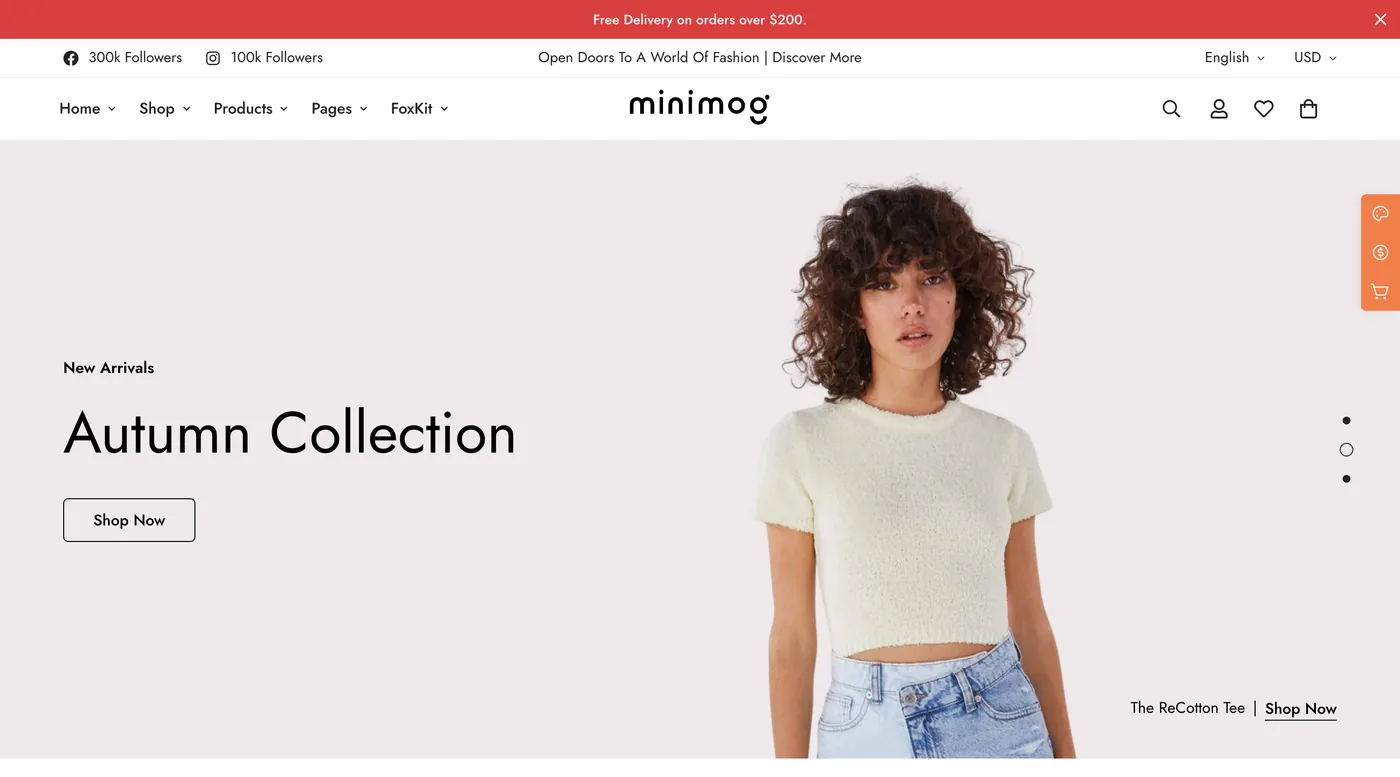
What is the Minimog Shopify theme?
Minimog is a premium, conversion-focused multipurpose Shopify theme from FoxEcom, sold on ThemeForest for $88 as a one-time purchase rather than on the Shopify Theme Store, and built for dropshipping and high-volume stores. The listing is published under the ThemeMove author account, a Power Elite Author on Envato, with an extended license at a much higher price for resale use. Like Ella, it is not listed on the Shopify Theme Store, so there is no Shopify positive-sentiment rating or Shopify-managed support. It sells through Envato’s ThemeForest, where it holds a very high buyer rating across roughly 16,700 sales and is updated regularly, most recently in mid-2026. You are trusting ThemeForest’s buyer base and FoxEcom’s own support rather than a Shopify score.
A quick note on the name, because it trips people up: you will see this theme called both Minimog and Minimog OS 2.0, and they are the same theme. The OS 2.0 part is not a separate product or an older edition. It refers to Shopify’s Online Store 2.0 architecture, the modern theme framework that allows sections on every page, JSON templates, and app blocks, which Minimog is built on.
That designation is baked into how the theme registers in a store’s code, which is why our detection data and stats page list it as Minimog OS 2.0 even though FoxEcom sells it simply as Minimog. The theme is currently on its version 5 line and also supports the newer Online Store 3.0, so a store on Minimog is on the current Shopify theme architecture, not a legacy one.
What you get for $88 is a conversion toolkit wrapped in a multipurpose theme. Minimog ships with a large library of pre-built demos, a drag-and-drop builder, and built-in upsell, cross-sell, and urgency features, much of it powered by FoxEcom’s companion FoxKit app. The pitch is that a store can launch with professional design and conversion tooling built in, cutting the app stack a dropshipping or high-volume store would otherwise pay for. The core of what it bundles:
- 100-plus pre-built demos spanning fashion, beauty, food, electronics and more.
- Drag-and-drop section builder so layout changes need no code.
- Built-in upsell and cross-sell through the FoxKit integration.
- Urgency and sales tools like countdown timers and sales notifications.
- Quick view, quick add, and mega menu for faster browsing on a deep catalog.
- Ajax cart and product filtering to keep the buying path short.
Is the Minimog theme worth the money?
Minimog is worth the money for a conversion-led store on a budget: at $88 one-time it bundles upsells, urgency tools, and more than 100 pre-built demos, plus real-world speed that most feature-heavy Shopify themes cannot match. It is weak value if you mainly want a simple store or the reassurance of a Shopify Theme Store rating, because Minimog sells on ThemeForest and offers neither.
Is Minimog growing or fading?
Minimog’s adoption is broadly stable with a slight downward drift: its share of live Shopify stores has held close to 2% through 2026 in Shopify Theme Detector’s monthly scans, easing back a little from its early-year peak rather than collapsing. It keeps that base entirely through ThemeForest and dropshipping communities rather than the Shopify Theme Store. The chart below tracks that share month by month, so you can read the trend for yourself before you commit.
Minimog Adoption Trend
Minimog OS 2.0 has held steady at about 2.2% of Shopify stores in our dataset over recent months.
Read that line against Minimog’s channel. It is not found by browsing the Shopify Theme Store, because it is not there. Minimog spreads through ThemeForest, dropshipping communities, and YouTube build-alongs as one of the go-to high-converting themes. A theme that holds a large base entirely outside Shopify’s own storefront is being chosen deliberately by people who know what they want it for, and Minimog has become a fixture of that ThemeForest conversion category rather than a passing name.
Who actually runs Minimog?
Minimog is run mostly by conversion-led dropshipping and high-volume direct-to-consumer stores. In Shopify Theme Detector’s live scans those stores keep a moderate app stack rather than a bloated one, because the theme already bundles upsells and urgency tools through FoxKit. The snapshot below pulls Minimog’s live position in our dataset: how common it is, where it ranks, and how many apps the typical Minimog store runs.
Minimog Usage Statistics
Minimog usage at a glance, from the Shopify stores in our dataset, refreshed daily.
The app count is worth a note. Minimog stores run a moderate stack rather than a bloated one, which fits a theme that already bundles upsells, urgency, and filtering natively through FoxKit. Part of what a conversion store would normally rent from apps is built into the theme, which is a real argument for the low price once you count the subscriptions you might skip. That native tooling is also, as we will see, part of why the theme still manages to stay quick.
Where does Minimog rank among all themes?
Minimog ranks among the most-used paid themes in Shopify Theme Detector’s dataset, sitting alongside the big ThemeForest names like Ella and Kalles and just behind Shopify’s own free and premium defaults. The leaderboard below puts that in context, listing the most-used themes so you can see exactly where Minimog lands.
Most-used Shopify themes
| Rank | Theme | % of stores |
|---|---|---|
| 1 | Dawn | 15.0% |
| 2 | Horizon | 7.9% |
| 3 | Prestige | 4.4% |
| 4 | Impulse | 4.0% |
| 5 | Shrine PRO | 3.3% |
| 6 | Impact | 2.4% |
| 7 | Minimog OS 2.0 | 2.1% |
| 8 | ella | 2.0% |
| 9 | Kalles | 1.8% |
| 10 | Broadcast | 1.7% |
The interesting part is the company it keeps. The themes above Minimog are Shopify’s free defaults and its best-known premium themes, plus the other big ThemeForest names like Ella, Kalles, and Glozin. Minimog holds its own in that group as an $88 theme sold outside Shopify’s store, sitting right alongside Ella as the two dominant low-cost multipurpose options. For a product you can only buy on ThemeForest, reaching that tier of adoption shows how much the conversion-plus-price combination appeals.
What kind of stores choose Minimog?
Minimog is chosen mostly by conversion and dropshipping stores. In Shopify Theme Detector’s live scans their most-installed apps are product reviews, the developer’s own FoxKit upsell tools, countdown timers, and sales-notification popups, the fingerprint of a store built to convert paid traffic. The table below shows those apps, pulled from our live scans.
Apps Most Used on Minimog Stores
The apps stores running Minimog install most, from live scans of the Shopify stores in our dataset.
| Rank | App | % of stores | Category |
|---|---|---|---|
| 1 | Judge.me Product Reviews App | 51.3% | Product reviews |
| 2 | Foxkit Upsell Bundles | 20.7% | Upsell and cross-sell |
| 3 | Klaviyo | 16.7% | Email Marketing |
| 4 | Sales Notification | 12.4% | Social Proof |
| 5 | Recharge | 12.1% | Subscriptions |
| 6 | Loox ‑ Product Reviews App | 10.8% | Product reviews |
| 7 | Shopify Inbox | 9.7% | Support - Other |
| 8 | Releasit Cod Form | 7.5% | Pay later |
| 9 | Foxkit Upsell Cross Sell | 7.3% | Upsell and cross-sell |
| 10 | Omnisend Email Marketing & SMS | 6.7% | Email Marketing |
Reviews lead the list, as they do on most themes, but the apps underneath tell the sharper story. The developer’s own FoxKit upsell and sales-boost apps, countdown timers, sales-notification popups, and cash-on-delivery order forms all sit near the top. That is the fingerprint of a conversion and dropshipping store, and it is exactly the model Minimog is built and marketed for.
The what-they-sell breakdown on our Minimog stats page rounds out the picture. Apparel and accessories is the biggest category, but health and beauty, food and drink, and home goods all take real shares, so Minimog is a broad, conversion-led theme rather than one tied to a single niche. The stats page lists the full split of what Minimog stores sell.
Is Minimog fast on real Shopify stores?
Yes. Minimog is one of the few feature-heavy Shopify themes that stays fast on real stores: in Shopify Theme Detector’s August 2026 field data, a clear majority of live Minimog storefronts pass Google’s Core Web Vitals, far ahead of a rival like Ella. Rather than quote a single lab score from the demo, the block below reads the Core Web Vitals recorded on hundreds of real Minimog storefronts.
| Theme | CWV pass rate | Few apps | Median LCP |
|---|---|---|---|
| Impulse | 78.4% | 85.4% | 1.6s |
| Dawn | 71.2% | 79.9% | 1.6s |
| Minimog OS 2.0 | 60.8% | 66.5% | 2.1s |
This is where Minimog separates itself from the pack. A clear majority of live Minimog stores pass Google’s Core Web Vitals, and the individual metrics for loading, interactivity, and layout stability all sit in the good range. That is unusual for a feature-heavy conversion theme, and it is a genuine point in Minimog’s favour, especially next to a rival like Ella where only about a quarter of stores clear the same bar. It still pays to size images well and avoid piling on redundant apps, but Minimog does not start you in a hole the way many loaded themes do.
What Minimog is genuinely good at
Minimog earns its price in a specific set of jobs, and it does them well.
The first is conversion tooling on a budget. Upsells, cross-sells, urgency timers, and sales popups ship with the theme through FoxKit, so a store built to convert paid traffic gets the merchandising stack without a pile of monthly app fees. For a dropshipping or high-volume seller counting margins, that bundling is the whole appeal.
The second is speed without stripping features. Most themes force a choice between rich features and fast pages, and Minimog is one of the few in its category that largely avoids it, with most live stores passing Core Web Vitals. That combination is rare and valuable.
The third is range and value. With a hundred-plus demos and a drag-and-drop builder for $88, Minimog can dress almost any product type and launch fast, which is why it competes so directly with Ella for the low-cost multipurpose crown.
Where Minimog falls short
Minimog’s strengths come with real trade-offs, and it is not for every store.
The first is complexity. All those demos, settings, and FoxKit features mean a learning curve, and a founder who just wants a clean store live quickly can find the sheer number of options overwhelming. The power that makes it flexible also makes it fiddly.
The second is ecosystem lock-in. A lot of Minimog’s conversion value runs through FoxEcom’s own FoxKit app, so you are leaning on one developer’s ecosystem for both the theme and the tooling. That is convenient while it works, but it ties more of your store to a single vendor than a neutral theme would.
The third is the lack of a Shopify safety net. Because Minimog is sold on ThemeForest rather than the Theme Store, there is no Shopify positive-sentiment rating to check and no Shopify-managed support. You rely on ThemeForest reviews and FoxEcom’s own help, which is capable but different from buying inside Shopify’s store.
Minimog vs the alternatives
If you are weighing Minimog against the other paid options, here is how they line up on price, rating, and who each one suits. Note that the ThemeForest themes carry no Shopify Theme Store rating, which is part of the decision.
| Theme | Price | Theme Store rating | Best for |
|---|---|---|---|
| Minimog | $88 (ThemeForest) | Not on Theme Store | Conversion-led, multipurpose, fast on a budget |
| Ella | $79 (ThemeForest) | Not on Theme Store | Feature-rich multipurpose (but slower) |
| Shrine PRO | $349 one-time | Not on Theme Store | Urgency-led DTC and dropshipping |
| Dawn | Free | 35% (283) | A clean, fast starting point |
The closest fight is Minimog against Ella: near-identical price and both feature-heavy multipurpose themes, but Minimog holds a real speed edge in the data, which is the deciding factor for most stores. For a cleaner, more minimal take on the same low-cost multipurpose theme, our Kalles review covers The4’s alternative. If your model is aggressive urgency and offers rather than a broad catalog, Shrine PRO is built for that at a higher price. And if you would rather start fast and simple and add only what you need, a free theme with a couple of apps costs nothing to prove the model first.
The verdict
Minimog is worth $88 for a specific kind of merchant: a dropshipping or high-volume seller who wants built-in upsells, urgency, and a big demo library for almost nothing, and who does not want to trade all of that away in page speed. Its place among the most-used themes, earned entirely outside the Shopify Theme Store, shows how much that conversion-plus-value combination appeals, and the speed data backs the pitch rather than just repeating it.
If you want a simple store, dislike ecosystem lock-in, or need the safety of a Shopify rating and managed support, Minimog is the wrong tool, and a lighter or Theme Store theme will serve you better. But among the low-cost, feature-heavy multipurpose themes, Minimog is the one that best keeps its promises without sinking your Core Web Vitals. For the wider Shopify theme picture, see our complete Shopify theme review guide.
-
How much does the Minimog theme cost?
Minimog costs $88 as a one-time purchase on ThemeForest, Envato’s marketplace, rather than through the Shopify Theme Store. That includes the full theme with its demos and FoxKit conversion features. An extended license for resale use costs far more, but the standard store license is a single low one-time fee.
-
Who makes the Minimog theme?
Minimog is built by FoxEcom, a developer that specialises in high-converting multipurpose themes and also makes the companion FoxKit upsell app. FoxEcom sells and supports Minimog through ThemeForest, where the listing is published under the ThemeMove author account and has recorded roughly 16,700 sales and holds a very high buyer rating.
-
Is Minimog good for dropshipping?
Yes, dropshipping and high-volume selling are what Minimog is built for. It ships with upsells, cross-sells, urgency timers, and sales popups through the FoxKit integration, and our data shows Minimog stores commonly run cash-on-delivery forms and sales-notification apps. Those are the exact tools a paid-traffic store uses to convert cold visitors.
-
Is the Minimog theme fast?
Yes, and that is one of its strengths. Across real stores, a clear majority of Minimog sites pass Google’s Core Web Vitals, with loading, interactivity, and layout stability all in the good range. That is unusual for a feature-heavy conversion theme and a clear advantage over slower rivals like Ella, though good image and app discipline still help.
-
Is there a free version of Minimog?
No. Minimog is a paid theme, and any site offering a free download is distributing a pirated copy. Those files often carry injected code that can compromise your store and customer data, and you get no updates or support. If you want conversion features without paying, start on a free theme like Dawn and add a few apps instead.
-
Is Minimog on the Shopify Theme Store?
No. Minimog is sold on ThemeForest by FoxEcom, under the ThemeMove author account, so it has no Shopify Theme Store listing, review count, or positive-sentiment rating. You rely on ThemeForest’s buyer ratings and FoxEcom’s own support rather than a Shopify-managed score. Themes sold on the Theme Store, by contrast, carry public ratings and Shopify support.