Fabric Shopify Theme Review 2026
Last modified: October 1, 2026
Fabric is a free Shopify theme with a bold, casual streak. It is built around edge-to-edge product grids, oversized swatches, and lifestyle imagery, so the overall feel is punchy and current rather than polished or formal. The verdict upfront: Fabric is at its best when a whole collection sits together on screen, where its standout dynamic product cards make a varied catalog look intentional instead of cluttered. The catch is stability. Reviews are genuinely mixed, and the sharpest complaints follow one pattern: features that worked can break or shift after a theme update, so this is a theme that rewards careful update habits.
If you sell fashion, jewelry, or food and drink, carry enough inventory to fill a grid, and you want a lively, modern storefront without hiring a designer, Fabric is a striking free option. If you run a very small catalog or want a set-and-forget theme you never have to babysit, it is a riskier pick. The sections below use live detection data to show exactly where it fits and what to watch for.
What is the Fabric Shopify theme?
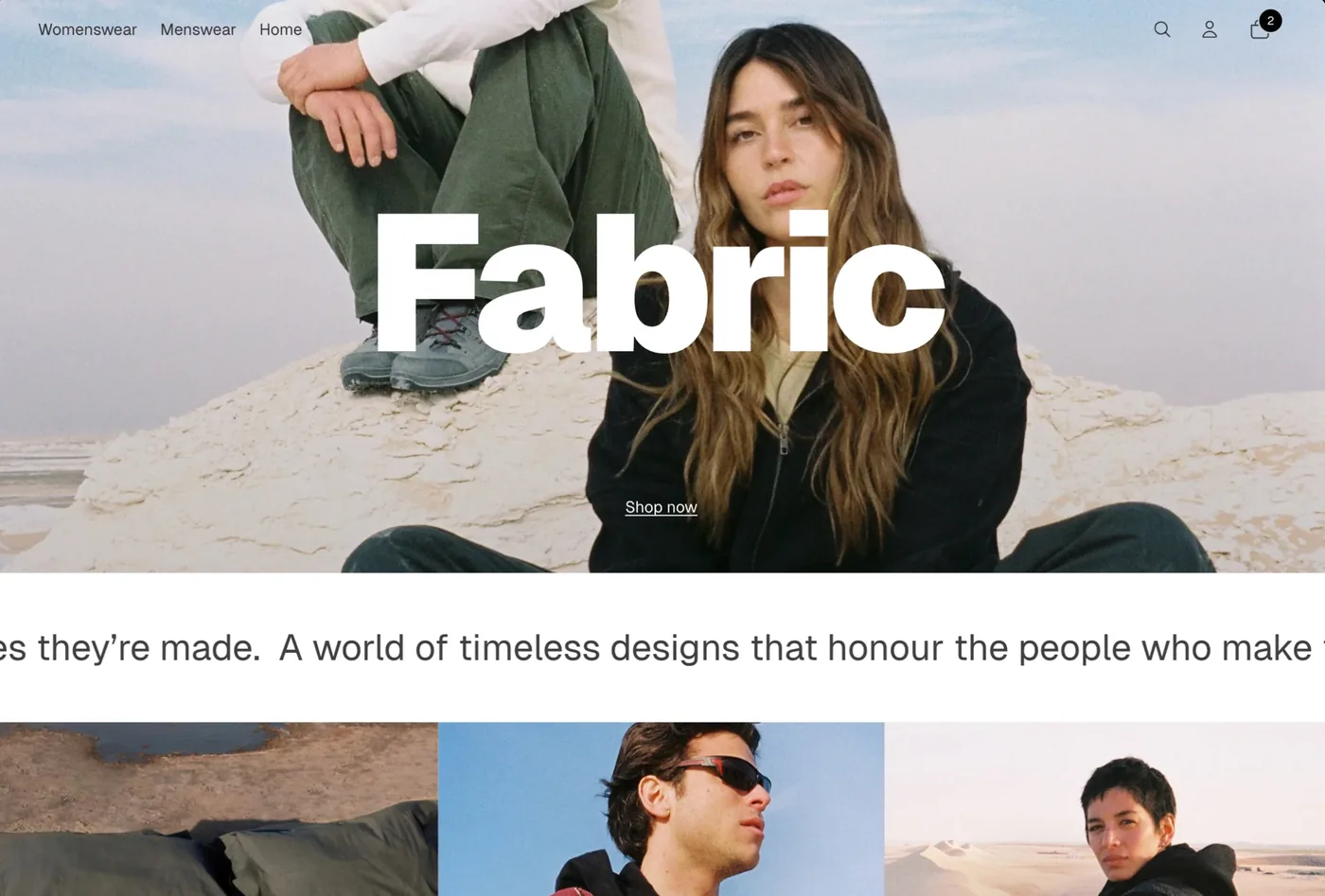
Fabric is a free Online Store 2.0 theme published by Shopify, so updates arrive through the theme library with no third-party dependency. It is aimed at brands that want energy over formality: fashion, jewelry, and food and drink stores that want to look lively and current. Edge-to-edge grids, oversized swatches, and lifestyle imagery give it a casual, contemporary character straight out of the box.
Because it is a first-party theme, Fabric edits through the drag-and-drop customizer with no code required, and it works with the wide library of Online Store 2.0 tutorials and sections. What it does differently from most free themes is lean hard into a grid-first layout, treating the collection page as the main event rather than an afterthought. Here is where Fabric sits across our dataset today.
How popular is Fabric, and is it growing?
Fabric is a smaller, newer theme, but its share of the stores we scan each month has been climbing rather than sitting still. That is the pattern of a theme steadily finding its audience: it appeals strongly to the casual fashion brands it is built for, and that niche keeps picking it up even though its overall share stays modest.
Fabric has climbed from 0.3% to 0.5% of Shopify stores in our dataset over recent months.
One number stands out about how Fabric stores operate: they run fewer apps than the average Shopify store. That is partly the theme, which builds filtering, dynamic cards, and quick buy in so owners need fewer add-ons, and partly the audience, since the fashion brands it attracts tend to keep their setups lean and let the products do the work.
Fabric design and layout
Fabric’s whole personality is bold and grid-first. The default layouts use edge-to-edge product grids and oversized swatches, so a collection page reads as a wall of product rather than a tidy list. For a brand with a broad, varied range, that energy works in its favor: the grid gives a busy catalog a rhythm, and lifestyle imagery keeps it feeling current rather than clinical.
The dynamic product cards are the design highlight. They keep collection pages moving and make a mixed catalog look intentional, which is exactly the problem most grid themes struggle with. The trade-off is that Fabric is built for volume: it shines when several products sit together and looks a little empty on a store with only a handful of items. It rewards a full grid and a casual, confident brand voice, and strains if you try to force a formal or minimal identity onto it.
Fabric features
Fabric’s merchandising runs deeper than the casual styling first suggests, with tools aimed at moving shoppers through a large catalog quickly.
- Product detail: image zoom and video so shoppers can inspect a product before they buy.
- Dynamic product cards: the standout feature, keeping collection pages lively and varied catalogs coherent.
- Fast browsing: filtering to help customers narrow a large range quickly.
- Quick selling: quick buy and pre-order to shorten checkout and sell items before they land.
- Standard Online Store 2.0 sections and settings, so tutorials and help written for Shopify’s free themes apply directly.
What you do not get is set-and-forget reliability, which is the theme’s real weak point and the reason for the section below. The tools are capable, but they need a watchful eye around theme updates.
How fast is the Fabric theme?
For Fabric, the most reliable speed signal is real-world field data rather than a lab test, and the live card below shows it: Core Web Vitals measured across real Fabric stores using Chrome UX Report data.
| Theme | CWV pass rate | Few apps | Median LCP |
|---|---|---|---|
| Impulse | 78.4% | 85.4% | 1.6s |
| Dawn | 71.2% | 79.9% | 1.6s |
| Fabric | 58.9% | 66.7% | 1.7s |
Real Fabric stores post a strong field Core Web Vitals score, though the share that fully passes is solid rather than exceptional, which is what you would expect from an image-and-grid-heavy theme. Field numbers reflect the kind of stores running Fabric as much as the code itself, so your own result depends on how you use it. The practical takeaway: grids and lifestyle imagery are heavy, so compress your images, keep the number of large media blocks in check, and run a lean app stack to stay on the fast side.
What kinds of stores use Fabric?
Fabric skews harder toward fashion than almost any theme we track. Apparel and accessories dominates its store base, with T-shirts a large group in their own right, followed by clothing, food and drink, and health and beauty. That fits a theme built for casual, grid-led brands with a broad, photogenic range.
By business model, subscription stores are the largest identifiable group, ahead of print on demand, dropshipping, and wholesale, though Fabric leans less on any single model than most themes. It is a theme for brand-led fashion stores with real inventory rather than tiny or single-product catalogs. For the full store-type and category breakdown, including how the mix shifts over time, see the live Fabric usage statistics.
Which apps do Fabric stores use?
The app stack on Fabric stores is fairly lean, and it leans toward tools that suit a browse-heavy fashion store. Reviews apps sit at the top, as they do for most young brands, with email marketing and urgency tools close behind and a notable showing from wishlist and Instagram-feed apps. Here is what we detect most often on live Fabric stores.
| Rank | App | % of stores | Category |
|---|---|---|---|
| 1 | Judge.me Product Reviews App | 30.0% | Product reviews |
| 2 | Klaviyo | 22.1% | Email Marketing |
| 3 | Loox ‑ Product Reviews App | 11.1% | Product reviews |
| 4 | Instafeed ‑ Instagram Feed | 7.3% | Marketing - Other |
| 5 | Recharge | 6.3% | Subscriptions |
| 6 | Shopify Inbox | 5.5% | Support - Other |
| 7 | PageFly ✦ AI Page Builder | 5.2% | Page builder |
| 8 | Swym Wishlist | 4.8% | Wishlists |
| 9 | Yotpo | 4.8% | Product reviews |
| 10 | Kiwi Size Chart & Recommender | 4.4% | Upsell and cross-sell |
The pattern fits a casual fashion brand: product reviews for credibility, email and countdown timers to drive action, and browse-and-save tools like wishlists and Instagram feeds that match how people shop a broad range. Because Fabric builds filtering, dynamic cards, and quick buy into the theme, owners reach for fewer add-ons than they would on a barer free theme, which helps keep the average app count down.
How much does Fabric cost?
Fabric is free. It is made by Shopify and installed straight from the Shopify Theme Store, with no license fee and no separate cost for updates. There is no paid tier for the theme itself. Your real costs are the apps you add and the Shopify plan you run your store on, not the theme.
Why is the Fabric rating low, and what should you watch for?
Fabric holds roughly a 1.55 out of 5 rating on the Shopify Theme Store, low even for a free theme, and its reviews are genuinely mixed rather than uniformly bad. The people who like it really like the grid-first design, while the sharpest criticism follows one clear pattern that is worth understanding before you commit.
The recurring complaint is stability across updates. Some owners report that features which worked stopped working, or that settings and layouts shifted, after a theme update. It is rarely a full dealbreaker, and many stores run Fabric happily, but it means the theme needs more hands-on care than a set-and-forget option. The design is genuinely capable, so the question is whether you can manage the maintenance.
The practical response is a simple routine. Treat every theme update as a checkpoint rather than a background task. Back up your customizations before you update, then re-check your key pages right after, so a silent change never reaches a customer. Handle updates that way and Fabric’s quirks stay manageable; ignore them and they are what the one-star reviews are made of.
Who should use Fabric?
Fabric is a strong free choice for a particular kind of store. Reach for it if you sell fashion, jewelry, or food and drink, carry enough inventory to fill a grid, and want a casual, modern, product-heavy storefront without paying for a premium theme. Brands that lean into a busy, confident collection page are exactly who it suits.
Pass on Fabric if you run a very small or single-product catalog, want a formal or minimal look, or need a theme you can install and never touch again. In those cases a steadier or more curated theme will serve you better. If you do choose Fabric, lean into full grids and strong lifestyle imagery, and build the update-checkpoint habit above into your routine from day one.
-
Is the Fabric Shopify theme free?
Yes. Fabric is a free Online Store 2.0 theme made by Shopify and installed from the Shopify Theme Store. There is no license fee and no charge for updates. Your only real costs are the apps you add and your Shopify plan, not the theme itself.
-
What is the Fabric Shopify theme best for?
Fabric is built for casual, grid-led brands with a broad catalog. It fits fashion, jewelry, and food and drink stores that carry enough inventory to fill its edge-to-edge product grids. It is a weaker fit for very small or single-product stores, where the grids look empty, and for anyone who wants a formal or minimal look.
-
Why does Fabric have such a low Theme Store rating?
Fabric sits near 1.55 out of 5, low even for a free theme, though its reviews are mixed rather than all negative. The recurring complaint is stability: some features can break or shift after a theme update. The design is genuinely capable, so the rating mostly reflects maintenance friction rather than a bad theme.
-
Does Fabric break after theme updates?
Some owners report that features which worked stopped working, or that settings shifted, after a Fabric theme update. It does not happen to every store, but it is common enough to plan for. Back up your customizations before updating, then re-check your key pages right after, so any silent change is caught before a customer sees it.
-
Is Fabric a fast Shopify theme?
Real Fabric stores post a strong field Core Web Vitals score, though the share that fully passes is solid rather than exceptional, which suits an image-and-grid-heavy theme. The code is not usually the bottleneck. Compress your images, limit large media blocks, and keep the app stack lean to keep a Fabric store quick.
-
What types of stores use the Fabric theme?
Fabric skews very heavily to apparel and accessories, with T-shirts a large group of their own, followed by clothing, food and drink, and health and beauty. By business model, subscription brands are the largest identifiable group. It suits broad, brand-led fashion catalogs more than tiny stores. You can see the full breakdown on the live Fabric statistics page.
Is Fabric worth installing?
For the right store, and with a maintenance habit, yes. Fabric gives a casual fashion brand a bold, grid-first storefront for nothing, and its dynamic product cards genuinely make a large catalog look deliberate. The low rating is a real caution, but it points at update stability rather than bad design, so the deciding factor is whether you will keep an eye on the theme after each update. Build that habit and the grid-first look is a strong free bargain. For the wider picture across Shopify’s free and paid themes, see our guide to Shopify theme reviews. And any time you spot a fashion store you admire, you can scan it to see whether it runs Fabric and which apps it pairs with.