Aurora Shopify Theme Review 2026
Last modified: October 1, 2026
The Aurora Shopify theme is a premium, fashion-focused theme from Getsitecontrol, sold on the Shopify Theme Store at one of the higher one-time prices in the catalog. It is built for clothing and lifestyle brands with medium to large inventories that need a polished, editorial look plus serious product discovery: mega-menus, advanced filtering, swatches, and lookbooks. This review looks past the theme’s own preview at what Aurora actually is, how the stores running it behave in our detection data, how fast it loads for real shoppers, and whether it earns its price.
Our angle is the data. We detect the themes and apps running on millions of live Shopify stores, so instead of repeating a feature list we can show what Aurora merchants really install, how their sites score on Google’s Core Web Vitals, and what kind of brand Aurora attracts. The short version: Aurora is a genuinely capable, design-led theme for fashion, but it is expensive, it draws an app-heavy crowd that pushes real-world speed down, and you should plan to test it before you commit.
View the Aurora theme on the Shopify Theme Store
What Is the Aurora Shopify Theme?
Aurora is a premium theme built by Getsitecontrol and listed on the Shopify Theme Store, which means it runs on Online Store 2.0 with drag-and-drop sections, JSON templates, and app blocks. It ships with 5 styles (Aurora, Auriga, Vega, Stella, and Astra) and more than 35 sections, so you can shape different looks without touching code. It holds a 97% positive score across 59 reviews on the Theme Store, which is strong, though the review count is smaller than the most established themes.
What you are paying for is a polished, editorial design plus deep product discovery. Aurora bundles a mega-menu, advanced and swatch filtering, enhanced search, infinite scroll, image hotspots, before-and-after sliders, lookbooks, product videos, and conversion touches like a stock counter, countdown timer, and recently viewed products. It is squarely aimed at fashion and lifestyle stores that want a designed storefront and the navigation to handle a large catalog.
What Apps Do Aurora Merchants Run?
Because we detect the apps on live stores, we can show the tools that most often sit alongside Aurora rather than guess at them.
| Rank | App | % of stores | Category |
|---|---|---|---|
| 1 | Klaviyo | 49.8% | Email Marketing |
| 2 | Judge.me Product Reviews App | 48.5% | Product reviews |
| 3 | Loox ‑ Product Reviews App | 17.9% | Product reviews |
| 4 | Instafeed ‑ Instagram Feed | 13.2% | Marketing - Other |
| 5 | Trustpilot | 11.9% | Marketing - Other |
| 6 | Triplewhale | 11.9% | Analytics |
| 7 | Recharge | 11.1% | Subscriptions |
| 8 | Swym Wishlist | 10.6% | Wishlists |
| 9 | Eg Auto Add To Cart | 8.9% | Cart customization |
| 10 | Gorgias | 8.1% | Support - Other |
The mix tells you who runs Aurora. Email marketing and product reviews lead by a wide margin, followed by Instagram feeds, analytics, subscriptions, and even affiliate software. This is a marketing-savvy, brand-building fashion crowd that invests in retention and social proof, not a set-and-forget starter store. It also signals that Aurora buyers are comfortable spending on their stack, which fits a premium theme.
Aurora by the Numbers
Here is Aurora’s footprint across the Shopify stores in our dataset, and how it compares with the typical store.
This is where the data challenges the “all-in-one” idea. Aurora carries a long feature list, yet its stores run more apps than the average Shopify store, not fewer. The built-in tools are real and useful, but Aurora attracts brands that still reach for dedicated email, reviews, analytics, and affiliate apps, so budget for apps on top of the theme. For the full breakdown, our Aurora statistics page tracks its adoption and app usage across the dataset.
How Fast Is the Aurora Theme?
Speed here is real-world Core Web Vitals from Google’s Chrome UX Report, measured across actual Aurora stores rather than a clean preview.
| Theme | CWV pass rate | Few apps | Median LCP |
|---|---|---|---|
| Impulse | 78.5% | 84.9% | 1.6s |
| Dawn | 70.8% | 79.1% | 1.6s |
| Aurora | 60.3% | 71.4% | 1.8s |
Aurora’s real-world speed is moderate rather than a standout. Filtering to stores running only a few apps barely moves the pass rate, though it does improve load time, which points to two things: the app-heavy crowd Aurora attracts weighs on Core Web Vitals, and large fashion catalogs with big hero imagery add their own load. Aurora can be quick, but it takes discipline: compress images, keep the app list lean, and lean on the theme’s own features before adding another app.
Aurora Design and Layout
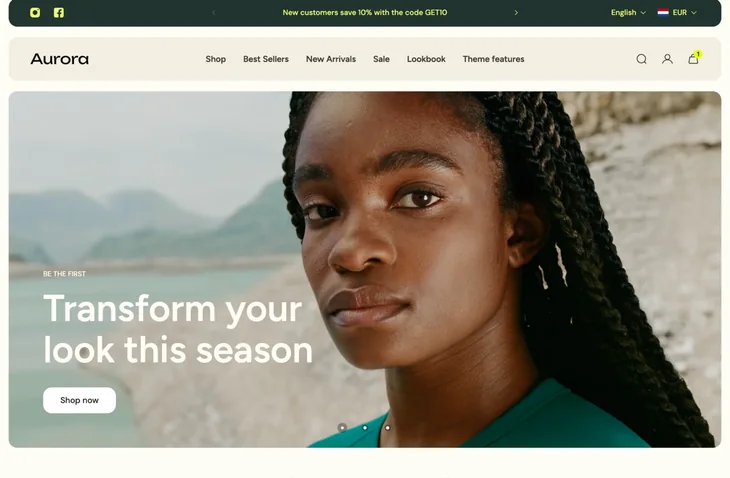
Aurora’s design is clean and editorial, the kind of look fashion brands pay a designer for. The default style opens with a full-width hero, an uncluttered header with a mega-menu, and generous whitespace that flatters lifestyle photography. Type is modern and restrained, and the layout keeps product imagery front and centre rather than crowding it with widgets.
The strength is range with polish. 5 styles and more than 35 sections mean you can move between a minimal boutique and a busier catalog store while keeping a designed feel. The trade-off is the usual one for feature-rich themes: the number of options takes time to learn, and it is easy to over-build a homepage if you do not plan the layout first.
Aurora Features Worth Knowing
Product discovery for large catalogs
Aurora’s filtering is its clearest advantage for bigger stores. Advanced and swatch filters, enhanced search, infinite scroll, and a mega-menu help shoppers move through a deep catalog without extra apps, which is where many fashion stores struggle.
Merchandising and storytelling
Image hotspots, before-and-after sliders, lookbooks, and product videos give fashion brands ways to show fit and styling, not just list products. These are the features that justify a premium theme for a visual, brand-led store.
Built-in conversion touches
Aurora folds in a stock counter, countdown timer, recently viewed products, quick buy, and a slide-out cart. They will not replace every specialist app, but they cover the basics so a new store can launch without a long starter app list.
Aurora Pricing
Aurora is a one-time purchase on the Shopify Theme Store rather than a subscription, and the price sits at the higher end of the catalog.
$390Because it is a Theme Store theme, you can add Aurora to an unpublished store and build with it free, then pay the one-time fee only when you publish. That try-before-you-buy path is a real advantage over off-marketplace themes, and it is the surest way to judge whether Aurora’s design and features are worth the premium for your catalog. Shopify’s free themes still cover plenty of stores at no cost, so the fee makes sense mainly when you need Aurora’s editorial look and large-catalog navigation.
Aurora Pros and Cons
Pros
- Clean, editorial design built for fashion and lifestyle brands
- Strong product discovery: advanced and swatch filtering, enhanced search, mega-menu, infinite scroll
- Merchandising tools for visual selling: image hotspots, before-and-after sliders, lookbooks, product videos
- 5 styles and 35+ Online Store 2.0 sections for flexible, code-free layouts
- Built-in conversion touches (stock counter, countdown, quick buy, slide-out cart) shorten the starter app list
- Theme Store theme, so you can try it free before paying and it meets Shopify’s theme standards
- High positive rating on the Theme Store
Cons
- One of the more expensive Theme Store themes, a real commitment for a new store
- Smaller review count than the most established themes
- Real-world Core Web Vitals are only moderate, not a speed leader
- Its own app-heavy audience drags live speed, so results depend on your stack
- The built-in feature set does not remove app costs; Aurora stores still run more apps than average
- The many styles and sections take time to learn and are easy to over-build
Who Should Use Aurora?
Aurora fits a specific kind of store better than others:
- Fashion, apparel, and lifestyle brands that want a designed, editorial storefront
- Medium and large catalogs that need strong filtering, search, and a mega-menu out of the box
- Brand-led merchants who invest in email, reviews, and content and want merchandising tools built in
- Store owners who value trying a paid theme free before committing to a premium price
New stores testing an idea, tight budgets, or small catalogs are usually better served by one of Shopify’s free themes until Aurora’s design and features clearly earn the premium.
Our Verdict on Aurora
Aurora is a strong, design-led theme for fashion brands that want an editorial look with real large-catalog navigation, and its high rating is deserved. Go in clear-eyed on two points: it is one of the pricier Theme Store themes, and our data shows its stores run more apps than average, so it will not cut your app bill. Use the Theme Store’s free trial to build a real page before you pay, and judge the speed on your own catalog. If the design and filtering fit your brand, Aurora is worth testing. For premium alternatives, our Impulse review covers another fashion favourite, our Warehouse review looks at a large-catalog option, our Boost review covers a faster premium option, and you can browse the rest of our Shopify theme reviews for free and paid picks.
-
Is the Aurora Shopify theme worth the price?
Aurora is one of the pricier Theme Store themes, so it is worth it mainly for fashion and lifestyle brands that need its editorial design and large-catalog filtering. It holds a high positive rating, and you can try it free before paying. If a free theme already handles your catalog and look, the premium is harder to justify. Use the free trial to decide on your own store.
-
Who makes the Aurora Shopify theme?
Aurora is built by Getsitecontrol and sold on the official Shopify Theme Store, so it runs on Online Store 2.0 and meets Shopify’s theme standards. Support and updates come through the Theme Store. It ships with 5 styles and more than 35 sections aimed at fashion and lifestyle stores.
-
Can I try Aurora before buying it?
Yes. Because Aurora is a Shopify Theme Store theme, you can add it to your store and build with it free on an unpublished basis, then pay the one-time fee only when you publish it live. That try-before-you-buy path is a real advantage over themes sold outside the Theme Store. It is the surest way to test Aurora’s speed and features on your own catalog.
-
Is Aurora a fast Shopify theme?
Aurora’s real-world Core Web Vitals are moderate rather than a standout, with a pass rate that trails the fastest themes across live stores. Part of that comes from the app-heavy, catalog-heavy fashion stores Aurora attracts, not the theme’s code alone. Filtering to stores with fewer apps improves load time. Compress images and keep your app list lean for the fastest load.
-
What kind of stores use Aurora?
Aurora skews heavily toward fashion and apparel, with health, beauty, and food brands next. Our detection data shows its merchants lean on email marketing, product reviews, Instagram feeds, and analytics, so it draws marketing-driven, brand-building stores. It suits medium and large catalogs more than tiny ones.
-
Does Aurora work with Shopify Online Store 2.0?
Yes. Aurora is an Online Store 2.0 theme, so every page uses drag-and-drop sections, JSON templates, and app blocks. You can rearrange sections and build layouts in the theme editor without editing code. It ships with more than 35 sections and 5 styles to start from.