Taiga Shopify Theme Review 2026
Last modified: September 27, 2026

Taiga is a paid Shopify theme from Woolman, a Finnish agency that builds enterprise Shopify storefronts and integrations more than it chases the Theme Store charts. It is aimed at a specific kind of merchant: brands that sell on subscription, wholesale, or several channels at once, and that run most of their logic through apps rather than the storefront. On the Shopify Theme Store it holds a 100% positive rating from 54 reviews, and it ships in four preset styles so one theme can dress a food brand, a fashion label, or a gear shop without a rebuild.
The verdict upfront: Taiga fits a store with a curated catalog and a heavier back office, recurring orders, B2B accounts, or marketplace feeds, and it is a poor fit for a general shop that just needs products online cheaply. It is fast where image-heavy themes usually are not, and its reviews are unusually strong for a paid theme. The catch is the price and the small install base, so you are buying a specialist tool and a smaller community along with it.
What Is the Taiga Shopify Theme?
Taiga is a premium theme sold on the Shopify Theme Store by Woolman, a Nordic agency that also builds custom Shopify Plus stores and B2B integrations. That background shows in the theme. Where most Theme Store themes are built for a shopper buying one item, Taiga is built for the store behind the storefront: recurring orders, wholesale logins, customer-specific pricing, and feeds out to other channels. Woolman’s own client work, merging direct-to-consumer and B2B on a single Shopify store, is the same problem Taiga is shaped around.
You buy Taiga once and own it, with no monthly fee, and every preset style is included in that price. Woolman ships updates and answers theme-setting and bug questions by email for paying customers. That support does not cover installing updates for you or wiring up third-party apps, which matters here because Taiga stores tend to run heavier app stacks than average, so plan for that integration work yourself or with a developer.
View Taiga on the Shopify Theme Store
What Apps Do Taiga Merchants Run?
Because ShopThemeDetector scans live stores, we can see the apps Taiga merchants actually install, not the ones a feature list implies. On Taiga the pattern is telling.
| Rank | App | % of stores | Category |
|---|---|---|---|
| 1 | Klaviyo | 57.0% | Email Marketing |
| 2 | Judge.me Product Reviews App | 39.8% | Product reviews |
| 3 | Loox ‑ Product Reviews App | 28.1% | Product reviews |
| 4 | Yotpo | 17.2% | Product reviews |
| 5 | Gorgias | 14.8% | Support - Other |
| 6 | Recharge | 12.5% | Subscriptions |
| 7 | Trustpilot | 12.5% | Marketing - Other |
| 8 | Paypal | 12.5% | Checkout - Other |
| 9 | Cookiebot | 10.2% | Cookie Consent |
| 10 | Swym Wishlist | 9.4% | Wishlists |
Email leads by a wide margin, with product reviews close behind, and subscription and support tools appear more often than they do under a mass-market theme. That mix fits the audience: stores built to keep customers coming back rather than chasing one-off sales, leaning on email and back-office apps to do it. Taiga stores also carry more apps on average than a typical store, so the theme is chosen by merchants already running a real operation, not a first-week shop.
Taiga by the Numbers
Adoption is the honest part of any theme review, and Taiga is not a mass-market default. Our live detection data shows where it actually sits.
A small share of the 3.5M+ Shopify stores we track run Taiga, and the ones that do carry noticeably more apps than average on smaller catalogs. That is the signature of a considered store, fewer products but more logic around each order, rather than a large or first-time shop. Low adoption is not a knock on the theme, it means Taiga is a deliberate choice picked for a job, not the option a store lands on by default.
How Fast Is the Taiga Theme?
Speed here is real-world Core Web Vitals from Chrome’s field data across live Taiga stores, not a lab score from one test page. It reflects both the theme and the kind of stores running it.
| Theme | CWV pass rate | Few apps | Median LCP |
|---|---|---|---|
| Taiga | 88.5% | 87% | 1.4s |
| Impulse | 78.2% | 85.5% | 1.6s |
| Dawn | 71% | 79.8% | 1.6s |
Taiga’s field results are strong, and they stand out next to a free default like Dawn and a popular premium theme like Impulse. Most live Taiga stores clear Google’s thresholds, and the median largest-contentful-paint sits well inside the good range, which is not a given on a theme this feature-rich. Your own numbers will still depend on image sizes and how many apps you add, but the theme itself is not the thing slowing you down.
Taiga Design and Layout
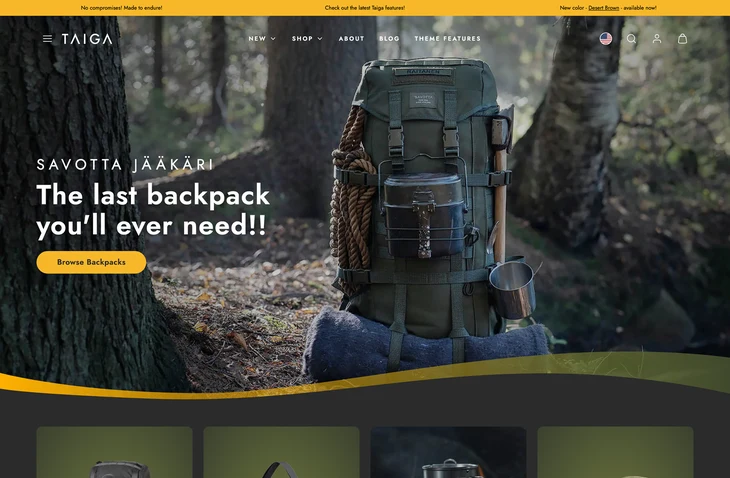
Taiga’s default homepage leads with a full-width hero, a clear headline and call to action, then a product grid directly below, so a visitor sees what the store sells within the first screen. The look is clean and modern rather than decorative, which suits a catalog built to convert rather than browse. It reads as a working storefront, not a lookbook.
The four preset styles, Taiga, Bubbly, Meadow, and Hehku, are more than color swaps. Each ships a different homepage rhythm and type treatment, from a bold, high-energy look to a quiet apparel layout, so very different brands can start from one theme. Every section is drag-and-drop, and the starter templates give you full pages to edit instead of a blank grid, which shortens setup for a team without a designer.
Taiga Features Worth Knowing
Subscription, wholesale, and multichannel support
This is where Taiga separates itself. It is built to sit on top of recurring-order, B2B, and marketplace setups, the kind of store where customer-specific pricing, wholesale logins, and feeds to other sales channels matter as much as the product page. If your store runs that way, the theme works with you instead of against you.
Merchandising and product discovery
Taiga includes a mega menu, enhanced search, swatch filters, and infinite scroll for larger or filtered catalogs, plus product videos, image zoom, color swatches, lookbooks, and size charts on the product page. These are the tools that keep a curated range easy to browse and easy to trust.
Conversion and marketing tools
Under the surface Taiga carries the conversion basics: a slide-out cart, quick buy, pre-orders, in-store pickup, countdown timers, promo banners and popups, and product and trust badges. Cross-sell and recommended products help lift average order value without a separate app.
Speed and support
Taiga is engineered for performance, which shows in its real-world Core Web Vitals, and Woolman ships regular updates with email support for settings and bug fixes. It does not install updates or set up apps for you, so keep a developer on hand if your stack is complex.
Taiga Pricing
Taiga is a one-time purchase at $500, with no recurring fee and every preset style included. That is a premium price, higher than most Theme Store themes, and it is the first thing to weigh.
Set that against a free official theme like Dawn, or a cheaper premium option like the Impulse theme. For a general catalog, a free theme does the job for nothing. Taiga earns its price only when you actually use what you are paying for: the subscription, wholesale, and multichannel logic built into it. If those features map to how your store runs, the cost is defensible. If they do not, you are paying for a specialist toolset you will not touch.
Taiga Pros and Cons
Pros
- Purpose-built for subscription, wholesale, and multichannel stores, not a general starter
- Strong real-world Core Web Vitals for a feature-rich theme
- Unusually high reviewer sentiment for a paid theme
- Four distinct presets plus starter templates, so setup does not begin from a blank page
- One-time price with no monthly fee and every style included
Cons
- Premium price, higher than most Theme Store themes
- Small install base, so a thin community and few third-party tutorials
- Support excludes app setup and installing updates for you
- More theme than a simple, general-catalog store needs
Who Should Use Taiga?
Taiga suits a store with a curated catalog and a real back office: subscription brands, wholesale and B2B sellers, and multichannel merchants who run recurring orders, tiered pricing, or marketplace feeds alongside direct sales. If most of your work happens in apps and integrations and you need the storefront to hold up around them, Taiga is built for exactly that.
If your main need is B2B or wholesale, compare Taiga with the Trade theme, built around wholesale ordering. Stores with large or complex operations should also look at the Enterprise theme and the Warehouse theme, two options aimed at high-volume, multi-catalog stores.
Taiga is the wrong tool for a simple store that just needs products online quickly, is testing an unproven idea, or has no use for subscription and B2B features. In those cases a free theme gets you selling without the up-front spend, and you can move to a specialist theme later if your model grows into one.
Our Verdict on Taiga
Taiga is a well-built specialist theme that earns its price for the store it was made for. The feature set covers subscription, wholesale, and multichannel needs that mainstream themes leave to apps, the field-data speed holds up despite that depth, and its Theme Store rating backs up the quality. The honest caveats are the premium price and the small community around it.
For how Taiga sits next to other options, see our Shopify theme reviews guide, and for live adoption and speed trends check the Taiga theme stats page. If your store runs on recurring revenue, wholesale, or several channels at once, Taiga is a confident pick. If it does not, a free theme will serve you just as well for less.
-
Who makes the Taiga Shopify theme?
Taiga is made by Woolman, a Nordic Shopify agency based in Finland that builds custom Shopify Plus stores and B2B integrations. It is Woolman’s own Theme Store product, so the theme reflects the kind of subscription, wholesale, and multichannel work the agency does for clients.
-
How much does the Taiga theme cost?
Taiga is a paid theme sold on the Shopify Theme Store as a one-time purchase, with no monthly fee. It sits at the premium end of Theme Store pricing, and every preset style is included in that single price, so you are not charged extra to switch looks later.
-
Is the Taiga theme good for B2B and wholesale stores?
Yes. Taiga is one of the few Theme Store themes built with B2B and wholesale in mind, from a developer whose client work merges direct-to-consumer and wholesale on the same store. It is designed to sit on top of customer-specific pricing, wholesale logins, and bulk ordering, though the underlying B2B features also depend on your Shopify plan and apps.
-
Does the Taiga theme work with subscription apps?
It does, and the stores running Taiga skew that way in our detection data. Subscription tools like Recharge show up more often on Taiga stores than on a typical theme, alongside email and reviews apps, which points to merchants selling recurring orders rather than one-off purchases.
-
How many preset styles does Taiga include?
Taiga ships in four preset styles: Taiga, Bubbly, Meadow, and Hehku. Each one is more than a color change, offering a different homepage layout and type treatment, so a food brand, an apparel label, and a gear shop can all start from the same theme without a rebuild.
-
Is Taiga worth it compared with a free Shopify theme?
It depends on your store. For a general catalog that just needs products online, a free theme like Dawn does the job for nothing. Taiga earns its premium price only when you use the subscription, wholesale, and multichannel features built into it, so it is worth it for a recurring-revenue or B2B store and overkill for a simple one.