Crisp Review: An Affordable Shopify Helpdesk, Tested 2026
Last modified: September 16, 2026
Crisp is a customer messaging platform built around a shared inbox and an AI chatbot, and its Shopify app connects that platform to your store. It pulls the channels a growing store usually juggles, email, live chat, WhatsApp, Instagram and Messenger, into one place, then layers an AI agent and a FAQ-trained chatbot on top to handle the repetitive questions for you. The verdict upfront: Crisp is the value option in the helpdesk category, because it is one of the only tools here with a real free plan and its paid tiers stay affordable as you grow. The honest catch is that it is a third-party platform rather than a Shopify-native one, so it syncs your store data and shows it beside each conversation, but it does not run refunds and order edits inside the ticket the way a deeply integrated helpdesk does.
If you run a small or mid-size store and want proper multichannel support without paying enterprise money, Crisp fits, and the free plan lets you start at no cost. If you are a high-volume brand that needs order actions handled inside every ticket, a Shopify-native helpdesk like Gorgias will suit you better, and if you only field a handful of messages a day, Shopify Inbox covers you for free. The sections below use live detection data to show how widely Crisp is used, what it does, what it costs, and the kind of store it actually suits.
What is Crisp?
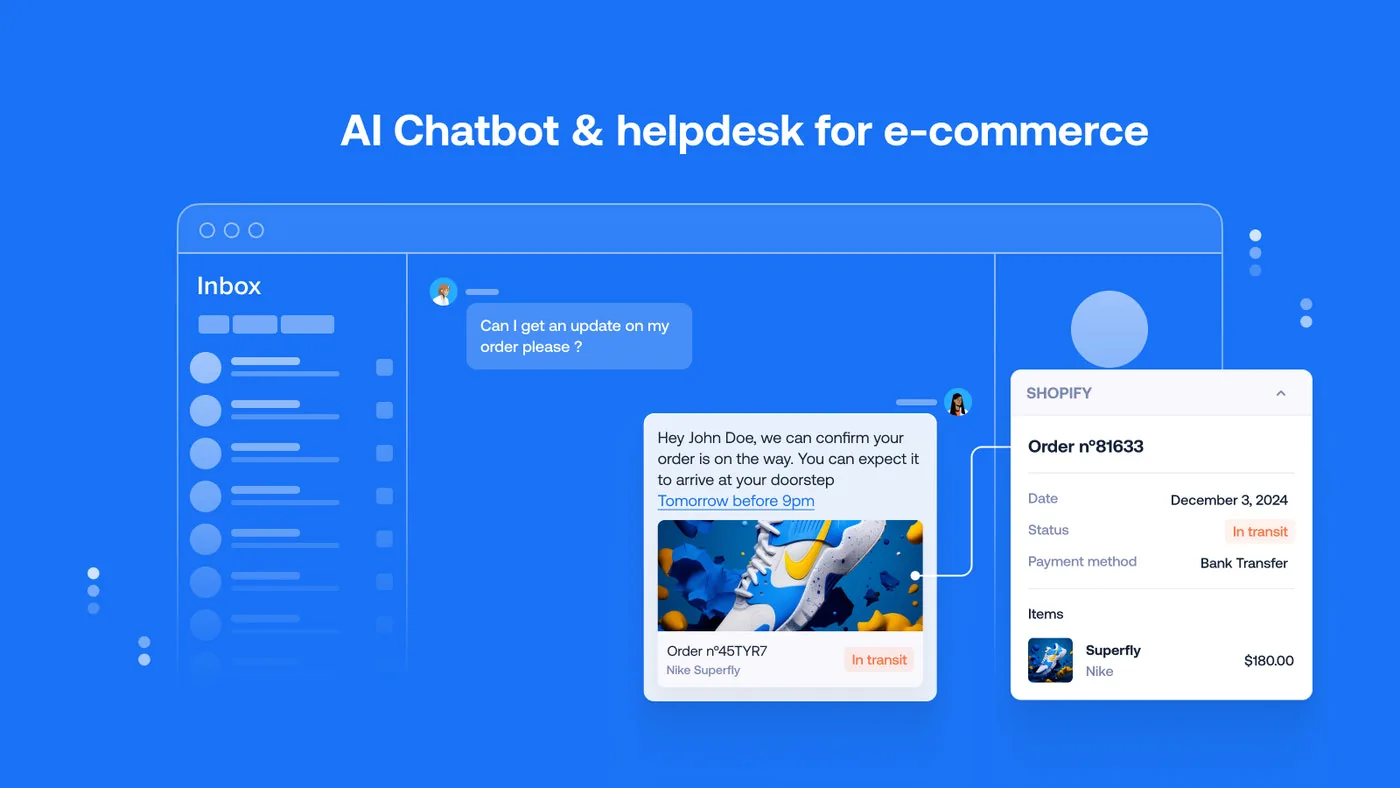
Crisp is a helpdesk and live chat platform that gives a Shopify store one shared inbox for customer messages. Instead of switching between email, Instagram DMs, WhatsApp, Messenger and website chat, agents work every conversation in one queue, with the shopper’s synced Shopify details shown beside the message. On top of the inbox sits an AI layer: a chatbot you train from a FAQ builder, an AI agent that answers common questions on its own, and a clean handover to a human when the bot reaches its limit. Because Crisp is a general messaging platform rather than a Shopify-only tool, it also carries features many rivals lack, such as real-time translation across more than a dozen languages, phone and video support, and a customer portal on the top plan. It holds a 4.0 out of 5 rating on the Shopify App Store. Here is how widely it is installed across our dataset.
How popular is Crisp?
Crisp sits mid-pack but comfortably inside the top tier of the helpdesk category. Live detection makes it the fourth most-used helpdesk app on Shopify, installed about 1.6 times as often as Re:amaze, the next tool in the ranking, though well behind category leaders like Gorgias and Tidio. It also tells you something about the stores that run it: they carry far heavier app stacks than the typical store, a sign of established, marketing-minded brands rather than brand-new shops.
One trend is worth flagging. Crisp’s share of stores has held roughly steady over the past several months, easing slightly from where it sat at the start of the year rather than climbing. That fits a crowded category where Shopify’s free Inbox and a wave of cheap AI chat tools keep pulling at the entry level, and where staying flat is itself a decent result.
Crisp has slipped from 1.1% to 1.0% of Shopify stores in our dataset over recent months.
What does Crisp do?
Four things sit at the core. First, a unified inbox: email, website live chat, WhatsApp, Instagram, Messenger, SMS and phone all land in one queue. Second, an AI chatbot and FAQ builder: you feed it your help content and it answers the common questions on its own, then hands off to an agent for the rest. Third, Shopify data sync: each shopper’s order history and details show next to the conversation, so an agent has context without leaving the inbox. Fourth, the extras that come from Crisp being a full messaging platform, real-time translation, a shared help center, a CRM view of contacts, and co-browsing or video on the higher plans.
The point of all of it is deflection and speed, the same as any helpdesk: the more of your routine questions the bot resolves, the fewer reach a person. Where Crisp differs from a Shopify-native rival is depth of integration. It reads your store data, but the heavier order actions, refunds, cancellations and edits, still happen in Shopify admin rather than inside the ticket.
Is Crisp worth it?
For a small or mid-size store that wants real multichannel support on a budget, yes. The free plan covers a basic website chat and Shopify sync at no cost, and the first paid tier adds the channels and history most growing stores need without a heavy monthly bill. For that kind of store Crisp is one of the best-value tools in the category.
Where it makes less sense is at the top end. A high-volume brand that wants automation acting directly on orders, or that lives inside a single Shopify-native workflow, will find a purpose-built helpdesk a tighter fit even at a higher price. Crisp trades some Shopify depth for breadth of channels and a lower bill, and whether that is the right trade depends on how much of your support is order operations versus conversations.
What Crisp costs
Crisp is one of the few helpdesks with a genuinely free plan, which covers website chat, Shopify data sync and a couple of seats. Paid tiers start at a low monthly price and rise as you add seats, contact records, sub-inboxes and AI automation, with the top plan aimed at larger teams. Billing for the paid plans is handled by Crisp rather than through your Shopify invoice, so check the current tiers on their site before you commit. For most small and mid-size stores the entry paid plan is enough.
Which themes and apps run with Crisp?
Because we detect both themes and apps, we can see the company Crisp keeps. Its most common theme is Shopify’s free Dawn, followed by conversion-built premium themes like Prestige and Impact. Here are the themes most often running it.
| Rank | Theme | % of stores |
|---|---|---|
| 1 | Dawn | 13.3% |
| 2 | Prestige | 5.2% |
| 3 | Minimog OS 2.0 | 4.8% |
| 4 | Impact | 4.3% |
| 5 | Zalify | 4.0% |
| 6 | Impulse | 3.8% |
| 7 | Horizon | 3.7% |
| 8 | Concept | 2.8% |
| 9 | Broadcast | 2.7% |
| 10 | ella | 2.1% |
The app side is the real tell. Most Crisp stores also run Judge.me for reviews and Klaviyo for email, and many pair it with Loox, a subscription tool like Recharge, or even a second support tool like Intercom. These are full marketing stacks, which is why Crisp stores carry close to double the app count of an average store. For the full breakdown of themes, paired apps and store types, see the live Crisp usage statistics.
What kinds of stores use Crisp?
Crisp stores skew toward businesses with ongoing customer relationships and steady message volume. Subscription brands are well represented, along with multichannel and marketplace sellers and a share of wholesale and B2B stores, the kinds of operation that field questions across several channels and want them in one place. These are established stores rather than weekend shops, which matches the heavy app stacks and the mid-tier category position.
Mind the platform, not just the price
Crisp’s low price is real, but remember it is a third-party platform. It syncs your Shopify data rather than running order actions inside the ticket, its billing sits outside Shopify, and some merchants report that closing an account is fiddlier than opening one. None of that is a dealbreaker for a store that mainly wants multichannel conversations, but check the fit before you move your whole support operation onto it.
Crisp pros and cons
Pros
- One of the only helpdesks with a genuinely free plan
- Wide channel coverage: chat, email, WhatsApp, Instagram, Messenger, SMS and phone
- AI chatbot and FAQ builder included, with real-time translation
- Affordable paid tiers that suit small and mid-size stores
Cons
- A third-party platform, not a Shopify-native helpdesk
- Order actions still happen in Shopify admin, not inside the ticket
- Stronger AI automation is gated to the higher plans
- Lower App Store rating than the category leaders
A live-chat widget loads on every page, so it is fair to ask whether Crisp slows a store down. On plain averages, stores using Crisp look a little slower, but that is mostly because larger, busier stores are the ones that run a full helpdesk. Compared fairly against similar stores, the ones with Crisp actually pass Google’s speed test (Core Web Vitals) slightly more often, about 63% versus 60% for comparable stores without it, among stores with enough traffic to appear in Google’s Chrome UX Report.
Does Crisp slow a store down?
Compared only against stores on the same theme, running the same number of apps and carrying a similar catalogue, stores with Crisp installed pass Core Web Vitals 1.6 points higher of the time (589 comparable stores across 212 matched groups).
| Comparison | With Crisp | Without | Stores compared |
|---|---|---|---|
| Like-for-like stores | 60.6% | 59% | 595 with · 28,842 without |
| All stores, unmatched | 61.2% | 67.9% | 666 with · 59,102 without |
Who should use Crisp?
Reach for Crisp if you run a small or mid-size store, want support across several channels, and would rather not pay enterprise prices to get it. The free plan is a genuine starting point, the paid tiers stay affordable as you grow, and the AI chatbot can take the routine questions off your plate. It is an especially good fit for multichannel and subscription brands whose shoppers message on WhatsApp and Instagram as much as by email.
Look elsewhere if your support is mostly order operations, the refunds, cancellations and edits you want handled inside each ticket, or if you are committed to a single Shopify-native workflow. Crisp gives you breadth of channels and a low bill in exchange for less Shopify depth, and that trade suits conversation-led support more than operations-led support.
Our verdict
Crisp is our pick for small and mid-size stores that want real multichannel support without the enterprise price tag. Start on the free plan, move up when you need more seats and AI, and lean on the chatbot to deflect the repetitive questions. If your support is mostly order actions, a Shopify-native helpdesk will fit better.
-
What is Crisp used for?
Crisp is a helpdesk and live chat platform for Shopify. It brings email, website chat, WhatsApp, Instagram, Messenger and SMS into one shared inbox, syncs each shopper’s Shopify details beside the conversation, and uses an AI chatbot to answer common questions. It suits stores that want multichannel support handled in one place.
-
Is Crisp free?
Yes. Crisp has a genuine free plan, not just a trial. It covers website chat, Shopify data sync and a couple of seats, which is enough to get a small store started. Paid plans add more channels, seats, history and AI automation as you grow.
-
How much does Crisp cost?
Crisp starts free, then paid tiers begin at a low monthly price and rise as you add seats, contact records, sub-inboxes and AI automation. Billing for the paid plans is handled by Crisp rather than through your Shopify invoice, so check the current tiers on their site before you commit.
-
Is Crisp better than Gorgias?
They aim at different stores. Gorgias is a Shopify-native helpdesk that runs order actions inside the ticket and leads the category, but it has no free plan and costs more. Crisp is a cheaper, multichannel platform with a free plan that syncs Shopify data rather than acting on orders. Small and mid-size stores on a budget lean Crisp; high-volume, operations-heavy stores lean Gorgias.
-
Does Crisp have AI?
Yes. Crisp includes an AI chatbot you train from a FAQ builder, plus an AI agent that can answer common questions on its own and hand off to a human when it reaches its limit. The stronger automation sits on the higher-priced plans.
-
What channels does Crisp support?
Crisp brings email, website live chat, WhatsApp, Instagram, Messenger, SMS and phone into one shared inbox, with real-time translation across more than a dozen languages. That breadth of channels is one of its main advantages over Shopify-only tools.
Is Crisp worth it?
For a small or mid-size store that wants multichannel support without a heavy monthly bill, yes. The data shows why it holds a top-tier spot in the category: Crisp is the fourth most-used helpdesk in our dataset, it is one of the only tools here with a genuine free plan, and it is chosen by established, app-heavy brands that handle questions across several channels. The trade is depth. It syncs Shopify data rather than running order actions inside the ticket, so if your support is mostly refunds and edits, a Shopify-native helpdesk will fit better. To see how it sits alongside everything else, browse our guide to the best Shopify apps or the roundup of Shopify customer service and support apps. And any time you spot a store running a slick chat widget, you can scan it to see whether it is Crisp and what theme and apps it pairs with.