GemPages Review 2026: One of Shopify’s Most-Installed Page Builders
Last modified: September 29, 2026
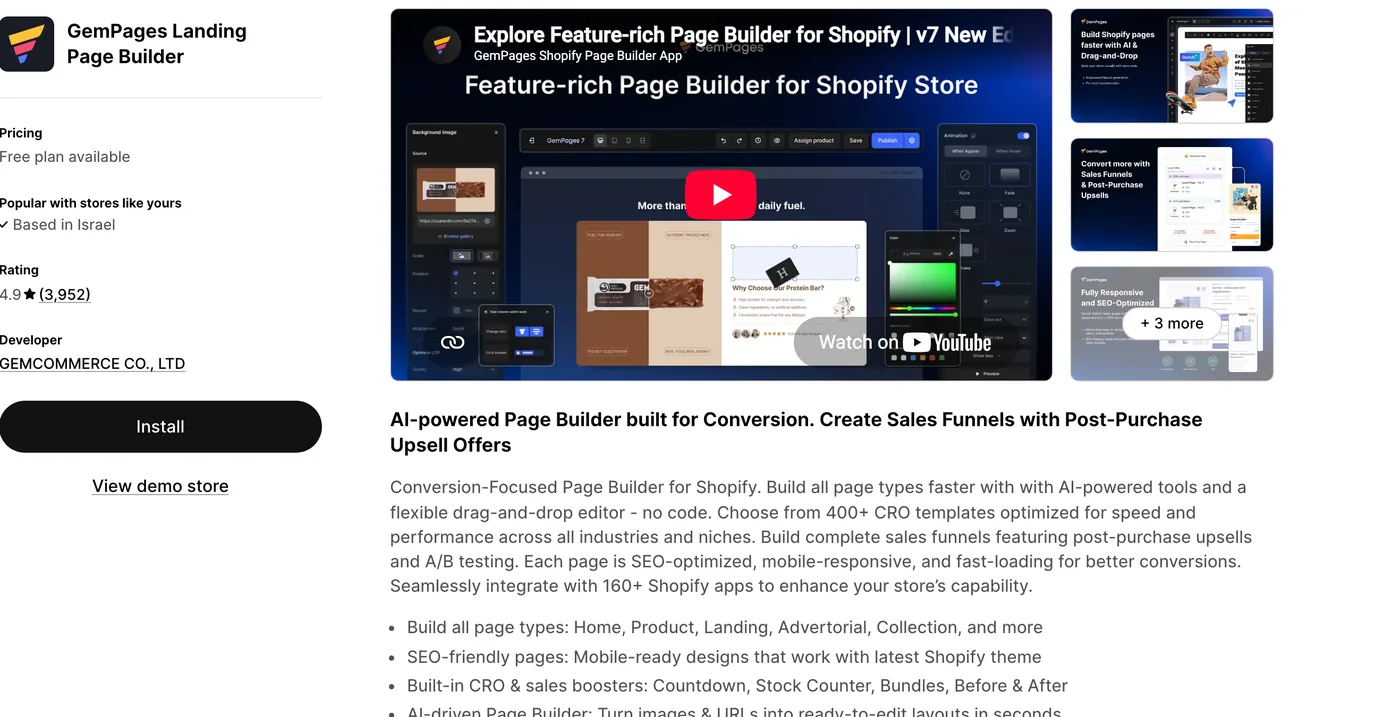
GemPages is a conversion-focused page builder for Shopify that lets you design landing pages, product pages, and full sales funnels with a drag-and-drop editor and no code. Built by GEMCOMMERCE, it leans hard into conversion, with 400-plus CRO templates, built-in sales boosters, post-purchase upsells, and an AI builder that turns an image or a URL into an editable layout. It carries a 4.9-star rating from nearly four thousand merchants, and in our detection data it is the second most-used landing page app on Shopify. The verdict upfront: for a store that wants custom, conversion-tuned pages beyond what the theme editor allows, GemPages is a strong, well-rated choice, and its funnel and upsell tools go a step further than a plain page builder. The honest catch is that it is another layer on your store. Pages built in it live inside the app, it adds a monthly cost once you pass one page, and, like any page builder, it can slow a page down if you overload it, so the gains come from using it with restraint.
If you are running campaigns, product launches, or funnels that need pages the theme cannot produce, GemPages earns its place. If you only need to tweak an existing template now and then, your theme’s own sections will do the job without another subscription. The sections below use live detection data to show how widely GemPages is used, what it does, what it costs, and the kind of store it actually fits.
What is GemPages?
GemPages is a visual page builder that sits on top of Shopify and lets you design pages the native theme editor cannot. You drag sections and elements onto a canvas, style them, and publish, with no code involved, and it covers every page type: home, product, landing, collection, blog, FAQ, and popups. What sets its pitch apart is the conversion angle. It ships with hundreds of templates built around CRO, sales boosters like countdown timers and stock counters, and an AI builder that can turn an image or a reference URL into a ready-to-edit layout, which shortens the blank-canvas problem. Here is how widely GemPages is detected across Shopify stores.
How popular is GemPages on Shopify?
GemPages is one of the two page builders that dominate this category on Shopify, sitting second behind PageFly by store count in our data and comfortably ahead of the rest of the field. The stores running it carry heavier app stacks than the typical store, the profile of conversion-minded brands that invest in tools to lift their numbers rather than run a stock theme. That places GemPages among the apps serious stores reach for when the built-in editor stops being enough.
What does GemPages do?
GemPages is built to design pages that convert, then wire them into a selling flow. Its core:
- Drag-and-drop page building. Design landing, product, home, collection, blog, and FAQ pages on a visual canvas, with 400-plus CRO-focused templates to start from.
- AI page builder. Turn an image or a reference URL into an editable layout in seconds, which cuts the time from idea to draft.
- Sales funnels and upsells. Build complete funnels with post-purchase upsell and downsell offers, so a page becomes part of a flow rather than a dead end.
- Built-in conversion tools. Countdown timers, stock counters, bundles, and before-and-after elements are included, plus A/B testing to see what actually lifts sales.
- SEO, speed, and integrations. Pages are mobile-responsive and SEO-minded, and it connects to 160-plus Shopify apps so your marketing and review tools show up on the page.
The common thread is conversion with control. GemPages is less about pretty pages for their own sake and more about pages engineered to sell, which is why it appeals to stores that treat their landing pages as a testable part of the funnel.
What GemPages costs on Shopify
GemPages has a free plan that covers a single published page, which is enough to try it on one campaign. Its full pricing is Free, or from $29/mo. Paid plans scale from a Build tier for unlimited pages, CRO templates, and AI tools, to an Optimize tier that adds sales funnels and post-purchase upsells, up to an Enterprise tier for the full feature set and priority support. Most stores start on the free page or the Build plan and move up only when funnels and upsells earn their keep, so you can prove the value before paying for the top tier.
Is GemPages worth it?
For a store that lives on custom pages, yes. A dedicated builder lets you ship landing pages, product pages, and funnels the theme editor cannot, and GemPages pairs that with real conversion tooling and A/B testing, so the pages are built to be measured and improved. Its rating reflects that: merchants who use it for what it is good at tend to rate it highly.
Where it makes less sense is a store that rarely builds new pages. If you only adjust an existing template occasionally, a page builder is more app, more cost, and more page weight than you need, and your theme’s own sections will cover it. The value scales with how much custom page building you actually do.
Which themes run with GemPages?
Because we detect both themes and apps, we can see the company GemPages keeps. Its most common theme is Shopify’s free Dawn, but the standout is its second: the conversion-built Shrine PRO, which pairs with GemPages far more than with the average app, a clear sign that GemPages stores are chasing conversion on both the theme and the page. Here are the themes most commonly running it.
| Rank | Theme | % of stores |
|---|---|---|
| 1 | Dawn | 15.6% |
| 2 | Shrine PRO | 12.8% |
| 3 | Horizon | 6.1% |
| 4 | Impact | 4.6% |
| 5 | Prestige | 3.8% |
| 6 | Elixir | 3.1% |
| 7 | Impulse | 2.9% |
| 8 | Sense | 2.2% |
| 9 | Shrine | 2.1% |
| 10 | Refresh | 2.0% |
That mix, a free flagship theme alongside conversion-focused premium themes, fits the profile: GemPages stores tend to be optimizing, whatever base they build on. For the full breakdown of themes, paired apps, and store types, see the live GemPages usage statistics.
What kinds of stores use GemPages?
GemPages stores skew toward conversion-focused, direct-to-consumer brands that build pages as a core activity. They run heavier app stacks than average and often sit on conversion-built themes, the profile of a store that treats landing pages, product pages, and funnels as levers to test rather than set-and-forget. These are brands running launches, ad campaigns, and offers that need pages the theme cannot produce on its own.
That explains its place in the category. A store investing in a page builder, CRO tools, and A/B testing is already thinking about conversion rate, and GemPages gives it the canvas to act on that. A store that rarely builds custom pages sits outside that profile, which is exactly what the comparison and the note below get into.
Mind lock-in, weight, and the learning curve
Three things to weigh. First, portability: pages you build live inside GemPages, so if you ever remove the app those custom pages need rebuilding, which is the trade-off with any page builder. Second, page weight: a heavy, element-packed page can load slowly, so keep designs lean and test speed rather than piling on sections. Third, the learning curve: the freedom to design anything means there is more to learn than the theme editor, and the free plan caps you at one page. Great for a store that builds pages often; more than you need for the occasional tweak.
GemPages pros and cons
Pros
- Conversion-focused builder with 400-plus CRO templates and built-in sales boosters
- Sales funnels, post-purchase upsells, and A/B testing beyond a plain page builder
- AI page builder turns an image or URL into an editable layout fast
- High App Store rating and broad app integrations
Cons
- Pages live inside the app, so removing it means rebuilding them
- Adds a monthly cost, and the free plan is limited to one page
- Element-heavy pages can slow down if you overbuild
- More to learn than the native theme editor
GemPages is a page builder, and page builders add weight, so speed deserves a straight answer here. Compared fairly against similar stores on the same theme and app load, stores running GemPages pass Google’s speed test (Core Web Vitals) noticeably less often, about 57% versus 63% for comparable stores without it, among stores with enough traffic to appear in Google’s Chrome UX Report. Some of that is expected from any builder, but the roughly six-point gap is real, so plan to compress images and trim unused sections after you build.
Does GemPages slow a store down?
Compared only against stores on the same theme, running the same number of apps and carrying a similar catalogue, stores with GemPages Landing Page Builder installed pass Core Web Vitals 6.2 points lower of the time (2,487 comparable stores across 487 matched groups).
| Comparison | With GemPages Landing Page Builder | Without | Stores compared |
|---|---|---|---|
| Like-for-like stores | 56.5% | 62.7% | 2,674 with · 35,134 without |
| All stores, unmatched | 56.1% | 68.4% | 2,913 with · 56,029 without |
GemPages vs PageFly
The honest comparison is with the one page builder ahead of it. PageFly is the most-used landing page app on Shopify, the broad, flexible default with the largest user base and a deep element library. GemPages sits just behind it and leans harder into conversion: AI page generation, CRO templates, and native sales funnels with post-purchase upsells are front and center. In practice, PageFly is the safe, widely-adopted pick for general page building, while GemPages appeals to stores that want funnel and upsell tooling and an AI head start baked in. Both are well rated, so the choice comes down to whether you want the biggest ecosystem or the more conversion-and-funnel-focused toolset.
Who should use GemPages?
Reach for GemPages if you build custom pages regularly and care about conversion: landing pages for campaigns, product pages tuned to sell, and funnels with upsells. If you run launches and offers that need pages beyond the theme, and you will use the A/B testing and CRO tools rather than just the templates, GemPages rewards the investment, and the AI builder shortens the work.
Skip it, for now, if you rarely build new pages or you only need small tweaks to an existing template. In that case your theme’s sections cover the job without another subscription or the extra page weight. GemPages is for stores where custom, conversion-focused page building is a regular part of how they sell.
Our verdict
GemPages is our pick for conversion-focused stores that build custom pages and funnels and want CRO tooling and AI help baked in. Start on the free page or the Build plan, design one campaign page, and move up to funnels and upsells once they prove out. If you rarely build pages, your theme’s own sections are enough, and if you want the largest ecosystem, PageFly is the broader alternative to weigh, and our EComposer review covers a newer, freemium builder in the same category.
-
What is GemPages used for?
GemPages is used to build custom pages on Shopify without code. Store owners use its drag-and-drop editor to create landing pages, product pages, and full sales funnels that the native theme editor cannot produce, then add conversion tools like upsells, A/B tests, and countdown timers. It is a conversion-focused page builder for campaigns, launches, and offers.
-
Is GemPages free?
GemPages has a free plan that covers a single published page, which is enough to try it on one campaign. Its paid pricing is Free, or from $29/mo, with higher tiers adding unlimited pages and AI tools, then sales funnels and post-purchase upsells, up to the full feature set. Most stores start free and upgrade as they build more.
-
Is GemPages better than PageFly?
They are the two leading Shopify page builders and suit slightly different needs. PageFly is the most-used, the broad and flexible default with the largest user base. GemPages sits just behind it and leans harder into conversion, with AI page generation, CRO templates, and native sales funnels and upsells. Both are well rated, so pick PageFly for the biggest ecosystem or GemPages for funnel and conversion tooling.
-
Does GemPages slow down your Shopify store?
It can if you overbuild. Like any page builder, GemPages adds elements and scripts to a page, so a heavy, section-packed design will load more slowly. Kept lean, with images optimized and only the sections you need, its pages perform fine. The practical advice is to test page speed after building and trim anything that is not pulling its weight.
-
What happens to my GemPages pages if I uninstall the app?
Pages you built in GemPages live inside the app, so if you remove it those custom pages stop working and would need rebuilding in another tool or your theme. This is the trade-off with any page builder, not unique to GemPages. If you rely on it for key pages, factor that lock-in into the decision and keep the app while those pages are live.
-
Which stores use GemPages most?
Conversion-focused, direct-to-consumer brands that build custom pages and funnels. In our data GemPages stores run heavier app stacks than average and often sit on conversion-built themes. Its most common theme is Shopify’s free Dawn, but it pairs unusually often with the conversion-focused Shrine PRO theme, a sign of how conversion-minded its users are.
Is GemPages worth it for Shopify?
For a store that builds custom pages and cares about conversion, yes. The data shows why it is popular: GemPages is the second most-used landing page app on Shopify, chosen by conversion-minded, app-heavy brands that often run conversion-built themes, and it pairs a drag-and-drop builder with CRO templates, sales funnels, and AI page generation. Its free single page makes it low-risk to try, and the paid tiers scale with how much you build. The catch is that same profile, it is a page builder, so it adds cost, page weight, and a learning curve that a store making only occasional tweaks will not want. If you are weighing options, our roundup of Shopify landing page apps puts it in context, and our PageFly review covers the one builder ahead of it. Any time you want to know a store’s setup, you can scan it to see whether it runs GemPages and what theme and apps it pairs with.