Loox Shopify App Review 2026
Last modified: September 29, 2026
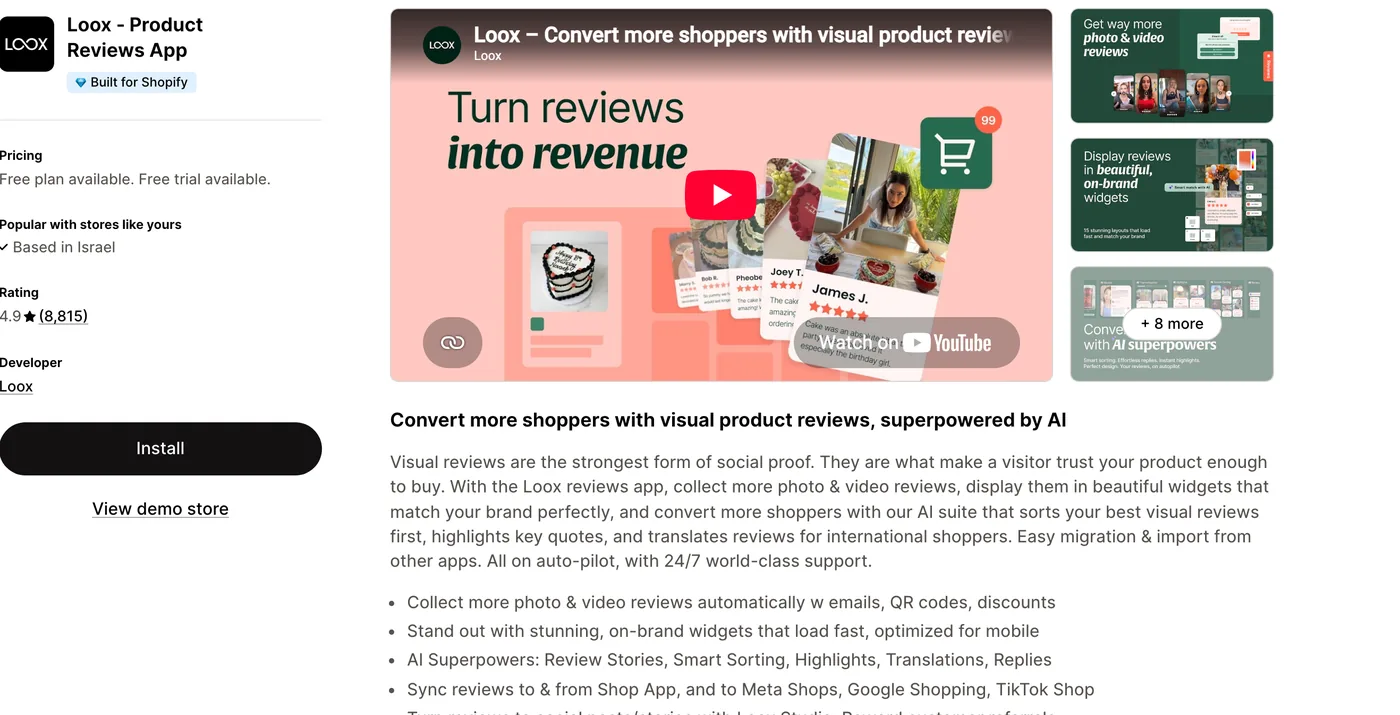
Loox is a product reviews app for Shopify built around visual reviews rather than plain text. It collects photos and videos from real customers and shows them in polished galleries, carousels, and star ratings styled to match your store, and it automatically asks for a review after each purchase by email or SMS. The verdict upfront: Loox makes photo and video reviews look genuinely good, which is exactly what a plain star-rating app cannot do, and that visual proof is why it is one of the most-installed reviews apps on Shopify and holds a 4.9 out of 5 App Store rating. The honest catch is price. Its free plan is limited, the paid tiers scale with your order volume, and it leans on discount incentives to get those photos, so a growing store pays for the polish.
If you sell visual products and your customers will happily share photos, Loox turns that content into some of your best marketing. If your store is plain or text-heavy, or you are on a tight budget, a free rival will cover the basics for nothing. The sections below use live detection data to show how widely Loox is used, what makes it different, what it costs, and where it falls short.
What is Loox?
Loox is a Shopify app for collecting and displaying product reviews, with a focus on photos and videos rather than written lines. Store owners use it to gather visual reviews, show them in galleries, carousels, and star ratings that match the store’s design, and automatically request a review after each order by email or SMS, including a prompt for a photo or video. Beyond collecting and showing reviews, it adds AI sorting and translation, feeds star ratings into Google search results, and runs referral and upsell tools. Here is how widely it is installed across our dataset.
How popular is Loox?
Loox is one of the most-detected apps on all of Shopify and one of the top reviews apps, which is notable for an app that is priced mainly for paid use. It also ranks highly among conversion tools and sits near the top of the stack for subscription stores, a sign that retention-focused merchants value visual social proof. In short, plenty of stores decide the polish is worth paying for.
Loox ‑ Product Reviews App has slipped from 19.3% to 13.2% of Shopify stores in our dataset over recent months.
What makes Loox different?
Most reviews apps center on the written review and treat photos as an add-on. Loox flips that: the photo or video is the point, and the app is built to collect visual content and present it beautifully. The galleries and carousels look designed rather than bolted on, and they carry your store’s styling instead of a generic widget.
That matters because for a lot of products, seeing the item in a real customer’s hands, home, or outfit is far more convincing than a five-star line of text. A shopper deciding on a dress, a candle, or a skincare set responds to real photos in a way star ratings alone cannot match. Loox turns customer content into a selling tool, which is why visual brands pick it even though a capable free alternative exists.
What do merchants say in Loox reviews?
Before the sentiment, here is the number nobody else writing up Loox reviews can put in front of you: Loox runs on 18.0% of every Shopify store we detect, which makes it the number 3 most-installed app on the whole platform and one of the most-installed reviews apps of any kind. That scale matters when you read its rating, because a score drawn from a huge, active base of stores says far more than one built on a handful.
On the Shopify App Store, Loox holds a 4.9/5 rating across 9,689 merchant reviews, and the company reports more than 100,000 merchants on the app. For an app that is priced mainly for paid use, that is an unusually strong score, and it answers the “is Loox legit” question plainly: the merchants who actually run it mostly rate it highly. Here is what those reviews cluster on, the good and the bad.
What merchants praise
- Photo and video collection that genuinely works. The automated post-purchase requests, paired with small discount incentives, pull in real customer images at rates a text-only app rarely reaches.
- Fast, low-effort setup. Reviewers repeatedly call the install and theme styling easy, with galleries that look on-brand straight away rather than needing a developer.
- Painless migration. Merchants switching from another reviews app, and dropshippers importing existing product reviews from AliExpress, single out how cleanly Loox carries that history across so a new store does not launch with empty galleries.
What merchants complain about
- The bill grows with the store. Loox pricing is tied to your monthly order volume, and the most common gripe is a subscription that climbs faster than expected as orders scale, catching out stores that signed up while they were small.
- The features people want sit on higher tiers. Google Shopping sync, full widget customisation, and multi-language display live on the pricier plans, so a small store that needs them feels the jump in cost sharply.
- A dashboard that several reviewers call clunky. Managing and moderating reviews at volume can feel slower than it should, though it does not stop the app doing its core job.
None of this contradicts the high rating. These are the trade-offs of a premium, visual-first app rather than signs of a weak one, and we break down the real cost of those tiers, the subscription plus the discount incentives, in the Where Loox falls short section below.
Loox features
Loox bundles a full visual-reviews toolkit rather than just a collection form, and the extras are aimed at turning reviews into repeat sales.
- Photo and video reviews: automatic requests after purchase by email or SMS, with a prompt for images, not just text.
- On-brand display: galleries, carousels, and star ratings styled to match your theme rather than a generic widget.
- Discount incentives: reward customers for leaving a photo or video review, which lifts submission rates.
- AI sorting and translation: surface the strongest reviews and show them in a shopper’s language.
- Search visibility: star ratings fed into Google rich snippets so they can appear in search results.
- Referrals and upsells: turn a happy reviewer into a repeat customer and a source of new ones.
The toolkit is deep, and it is built to be seen. That is its strength for a visual brand and its weakness for a store that just needs a review count next to the price.
Does Loox help with SEO?
Yes. Like other strong reviews apps, Loox marks up your star ratings so they can appear as Google rich snippets, the gold stars and review counts under some search results, which can lift click-through from search. The difference with Loox is that the on-site experience behind those stars is a gallery of real customer photos, which tends to convert the visitor once the richer listing has earned the click. For a visual brand, that pairing of search visibility and visual proof is a real reason to choose it.
How much does Loox cost?
Loox has a limited free plan and a free trial, so a low-volume store can start at no cost, but the free allowances are tight and most growing stores move to a paid tier. Those paid tiers are tied to your monthly order volume, so the cost rises as your store grows, and there is a separate cost to keep in mind: the discount rewards Loox uses to encourage photo reviews come out of your margin. Budget for both the subscription and the incentives.
That pricing is the honest sticking point, and it is the clearest line between Loox and a cheaper rival. A budget-focused store will get a more generous free tier and most of the same core review features from a free app like Judge.me. Loox earns its price when the visual galleries and referral tools are genuinely used, not just installed. If you are going to lean on customer photos as marketing, it pays for itself; if you only need a star rating under the product title, it is more than you need.
Which themes and apps run with Loox?
Because we detect both themes and apps, we can see the company Loox keeps. On the theme side it is near-universal, showing up most on Shopify’s free Dawn theme and then across popular premium themes, which reflects how widespread it is rather than any special pairing. Here are the themes most commonly running it.
| Rank | Theme | % of stores |
|---|---|---|
| 1 | Dawn | 14.3% |
| 2 | Shrine PRO | 5.7% |
| 3 | Prestige | 5.5% |
| 4 | Impulse | 5.1% |
| 5 | Impact | 4.2% |
| 6 | Horizon | 4.1% |
| 7 | Broadcast | 1.8% |
| 8 | Symmetry | 1.7% |
| 9 | Focal | 1.6% |
| 10 | Concept | 1.6% |
On the app side, Loox rarely runs alone. Most Loox stores also run an email marketing platform, a subscription tool, page builders, and often a second reviews app, which is why Loox stores carry heavier app stacks than the average store. Notably, a good share of Loox stores also run Judge.me, usually because an owner uses one for visual galleries and keeps the other for its free syndication, or is mid-switch between them. For the full breakdown of themes, paired apps, and store types, see the live Loox usage statistics.
What kinds of stores use Loox?
Loox’s user base is visual by nature. Apparel and accessories leads, followed by health and beauty, home and garden, and food and drink, all categories where a customer photo does real selling work. These are products people want to see in use before they buy, which is exactly where visual reviews earn their keep.
By business model, subscription stores are heavily represented, alongside multichannel sellers, which fits an app that turns reviews into referrals and repeat sales. The pattern is clear: Loox is chosen by brand-led, visual, repeat-purchase stores rather than plain or one-off-purchase ones. If your products are photogenic and your customers are the kind who post, you are the target.
Where Loox falls short
The honest downside is cost, on two fronts. First, the free plan is limited, so most growing stores move to a paid subscription that scales with your order volume and pays more over time. Second, the discount incentive that drives Loox’s high photo-review rates is a real expense of its own, coming straight out of your margins on those orders. Neither is hidden, but together they make Loox meaningfully more expensive than a free reviews app.
The other consideration is fit. Loox is built to make visuals shine, so its value collapses on a store where customers will not share photos or where the product simply does not benefit from being seen. For those stores, you are paying for galleries that stay empty. None of this makes Loox a weak app, it is an excellent one, but it is an excellent app for a specific kind of store, and the wrong pick for a plain or budget-first one.
If reviews are only one of several conversion tools you plan to run, our Vitals review covers the all-in-one alternative that bundles reviews with upsells, bundles, popups and visitor replays under a single $29.99 subscription. Loox goes deeper on photo reviews specifically; Vitals is the cheaper choice when reviews are one job among four or five.
One worry with a reviews app like Loox is speed, since it adds photo and star widgets to your product pages. On plain averages, stores using Loox can look a little slower, but that is mostly because busier, higher-volume stores are the ones that add it. Compared fairly against similar stores on the same theme and app load, the ones running Loox actually pass Google’s speed test (Core Web Vitals) more often, about 66% versus 63% for comparable stores without it, among stores with enough traffic to appear in Google’s Chrome UX Report.
Does Loox slow a store down?
Compared only against stores on the same theme, running the same number of apps and carrying a similar catalogue, stores with Loox ‑ Product Reviews App installed pass Core Web Vitals 3.5 points higher of the time (11,404 comparable stores across 1,061 matched groups).
| Comparison | With Loox ‑ Product Reviews App | Without | Stores compared |
|---|---|---|---|
| Like-for-like stores | 65.8% | 62.3% | 12,141 with · 33,032 without |
| All stores, unmatched | 64.8% | 68.8% | 13,630 with · 45,312 without |
Who should use Loox?
Loox is the right choice if you are a visual brand in fashion, beauty, skincare, or home, your products are photogenic, and your customers are happy to share photos and videos. For that store, no free app matches the way Loox presents visual proof, and the galleries and referrals will comfortably justify the cost. It is an especially strong fit for repeat-purchase and subscription brands that want reviews to drive marketing, not just sit under a product.
Pass on Loox if you are on a tight budget, your catalog is plain or text-heavy, or your customers are unlikely to post photos. In those cases a free app like Judge.me gives you the core reviews, star ratings, and search visibility for nothing, and you can always move up to Loox later if visual content becomes central to how you sell.
-
Is Loox free?
Loox has a limited free plan and a free trial, so a low-volume store can start at no cost, but the free allowances are tight and most growing stores move to a paid tier. Paid tiers are tied to your monthly order volume, and you should also budget for the discount rewards it uses to encourage photo reviews. A free rival like Judge.me offers a more generous free tier if budget is the priority.
-
Is Loox worth the price?
For a visual brand whose customers share photos, yes. Loox turns those photos and videos into polished, on-brand galleries that sell products better than star ratings alone, and its referral and upsell tools drive repeat sales. It is not worth it for a plain or text-heavy store, or one on a tight budget, where a free reviews app does the core job for nothing.
-
What is the difference between Loox and Judge.me?
Both collect Shopify reviews, but they compete on different things. Loox leads on design, with photo and video reviews in beautiful, on-brand galleries, and while it has a limited free plan it is priced mainly for paid use. Judge.me wins on price and features, with a more generous free plan and Google rich snippets included. Choose Loox for visual polish, and Judge.me for a free, feature-rich start.
-
Does Loox help with SEO?
Yes. Loox adds star-rating markup so your ratings can appear as Google rich snippets in search results, which can lift click-through. The on-site experience behind those stars is a gallery of real customer photos, so the richer search listing earns the click and the visual proof helps convert the visitor. That search-and-visual pairing is a real reason visual brands choose it.
-
What kinds of stores use Loox most?
Loox skews to visual, photogenic niches: apparel and accessories leads, followed by health and beauty, home and garden, and food and drink. By business model, subscription and multichannel stores are well represented, since Loox turns reviews into referrals and repeat sales. It suits brand-led, visual, repeat-purchase stores far more than plain or one-off-purchase ones.
-
Is Loox legit, and what do merchants say in reviews?
Yes. Loox is a legitimate, widely used app that runs on a large share of Shopify stores and holds a 4.9/5 rating on the Shopify App Store across 9,689 merchant reviews, with the company reporting more than 100,000 merchants. In those reviews, merchants praise how well its automated requests collect real photo and video content and how quickly its on-brand galleries set up. The most common complaint is cost, since pricing scales with your order volume and the photo discounts come out of your margin.
Is Loox worth it?
For a visual brand, yes, and it is the strongest way to turn customer photos into marketing on Shopify. Loox makes photo and video reviews look genuinely good in on-brand galleries, feeds star ratings into search, and adds referral and upsell tools, which is why it holds a 4.9 out of 5 rating. The trade-off is real: the free plan is limited, the price scales with your orders, and the discount incentives add to the bill, so it pays off only when the visuals are actually central to how you sell. If your products are photogenic and your customers post, Loox earns its cost; if not, a free app covers the basics. To see how it fits alongside everything else, browse our guide to the best Shopify apps. And any time you spot a store with a gorgeous review gallery, you can scan it to see whether it runs Loox and which theme and apps it pairs with.