Omnisend Email Marketing & SMS Review 2026
Last modified: August 16, 2026
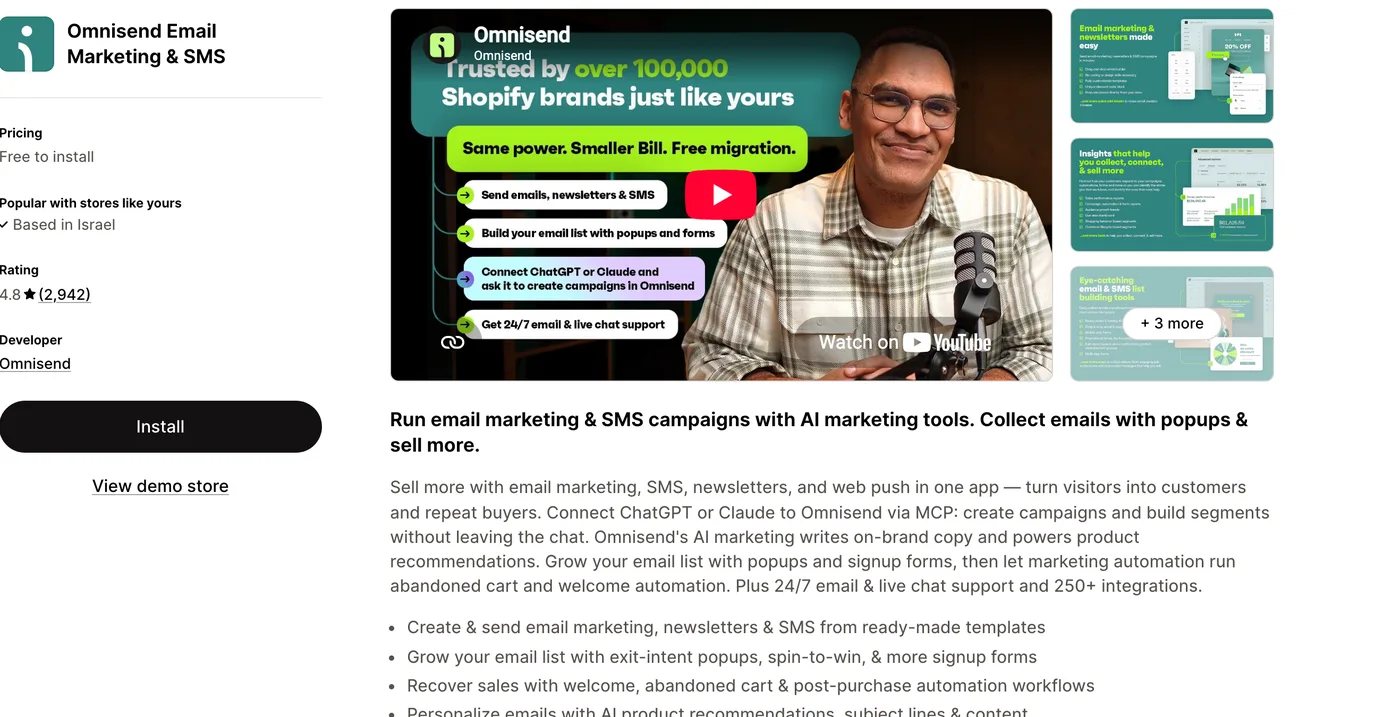
Omnisend Email Marketing & SMS is an all-in-one marketing app for Shopify that runs your email, SMS, and web push from one place. Made by Omnisend, it pairs campaign sending and pre-built automations, welcome flows, abandoned-cart recovery, post-purchase, with the list-building side: exit-intent popups, spin-to-win, and signup forms that turn visitors into subscribers. It is best known as an affordable, easier alternative to the bigger email platforms, with SMS included rather than bolted on, and it is rated accordingly with a 4.8 out of 5 across nearly 3,000 reviews. The verdict upfront: for a small-to-mid Shopify store that wants email and SMS marketing in one tool without a steep price or a steep learning curve, Omnisend is one of the strongest picks, and its free plan makes it low-risk to try. The honest catch is scale. At a large list with deep segmentation and complex data needs, the heavier platforms like Klaviyo still go further.
If you want to grow a list and run automated email and text campaigns without paying enterprise prices, Omnisend earns its place. If you are already running advanced, data-heavy flows across many channels, weigh it carefully against the pricier incumbents. The sections below use live detection data to show how widely Omnisend is used, what it does, what it costs, and the kind of store it actually fits.
What is Omnisend?
Omnisend is a marketing app made by Omnisend that brings email, SMS, and web push into a single tool for Shopify. On the sending side, you build campaigns and newsletters from ready-made templates and run pre-built automation workflows, welcome series, abandoned-cart and abandoned-browse recovery, and post-purchase follow-ups, that fire on their own. On the list-building side, it adds exit-intent popups, spin-to-win wheels, and signup forms to turn visitors into subscribers. It also includes segmentation, A/B testing, product recommendations, AI-written copy, and more than 250 integrations, and it says over 100,000 Shopify brands use it. It is free to install with a genuine free plan, and holds a 4.8 rating across nearly 3,000 reviews. Here is how widely it is installed across our dataset.
How popular is Omnisend?
Omnisend leads its category. In our data it is filed under list-building and popups, its email-capture side, and there it is the most-used app of its kind, well ahead of the next tool in the ranking. The stores that run it also carry heavier app stacks than average, the mark of active, marketing-minded brands rather than minimal shops.
One trend sets Omnisend apart from a lot of apps we track. Where many tools are slowly losing share, Omnisend’s adoption has been climbing month over month, which fits its positioning as a lower-cost way to run email and SMS as the bigger platforms raise prices.
Omnisend Email Marketing & SMS has climbed from 5.7% to 6.2% of Shopify stores in our dataset over recent months.
What does Omnisend do?
Omnisend covers the full loop from capturing a visitor to keeping a customer. It captures with popups and signup forms, then nurtures with automated flows: a welcome series for new subscribers, cart and browse abandonment recovery, and post-purchase messages that bring buyers back. Campaigns and newsletters go out by email or SMS from the same builder, so a promotion can hit both channels without extra tools.
Around that sit the tools to make it work: segmentation to target the right people, A/B testing to compare versions, product recommendations and AI-written copy to speed up building, and reporting to see what earned revenue. The point is one tool for the whole marketing loop, which is why stores pick it over stitching a separate popup app to a separate email app to a separate SMS app.
Is Omnisend worth it?
For most small-to-mid stores, yes. Getting email, SMS, and popups in one affordable tool removes a lot of cost and complexity, and the free plan lets you prove it earns revenue before you pay. The automations do the heavy lifting, recovering carts and welcoming subscribers on their own, which is where email marketing makes most of its money.
Where it makes less sense is at the top end. A large brand running deep, data-heavy segmentation across many channels may hit the limits of Omnisend’s flexibility, and that is where a heavier platform earns its higher price. Treat Omnisend as the strong-value all-rounder, and only reach past it when your list and your data genuinely outgrow it.
What Omnisend costs
Omnisend has a genuine free plan that covers a small contact list and a capped number of emails a month, enough to start and prove it works. Its pricing is Free, or from $16/mo, and paid plans scale with your list size across a Standard tier and a Pro tier, with SMS credits included. Because the price tracks your contacts, it stays cheap while your list is small and grows with it, which is a big part of why smaller stores favor it over pricier platforms.
Omnisend vs Klaviyo
This is the comparison most stores actually weigh. Omnisend is the affordable, all-in-one option: email, SMS, and popups in one tool, a real free plan, and a gentler learning curve, which is why it wins with small-to-mid stores. Klaviyo is the heavier, data-first platform: deeper segmentation, more advanced analytics, and a bigger integration and partner ecosystem, at a higher price that climbs faster as your list grows.
Neither is strictly better. If you want strong email and SMS without enterprise cost or complexity, Omnisend is the value pick. If your growth depends on advanced, data-driven personalization at scale, Klaviyo justifies its premium. Interestingly, our data shows a meaningful share of Omnisend stores also run Klaviyo, a sign of brands trialling or migrating between the two.
Which themes and apps run with Omnisend?
Because we detect both themes and apps, we can see the company Omnisend keeps. Its most common theme is Shopify’s free Dawn, followed by conversion-built and premium themes like Prestige and Impulse. Here are the themes most commonly running it.
| Rank | Theme | % of stores |
|---|---|---|
| 1 | Dawn | 12.5% |
| 2 | Prestige | 5.4% |
| 3 | Impulse | 4.3% |
| 4 | Shrine PRO | 4.1% |
| 5 | Horizon | 4.0% |
| 6 | Elixir | 3.7% |
| 7 | Crave | 3.6% |
| 8 | Impact | 3.0% |
| 9 | Broadcast | 2.1% |
| 10 | Ella | 2.0% |
On the app side, Omnisend sits inside a full conversion-and-retention stack: most stores running it also run a reviews app, and many pair it with subscriptions, urgency, and page-building tools. That company confirms the profile, active marketing operations building and working a customer list. For the full breakdown of themes, paired apps, and store types, see the live Omnisend usage statistics.
What kinds of stores use Omnisend?
Omnisend stores skew toward small-to-mid, marketing-active brands that treat email and SMS as a core channel but want to keep costs down. They run heavier app stacks than average and sell across the usual direct-to-consumer categories, the kind of stores building a subscriber list and running regular campaigns rather than relying on ads alone.
That profile explains both the growth and the category lead. A cost-conscious store that still takes marketing seriously is exactly who benefits from email, SMS, and popups in one affordable tool. Very large brands with dedicated data teams are the exception, and usually the ones weighing a heavier platform instead.
A list is only as good as its quality
Omnisend makes it easy to grow and message a list, but revenue comes from a healthy one. Sending to unengaged or poorly collected contacts hurts deliverability and can land you in spam, which costs more than the extra reach wins. Use the segmentation to message engaged subscribers, keep your signup sources clean, and watch that the plan cost still clears the revenue as your list grows.
Omnisend pros and cons
Pros
- Email, SMS, and web push in one tool, with SMS included rather than bolted on
- A genuine free plan, and paid plans that stay affordable as your list grows
- The most-used list-building and popups app on Shopify, rated 4.8 across nearly 3,000 reviews
- Pre-built automations plus popups and signup forms in the same app
Cons
- Less flexible than heavier platforms for very large lists and deep segmentation
- Cost still scales with your contact count as you grow
- Revenue depends on list quality and good deliverability
- Advanced, data-driven brands may outgrow it
Omnisend is mostly email and SMS automation that runs off your storefront, so it should have little speed impact, and it does not. Compared fairly against similar stores, the ones running Omnisend pass Google’s speed test (Core Web Vitals) at about the same rate, roughly 65% versus 66% for comparable stores without it, within a point either way, among stores with enough traffic to appear in Google’s Chrome UX Report.
Does Omnisend slow a store down?
Compared only against stores on the same theme, running the same number of apps and carrying a similar catalogue, stores with Omnisend Email Marketing & SMS installed pass Core Web Vitals 1.9 points higher of the time (3,635 comparable stores across 691 matched groups).
| Comparison | With Omnisend Email Marketing & SMS | Without | Stores compared |
|---|---|---|---|
| Like-for-like stores | 65.9% | 64.1% | 3,869 with · 38,979 without |
| All stores, unmatched | 65.7% | 68% | 4,289 with · 54,653 without |
Who should use Omnisend?
Reach for Omnisend if you are a small-to-mid Shopify store that wants email and SMS marketing in one affordable tool, with popups to grow the list and automations to work it. For those stores the value is hard to beat, and the free plan lets you start earning from email before you pay anything.
Think twice, or plan to graduate, if you run a very large list with advanced segmentation and a dedicated marketing data team. In that case a heavier platform may justify its higher cost. Omnisend is the right tool for the vast majority of stores building and working a customer list, and only the largest, most data-driven operations tend to need more.
Our verdict
Omnisend is our value pick for stores that want email, SMS, and popups in one affordable tool. Start on the free plan, set up the welcome and abandoned-cart automations first since they earn the most, and let the price scale with your list. Only reach for a heavier platform once your segmentation and data needs genuinely outgrow it.
-
What is Omnisend used for?
Omnisend is used to run email, SMS, and web push marketing for a Shopify store from one app. It sends campaigns and newsletters, runs automated flows like welcome and abandoned-cart recovery, and grows your subscriber list with popups and signup forms. Stores use it to turn visitors into subscribers and subscribers into repeat buyers.
-
Is Omnisend free?
Omnisend has a genuine free plan that covers a small contact list and a capped number of emails a month, which is enough to start. Its paid pricing is Free, or from $16/mo, scaling with your list size across a Standard tier and a Pro tier, with SMS credits included. Most stores start free and upgrade as their list grows.
-
Is Omnisend better than Klaviyo?
They suit different stores. Omnisend is the affordable, all-in-one option with email, SMS, and popups in one tool, a free plan, and an easier setup, which fits small-to-mid stores. Klaviyo is the heavier, data-first platform with deeper segmentation and analytics at a higher price. Omnisend is the value pick; Klaviyo suits advanced, data-driven brands at scale.
-
Does Omnisend do SMS?
Yes. SMS is built into Omnisend alongside email and web push, so you can send text campaigns and include SMS steps in your automations from the same tool. Paid plans include SMS credits, and extra credits are available. Having SMS in the same app is one of the main reasons stores choose Omnisend over an email-only tool.
-
Does Omnisend have popups?
Yes, and in our data it is the most-used popups and list-building app on Shopify. It includes exit-intent popups, spin-to-win wheels, and signup forms to capture email and SMS subscribers, which then flow straight into your automations. The combination of list-building popups and marketing in one tool is a core part of its appeal.
-
Which stores use Omnisend most?
Small-to-mid, marketing-active brands that want email and SMS without enterprise cost. In our data Omnisend stores run heavier app stacks than average and sell across the usual direct-to-consumer categories. Its most common theme is Shopify’s free Dawn, followed by conversion-built and premium themes.
Is Omnisend worth it?
For most small-to-mid Shopify stores, yes. The data shows why it is growing: Omnisend is the most-used list-building and popups app on Shopify, and it is chosen by marketing-active brands that want email, SMS, and popups in one affordable tool rather than three. Its automations do the heavy lifting, and the free plan lets you prove it earns revenue before you pay. The only real limit is scale, so a very large, data-heavy brand may outgrow it and weigh a heavier platform like Klaviyo instead. To see how it fits alongside everything else, browse our guide to the best Shopify apps. And any time you spot a store running a slick popup or email flow, you can scan it to see whether it is using Omnisend and what theme and apps it pairs with.