Refresh Shopify Theme Review 2026
Last modified: October 1, 2026

Refresh is Shopify’s free, product-first theme built for small brands that want to look modern on a tight budget. The verdict upfront: it is genuinely fast, it is one of the most-used themes on Shopify, and it gives a new store enough merchandising and trust tools to launch on day one. The catch is a low Shopify Theme Store rating and a design that only works if you keep the storefront uncluttered and let strong product photos lead. This review pulls from live detection across millions of stores to show exactly where Refresh fits, where it strains, and how it stacks up against the other free Shopify themes.
If you sell beauty, food, or a single hero product and your photography is strong, Refresh is one of the better free starting points. If you run a large catalog or need heavy layout customization, it will feel limiting. The sections below break down the data behind that call.
What is the Refresh Shopify theme?
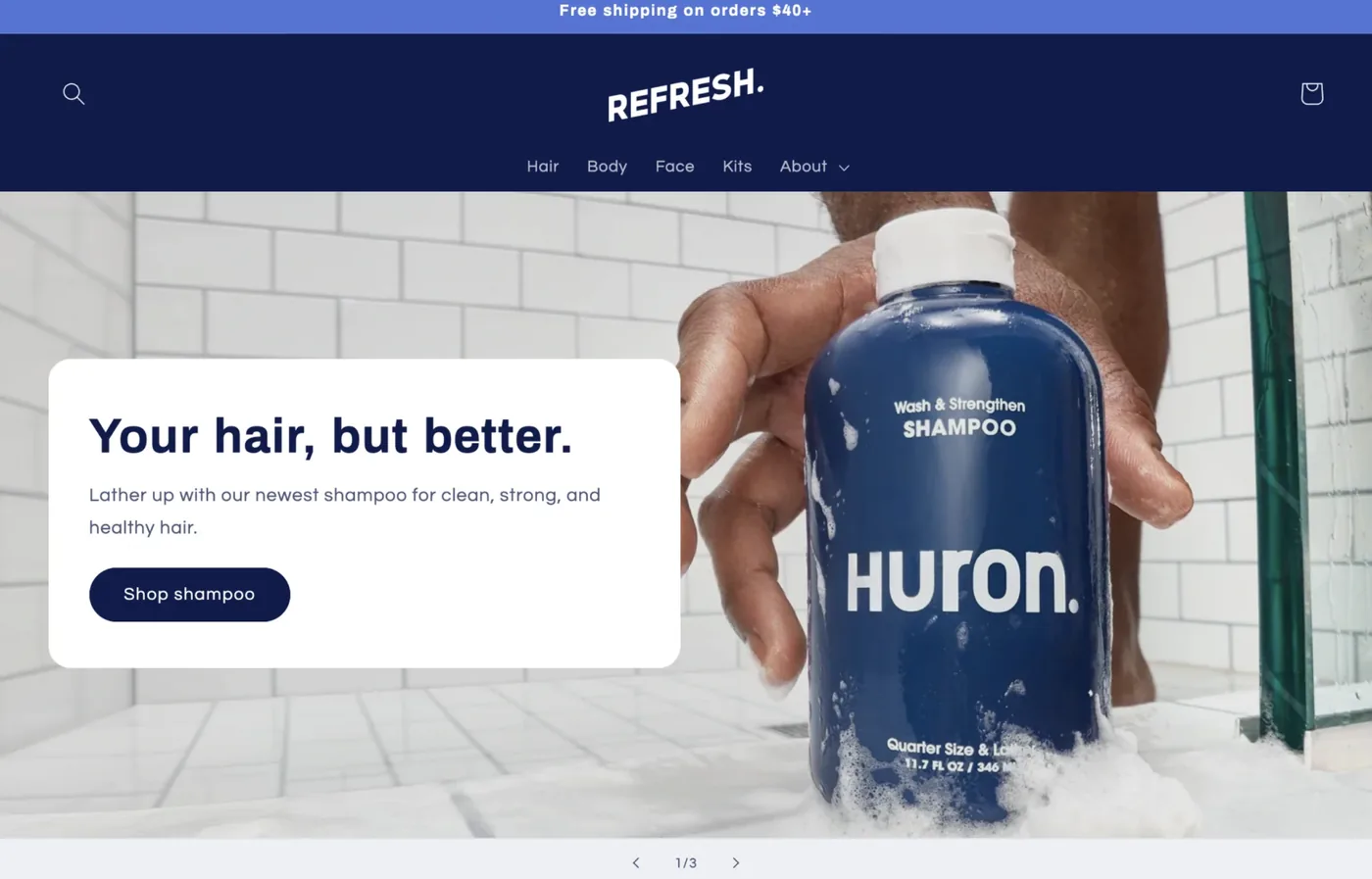
Refresh is a free Online Store 2.0 theme published by Shopify itself, so updates arrive through the theme library with no third-party dependency. It ships with a bold, confident visual identity: large type, generous spacing, and product blocks that keep the item front and center. Shopify positions it for beauty, food and drink, and single-product brands, which matches what we see in the wild.
Because it is a first-party theme, Refresh runs on Shopify’s standard Online Store 2.0 architecture, so it edits through the drag-and-drop theme customizer with no code required and works with the wide library of Online Store 2.0 tutorials and third-party sections. What sets it apart is its bolder default styling and product-first section library. Here is where Refresh sits across our dataset today.
How popular is Refresh, and is it climbing?
Refresh is not a niche theme. Live detection places it among the most-used themes on Shopify overall, and its share of stores we scan each month has been trending up rather than flat. For a free theme, holding a spot among the fifteen most-used themes on the whole platform is a strong signal that new stores keep reaching for it.
Refresh has held steady at about 1.0% of Shopify stores in our dataset over recent months.
Two numbers stand out when you look at how Refresh stores actually behave. Refresh tests faster than most themes we measure, and the stores running it lean on fewer apps than average. That second point matters: a lighter app stack is one of the biggest levers on real-world speed, so Refresh stores tend to stay quick partly because their owners add less.
Refresh design and layout
Refresh leans on confident typography and a product-first grid. The default homepage puts big headings and clean image blocks above everything else, so nothing on the page competes with the product itself. That is why it reads so well for a new beauty, food, or single-product brand where the item and its packaging are the story.
The design is opinionated, and that cuts both ways. The bold look holds up only when the store stays uncluttered. Add too many sections, mismatched fonts, or weak photography and the same layout that looked deliberate starts to look empty. Refresh rewards restraint: fewer sections, strong images, and a single clear identity per page. Owners who try to make it do everything usually end up fighting the theme instead of using it.
Refresh features
For a free theme, Refresh covers the storefront essentials that a young brand needs to look credible before it has reviews or a reputation. The merchandising and trust tools are the reason it works on day one.
- Product media that sells: color swatches, image galleries, zoom, and video on the product page.
- Simple browsing and checkout: collection filtering and quick buy keep the path to cart short.
- Built-in blog sections, so you have room to explain the brand and its story.
- Space for ingredients, certifications, and press or testimonial blocks, which help build trust early.
- Standard Online Store 2.0 sections and settings, so tutorials and developer help written for Shopify’s free themes transfer directly.
What you do not get is unusual for the price. Advanced page building, deep content settings, and heavy layout flexibility are where free themes stop. Most of the friction Refresh owners report sits in those advanced settings, not in the storefront a shopper sees.
How fast is the Refresh theme?
Speed is where Refresh earns its keep. We measure Refresh on real-world Core Web Vitals across hundreds of live Refresh stores, using Google’s Chrome UX Report field data rather than a lab test. The reading is shown live below and refreshes with our data, so it never drifts from the theme’s stats page.
| Theme | CWV pass rate | Few apps | Median LCP |
|---|---|---|---|
| Impulse | 78.4% | 85.4% | 1.6s |
| Dawn | 71.2% | 79.9% | 1.6s |
| Refresh | 70.9% | 76% | 1.6s |
The field data reflects the kind of small, lighter stores that tend to run Refresh. Either way, Refresh sits comfortably on the fast side of the themes we measure. The practical takeaway: the theme is not your speed problem. Oversized images and too many apps are what slow a Refresh store down.
What kinds of stores use Refresh?
Refresh skews toward a clear set of niches. In our classification, health and beauty and apparel are the two largest groups, followed by home and garden and then food and drink. That tracks with the theme’s product-first, photography-led design, which flatters clean packaging and lifestyle shots.
By business model, subscription stores are the standout group running Refresh, well ahead of dropshipping, wholesale, or print on demand. That fits a theme aimed at brand-led sellers with a small, repeatable catalog rather than sprawling reseller stores. For the full store-type and category breakdown, including how the mix shifts over time, see the live Refresh usage statistics.
Which apps do Refresh stores use?
The app stack on Refresh stores says a lot about who runs them. Reviews apps sit at the very top, which makes sense for young brands that need social proof fast, and email marketing and subscriptions feature heavily too. Here is what we detect most often on live Refresh stores.
| Rank | App | % of stores | Category |
|---|---|---|---|
| 1 | Judge.me Product Reviews App | 35.3% | Product reviews |
| 2 | Klaviyo | 21.6% | Email Marketing |
| 3 | Loox ‑ Product Reviews App | 18.0% | Product reviews |
| 4 | Recharge | 15.6% | Subscriptions |
| 5 | PageFly ✦ AI Page Builder | 8.2% | Page builder |
| 6 | Shopify Inbox | 7.4% | Support - Other |
| 7 | GemPages Landing Page Builder | 6.3% | Page builder |
| 8 | Releasit Cod Form | 6.2% | Pay later |
| 9 | Kaching Bundles | 6.1% | Product bundles |
| 10 | Yotpo | 5.8% | Product reviews |
The pattern is a trust-and-retention stack: product reviews first to build credibility, email to bring shoppers back, and subscription tooling for the recurring-order brands that favor this theme. Notably, page-builder apps also show up, which is how many Refresh owners work around the theme’s limited advanced layout settings.
How much does Refresh cost?
Refresh is free. It is made by Shopify and installed straight from the Shopify Theme Store, with no license fee and no separate cost for updates. There is no paid tier or upsell for the theme itself. Your real costs are the apps you add and the plan you run your store on, not the theme.
Why is the Refresh Theme Store rating so low?
Refresh holds roughly a 1.8 out of 5 rating on the Shopify Theme Store, and that number surprises people given how widely the theme is used and how well it tests. The gap is worth explaining, because the rating measures something different from what our detection data measures.
Free Shopify themes as a group rate low on the Theme Store, and Refresh is no outlier. Two things drive it. First, free themes are the default choice for brand-new store owners, so a large share of one-star reviews are really frustration with Shopify, apps, or the learning curve, not the theme code. Second, a very large install base surfaces more edge cases and more owners who hit the theme’s customization ceiling and leave a review about it. A small paid theme with a handful of expert users can post a near-perfect score simply because its audience is smaller and more technical.
None of that means the rating is meaningless. It is a fair warning that Refresh has a real customization ceiling and that support is community-and-docs rather than a dedicated developer. Read it as a caution about flexibility, not as evidence the theme is broken. On the metrics we can measure directly, speed and adoption, Refresh performs well.
Who should use Refresh?
Refresh is a strong free starting point for a specific kind of store. Reach for it if you are a new, budget-minded brand built around one product or a small, tightly branded catalog, and your product photography is genuinely good. Beauty, skincare, wellness, food, and drink are the best fits, and subscription brands do well on it too.
Pass on Refresh if you run a large or fast-changing catalog, need heavy custom layouts, or sell in a category that wants bold, high-contrast staging rather than clean minimalism. In those cases a more general-purpose free theme, or a paid theme with more built-in sections, will save you time. Before you commit, resist the urge to fill every section: add less, lean on photography, and let the product lead the page.
-
Is the Refresh Shopify theme free?
Yes. Refresh is a free Online Store 2.0 theme made by Shopify and installed directly from the Shopify Theme Store. There is no license fee and no charge for updates. Your only real costs are the apps you add and your Shopify plan, not the theme itself.
-
Is Refresh a good Shopify theme?
Refresh is a solid free choice for small beauty, food, and single-product brands with strong photography. It tests fast and is one of the most-used themes on Shopify. Its weak spot is a customization ceiling, which is what the low Theme Store rating mostly reflects. For a large-catalog or highly custom store, a more flexible theme is often a better fit.
-
Why does Refresh have a low Theme Store rating?
Free themes attract brand-new store owners, so many low reviews are really frustration with Shopify or apps rather than the theme. A large install base also surfaces more edge cases. Refresh sits near 1.8 out of 5, in line with other free Shopify themes, yet tests fast and is widely adopted in our detection data.
-
Can I use Refresh for a large catalog?
Refresh is built for small, tightly branded catalogs and single-product brands, so a large or fast-changing catalog will feel cramped. Its collection filtering and quick buy cover the basics but are not designed for deep merchandising across hundreds of products. If you carry a big catalog, you will get more from a theme with heavier catalog and layout controls.
-
What types of stores use the Refresh theme?
Refresh skews toward health and beauty and apparel, followed by home and garden and food and drink. By business model, subscription brands are the standout group. It fits small, brand-led catalogs more than large reseller or dropshipping stores. You can see the full breakdown on the live Refresh statistics page.
-
Is Refresh a fast Shopify theme?
Yes. Refresh tests faster on Google PageSpeed than most themes we measure, and real-world Core Web Vitals across live Refresh stores score well too. The theme itself is not usually the bottleneck. Oversized images and a heavy app stack are what slow Refresh stores down, so keep both lean.
Is Refresh worth installing?
For the right store, yes. Refresh makes a small brand look deliberate and modern for nothing, keeps attention on the product, and stays fast as long as you do not weigh it down with apps and oversized images. The low Theme Store rating is a fair caution about its customization ceiling, not a sign of a bad theme, and our live data shows it is both quick and widely trusted by new brands. For the wider picture across Shopify’s free and paid themes, see our guide to Shopify theme reviews. And any time you spot a store you admire, you can scan it to see whether it runs Refresh and exactly which apps it pairs with.