Rise Shopify Theme Review 2026
Last modified: October 1, 2026

Rise is a free Shopify theme built by Shopify, an Online Store 2.0 template aimed at detail-rich, storytelling catalogs of any size. It leans on flexible, information-dense layouts, slideshows, and product pages built to show off specs and brand story, and because it is a first-party theme it installs in one click, updates through Shopify, and costs nothing to keep. The honest catch is its Theme Store rating, which sits low so far on a small number of reviews, with complaints about locked-down mobile typography and a couple of display bugs. What those reviews miss is speed: our real-store data shows Rise is one of the faster themes we track, so it is worth judging on your own store rather than on its star count.
This review leans on our detection data for the real stores running Rise, not just the demo. That data shows who installs it, the apps they run beside it, and how their storefronts actually perform for shoppers. It tells a different story than the rating alone: Rise stores post strong Core Web Vitals and keep lean app stacks, which points to a quick, solid foundation whose friction is more about customization limits than performance.
Try Rise free on the Shopify Theme Store
What Is Rise?
Rise is a free Shopify theme made by Shopify, listed on the Shopify Theme Store and built on Online Store 2.0. It is aimed at detail-focused merchandising and storytelling: information-rich sections, slideshows, and product pages designed to surface specifications and brand story rather than just a grid of thumbnails. It is flexible enough to suit a handful of products or a large catalog, and it is a keep-forever theme rather than a subscription, so you install it, own it, and pay nothing.
Being a first-party theme matters here. Rise installs in one click, updates through Shopify’s managed path, and has passed Shopify’s own review, so you get the vetting and support flow an official listing carries. It is also a mature theme, several major versions in and still actively maintained, which cuts both ways: it is stable and proven, but its customization model is more fixed than the newer block-based themes, which is where some of the review friction comes from.
What Apps Do Rise Merchants Install?
The apps a store runs tell you what kind of business it is. Here is the real install pattern across the Rise stores in our dataset.
| Rank | App | % of stores | Category |
|---|---|---|---|
| 1 | Judge.me Product Reviews App | 32.3% | Product reviews |
| 2 | Recharge | 8.1% | Subscriptions |
| 3 | Klaviyo | 7.7% | Email Marketing |
| 4 | Loox ‑ Product Reviews App | 7.4% | Product reviews |
| 5 | Omnisend Email Marketing & SMS | 5.3% | Email Marketing |
| 6 | PageFly ✦ AI Page Builder | 4.2% | Page builder |
| 7 | Shopify Inbox | 4.2% | Support - Other |
| 8 | Swym Wishlist | 3.9% | Wishlists |
| 9 | Releasit Cod Form | 3.5% | Pay later |
| 10 | Kaching Bundles | 3.5% | Product bundles |
This is a reviews-led stack. A product review app sits well out in front, a sign that Rise merchants lean on social proof to sell detail-rich products, and below it sit an urgency and countdown tool and a subscription platform. That mix, paired with a light overall app count, is the fingerprint of focused direct-to-consumer stores rather than sprawling general shops, and it fits a theme built to present products in depth rather than bury them in add-ons.
How Popular Is Rise?
Rise is a specialist free theme rather than a mass-market default, and its adoption reflects that. Here is where it sits across the stores we track.
The detail worth watching is restraint. Rise stores run fewer apps than the typical store in our dataset, which fits both the clean design and the speed that comes with keeping a storefront light. Its share is modest, but the stores that pick it tend to be deliberate about a considered, content-led presentation rather than a busy template.
How Fast Is Rise?
Speed is where the detection data pushes hardest against the reviews, and it is measured from the Chrome UX Report on real stores, not a single lab run.
| Theme | CWV pass rate | Few apps | Median LCP |
|---|---|---|---|
| Impulse | 78.3% | 85.5% | 1.6s |
| Rise | 75% | 73.6% | 1.7s |
| Dawn | 71.2% | 79.8% | 1.6s |
These are strong field numbers. Real Rise storefronts load quickly for shoppers, with fast largest-contentful-paint times, responsive interaction, and effectively no layout shift, and they clear Core Web Vitals at a higher rate than most themes we track. Filter to lightly-loaded stores and the picture holds. Read against a low buyer rating, that is the tell: Rise’s own foundation is quick and stable, so most of the negative feedback traces to customization limits and specific display bugs rather than to how the theme performs for shoppers.
Rise Design and Layout
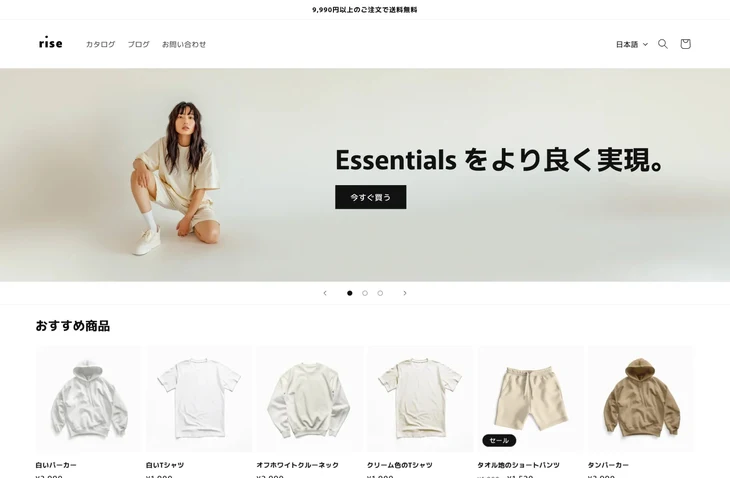
Rise commits to a detail-first, storytelling look. Information-rich sections, slideshows, and product pages are built to carry specifications, comparisons, and brand narrative, which suits merchants who sell on the strength of what a product is and does rather than on a single hero image. The layouts flex from a few products to a large catalog, and its customization settings let you shape the store without touching code.
The honest note is that the customization has edges. Several reviewers ran into locked-down mobile typography, with product titles and descriptions rendering larger than they wanted and no obvious setting to adjust them, and a couple reported display bugs such as blurry product images after an update or a sold-out label showing on in-stock items. None of these are universal, but they are real, so if mobile appearance and fine typographic control matter to you, build a test store on the free trial and check those specific pieces before you commit.
Rise Features That Matter
Rise bundles the tools a content-led store actually uses, wrapped in Shopify’s Online Store 2.0 system. The pieces that carry the most weight:
- Information-rich sections and slideshows for storytelling and product detail.
- Detailed product pages built to surface specs, comparisons, and brand story.
- Merchandising and product discovery tools, including filtering and search.
- Flexible layouts that scale from a small range to a large catalog.
- No-code customization settings to shape the design without editing code.
- Marketing and conversion features for promotions and campaigns.
- Updated customer accounts, moved to Shopify’s newer customer account experience.
- Built-in product reviews support to show social proof on product pages.
Test the mobile view before you commit
Because Rise is free with a trial, build a real version of your store on it and check the pieces reviewers flagged, mobile typography, product-image rendering, and how your longer descriptions look, before you switch. That risk-free trial is the strongest reason to judge Rise on your own store rather than on its rating.
How Much Does Rise Cost?
Rise is completely free. It is a first-party Shopify theme with a one-time, keep-forever license, so there is no upfront purchase and no monthly fee, and you get Shopify’s managed install and updates at no cost. For a theme that posts speed numbers this strong, free is a genuine advantage over the paid templates it sits beside.
| Theme | Price |
|---|---|
| Rise | Free |
Free, with nothing to pay for later
Rise carries no theme fee at all: install it, keep it, and update it through Shopify without paying. Your only store costs are your Shopify plan and any apps you add. Confirm the current listing on the Theme Store, but as a first-party free theme, there is no paid tier to buy into.
Rise Pros and Cons
Pros
- Completely free, with a one-time keep-forever license
- Built by Shopify, with one-click install, vetting, and managed updates
- Strong real-world Core Web Vitals, passing at a higher rate than most themes we track
- Flexible, detail-first layouts that scale from a few products to a large catalog
- Storytelling sections and product pages that suit content-led stores
Cons
- Low Theme Store rating so far, on a small sample of reviews
- Reviewers cite locked-down mobile typography they could not adjust
- A few reported display bugs, such as image rendering and sold-out labels
- Customization is more fixed than the newer block-based themes
- The detail-first look leans on strong product content to shine
Who Should Use Rise?
Choose Rise if you sell detail-rich products and want a fast, free storefront that tells a product story and scales from a small range to a large catalog. It suits merchants who lead with specifications, comparisons, and brand narrative and prefer a clean, content-led store. For another free Shopify-made option, our Craft review covers a storytelling theme built for makers, and our Sense review weighs a product-forward free pick for smaller catalogs. Our Pitch review covers another free Shopify-made theme, a bolder, image-led pick for beauty and jewelry stores.
Look elsewhere if you need deep control over mobile typography or a newer, block-based build. Our Vessel review covers Shopify’s newer free theme from the Horizon collection, with nested blocks for more flexible layouts, and a paid multipurpose theme like the one in our Ecomus review gives you more prebuilt design and demos to start from.
Try Rise free on the Shopify Theme Store
Is Rise Worth It?
Our verdict
For a store that sells detail-rich products and wants a fast, free storefront, Rise is easy to recommend trying: it is built by Shopify, its real-world speed is stronger than most themes we track, and it scales from a few products to a large catalog. The caution is its low rating and its more fixed customization, so test mobile typography and any display quirks during the free trial. Because it costs nothing, the smart move is to build on it and judge it against your own store rather than its star count.
Rise is a fast, no-cost theme with a clear audience and a few customization trade-offs. Weigh it against the rest of the lineup in our guide to Shopify theme reviews, and check the live numbers any time on our Rise usage statistics page.
-
Is the Rise Shopify theme free?
Yes. Rise is a first-party theme made by Shopify, and it carries a one-time, keep-forever license with no theme fee at all. You install it, own it, and update it through Shopify without paying. Your only store costs are your Shopify plan and any apps you choose to add.
-
Who makes the Rise theme?
Shopify builds and maintains Rise directly, which is why it installs in one click and updates through Shopify’s managed path. It is an Online Store 2.0 theme from Shopify’s own free lineup, several major versions in and still actively updated, so it is a mature, proven option rather than a brand-new release.
-
Is Rise a good theme despite its low rating?
The rating is low but sits on a small sample of reviews, mostly over customization limits and a few display bugs rather than performance. Our detection data is more reassuring: real Rise stores post strong Core Web Vitals and run lean app stacks. Because the theme is free and trials at no cost, the honest answer is to test it on your own store before judging it.
-
Is Rise fast on Core Web Vitals?
Yes. Real Rise storefronts perform well in the Chrome UX Report, with quick load times, responsive interaction, and effectively no layout shift, and they pass Core Web Vitals at a higher rate than most themes we track. That strong real-world speed is the clearest gap between the detection data and the theme’s buyer rating.
-
Can you change the font size on the Rise theme?
Rise gives you typography settings, but its control is more limited than the newer block-based themes, and several merchants have found mobile font sizes hard to adjust from the theme editor alone. Larger changes, especially on mobile, may need custom CSS. If fine typographic control matters to you, test the mobile view on the free trial before committing.
-
What kind of store is Rise suited to?
Rise fits detail-rich, content-led stores that sell on specifications, comparisons, and brand story, and it scales from a small range to a large catalog. Its stores tend to lead with product reviews and keep their app stacks lean. If you need deep control over mobile typography or a newer block-based build, a different theme may suit you better.