Simprosys Google Shopping Feed Review 2026
Last modified: September 22, 2026

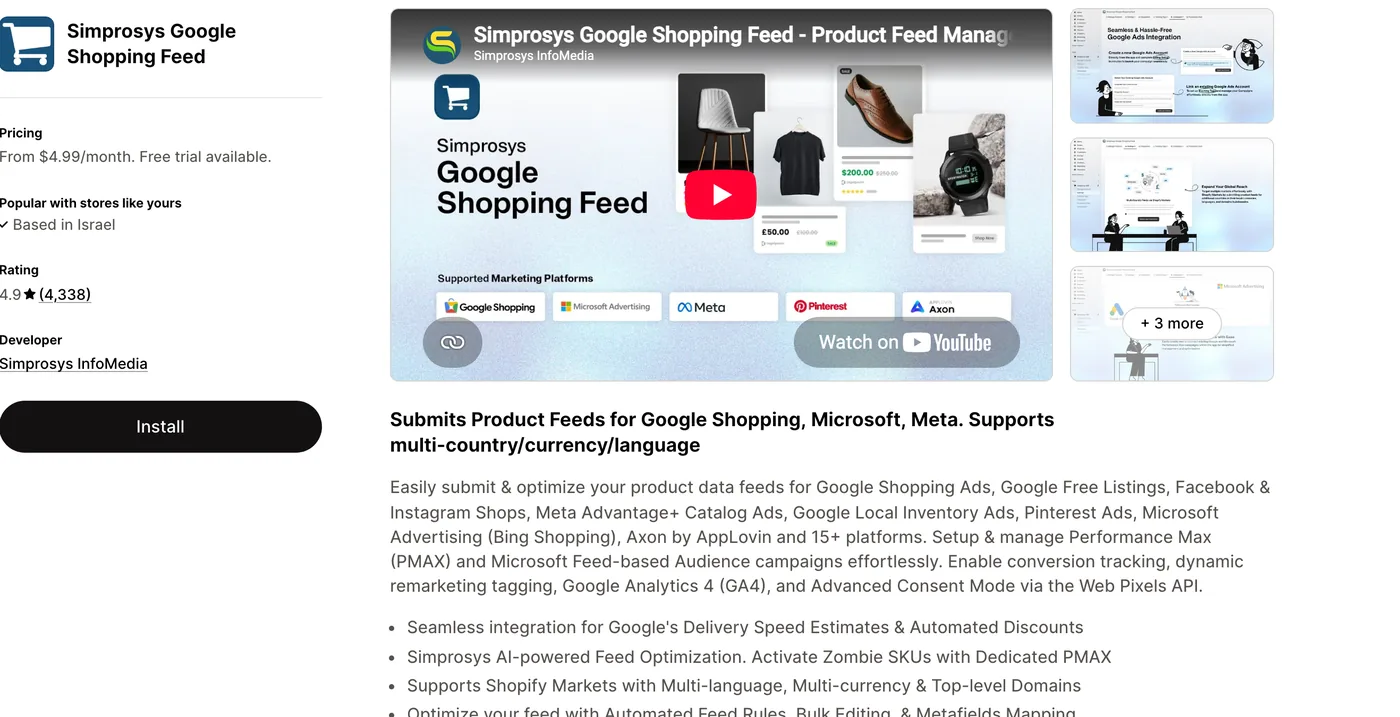
Simprosys Google Shopping Feed is a product feed app for Shopify that sends your catalog to the places you advertise it: Google Shopping, Google free listings, Meta and Instagram Shops, Microsoft, Pinterest, and more than a dozen other channels. Built by Simprosys InfoMedia, it also sets up conversion tracking and manages Google Performance Max campaigns, and in our detection data it is the most-used multichannel and marketplace app on Shopify by a wide margin. It carries a 4.9-star rating from well over four thousand merchants. The verdict upfront: if you run, or plan to run, product ads on Google and beyond, Simprosys is the standard tool for the job, cheap to start, broad in what it feeds, and highly rated for good reason. The honest catch is that it is plumbing, not magic. Shopify’s own Google & YouTube channel app covers the same basic feed job for free and is the default most merchants meet first; Simprosys steps in when the feed needs more control across markets, categories, and channels. It gets an accurate, optimized feed into your ad channels, but you still need a Google Merchant Center account, ad accounts, and a budget, and the results come from the ads themselves, not from the feed alone.
If you are selling through Google Shopping or multichannel product ads, Simprosys earns its place as the layer that keeps your feed clean and connected. If you do not advertise your products at all, a feed app has nothing to do yet. The sections below use live detection data to show how widely Simprosys is used, what it does, what it costs, and the kind of store it actually fits.
What is Simprosys Google Shopping Feed?
Simprosys is a product data feed manager. Shopify holds your products, but Google, Meta, Microsoft, and Pinterest each want that catalog in their own format with their own required fields, and Simprosys builds and submits those feeds for you, then keeps them in sync as your products change. Beyond the feed itself, it sets up conversion tracking, dynamic remarketing tags, Google Analytics 4, and consent handling, and it can create and manage Performance Max and Microsoft feed-based campaigns without leaving the app. In short, it is the connective layer between your store and the ad platforms where your products appear. Here is how widely Simprosys is detected across Shopify stores.
How popular is Simprosys on Shopify?
Simprosys is the most-used multichannel and marketplace app in our dataset, several times more common than the next feed app in the ranking, which makes it the default choice in its category rather than one option among many. The stores running it carry heavier app stacks than the typical store and tend to hold larger catalogs, the profile of a store that actively advertises its products and needs its feed handled properly. That standing is the story here: when a Shopify store puts its catalog on Google Shopping, this is the app it most often reaches for.
What does Simprosys do?
Simprosys covers the whole path from your catalog to your ad channels. Its core:
- Multichannel feeds. Submit and optimize product feeds for Google Shopping, Google free listings, Meta and Instagram Shops, Microsoft, Pinterest, Local Inventory Ads, and 15-plus platforms from one place.
- Feed optimization. Automated feed rules, bulk editing, and metafield mapping fix and enrich product data, with AI-assisted optimization to reduce disapprovals and improve quality.
- Campaign management. Set up and manage Google Performance Max and Microsoft feed-based audience campaigns without leaving the app.
- Tracking and consent. Conversion tracking, dynamic remarketing tags, Google Analytics 4, and consent mode via the Web Pixels API, so your measurement is set up correctly.
- Multi-country and currency. Support for Shopify Markets with multi-language, multi-currency, and top-level domains, for stores selling across regions.
The common thread is a correct, connected feed. Ad platforms reject products over small data problems, and Simprosys exists to keep the feed clean, compliant, and flowing to every channel you sell on, which is what turns a catalog into ads that actually run.
What Simprosys costs on Shopify
Simprosys is inexpensive for what it does. Pricing starts around a low monthly price with a free trial, and scales up with your product count and the features you use, so a small catalog pays very little and larger stores pay more as they grow. Remember this is the cost of the feed and management app only, not your advertising: you still need a Google Merchant Center account and an ad budget for the campaigns it feeds. Budget for the app and the ad spend together, not the app alone.
Is Simprosys worth it?
For a store that advertises its products, yes. Getting an accurate feed into Google and other channels by hand is tedious and error-prone, and a single wrong field can get products disapproved, so a tool that builds, optimizes, and syncs the feed pays for itself quickly at its low price. Its rating reflects that: merchants who run product ads tend to rate it highly.
Where it makes less sense is a store not running product ads at all. A feed app only earns its keep once there is a Merchant Center account and a campaign to feed, so a store that has not started advertising has nothing for it to do yet. The value is tied directly to whether you are selling through Google Shopping and similar channels.
Which themes run with Simprosys?
Because we detect both themes and apps, we can see the company Simprosys keeps. Its most common theme is Shopify’s free Dawn, followed by conversion-minded premium themes like Impulse and Prestige, the kind of themes you would expect from stores investing in paid traffic. Here are the themes most commonly running it.
| Rank | Theme | % of stores |
|---|---|---|
| 1 | Dawn | 10.8% |
| 2 | Prestige | 6.8% |
| 3 | Impulse | 6.7% |
| 4 | Impact | 5.4% |
| 5 | Shrine PRO | 3.3% |
| 6 | Horizon | 2.9% |
| 7 | Broadcast | 2.1% |
| 8 | Enterprise | 2.0% |
| 9 | Empire | 2.0% |
| 10 | Symmetry | 2.0% |
That spread, a free flagship theme alongside conversion-focused premium themes, fits the profile: Simprosys stores are advertisers, and they run on whatever base gets the sale. For the full breakdown of themes, paired apps, and store types, see the live Simprosys usage statistics.
What kinds of stores use Simprosys?
Simprosys stores skew toward advertising, catalog-driven brands. They run heavier app stacks than average and tend to hold larger product ranges, the profile of a store pushing traffic through Google Shopping and multichannel ads rather than relying on organic alone. These are operations for which the product feed is business-critical, because it is what puts their catalog in front of shoppers who are ready to buy.
That fit explains its reach. A store spending on product ads needs its feed accurate and connected across channels, and Simprosys is the app that does it cheaply and broadly. A store that does not advertise sits outside that profile, which is exactly what the note and the closing section get into.
It feeds your ads, it does not run them
Two things to keep in mind. First, prerequisites: Simprosys manages the feed and campaigns, but you still need a Google Merchant Center account, connected ad accounts, and a budget, and it will not generate sales on its own. Second, the learning curve: product feeds, Merchant Center rules, and Performance Max have their own complexity, so expect a setup period, and lean on the app’s support and automation to get feeds approved. Great for a store that advertises its products; not needed for one that does not.
Simprosys pros and cons
Pros
- Feeds your catalog to Google, Meta, Microsoft, Pinterest, and 15-plus channels from one app
- Feed optimization, automated rules, and bulk editing reduce product disapprovals
- Manages Performance Max campaigns and sets up conversion tracking
- Inexpensive, from a few dollars a month, and very highly rated
Cons
- You still need Google Merchant Center, ad accounts, and a budget to see results
- Product feeds and Merchant Center rules have a learning curve
- It feeds and manages ads but does not guarantee sales on its own
- Cost scales with catalog size as you grow
Simprosys mainly works in the background to manage your Google Shopping feed, so it should have little effect on your storefront speed, and the data agrees. Compared fairly against similar stores, the ones running Simprosys pass Google’s speed test (Core Web Vitals) slightly more often, about 66% versus 63% for comparable stores without it, among stores with enough traffic to appear in Google’s Chrome UX Report.
Does Simprosys slow a store down?
Compared only against stores on the same theme, running the same number of apps and carrying a similar catalogue, stores with Simprosys Google Shopping Feed installed pass Core Web Vitals 4.2 points higher of the time (2,477 comparable stores across 517 matched groups).
| Comparison | With Simprosys Google Shopping Feed | Without | Stores compared |
|---|---|---|---|
| Like-for-like stores | 65.8% | 61.7% | 2,563 with · 35,442 without |
| All stores, unmatched | 65.1% | 68% | 2,814 with · 56,128 without |
Who should use Simprosys?
Reach for Simprosys if you sell through Google Shopping or run multichannel product ads, or you are about to start. If you need your Shopify catalog on Google, Meta, Microsoft, and Pinterest with a feed that stays accurate and campaigns you can manage in one place, Simprosys is the standard tool, and its low price makes it easy to add. It fits naturally once product advertising is part of how you grow.
Skip it, for now, if you do not advertise your products. A feed app has nothing to do until there is a Merchant Center account and a campaign behind it, so a store relying purely on organic or social traffic can wait. Add it when you are ready to put your catalog in front of shoppers through paid channels.
Our verdict
Simprosys is our pick for stores running or starting product ads on Google and beyond. Start with the free trial, connect Merchant Center, and let it build and optimize your feed before you scale spend. It is cheap, broad, and highly rated, and it does the tedious feed work well, just remember it feeds your ads rather than replacing the budget and strategy behind them.
-
What is Simprosys Google Shopping Feed used for?
Simprosys is used to send your Shopify product catalog to advertising channels. It builds and submits product feeds for Google Shopping, Meta, Microsoft, Pinterest, and more than a dozen other platforms, keeps them in sync as products change, and sets up conversion tracking. Stores use it to get their catalog into Google Shopping and multichannel ads with a feed that stays accurate and approved.
-
How much does Simprosys cost?
Simprosys is inexpensive. Pricing starts at a low monthly price with a free trial, and scales up with your product count and the features you use, so a small catalog pays very little and larger stores pay more as they grow. Remember this is the cost of the feed app only. You still need a Google Merchant Center account and an ad budget for the campaigns it feeds.
-
Does Simprosys work with Google Merchant Center?
Yes. Simprosys connects to your Google Merchant Center account and pushes an optimized product feed to it, which is what powers Google Shopping ads and free listings. It also helps fix common feed issues that cause product disapprovals in Merchant Center. You set up the Merchant Center account first, then link it to the app.
-
What channels does Simprosys support?
A lot of them. Beyond Google Shopping and Google free listings, Simprosys feeds Meta and Instagram Shops, Meta Advantage+ catalog ads, Google Local Inventory Ads, Microsoft Advertising (Bing Shopping), Pinterest Ads, Axon by AppLovin, and 15-plus platforms in total. It can also set up and manage Google Performance Max and Microsoft feed-based campaigns from inside the app.
-
Do you need to run ads to use Simprosys?
Effectively yes, for it to be worth it. Simprosys manages the product feed and campaigns, but the feed only does something once it powers Google Shopping listings or ads on a connected channel. If you do not advertise your products or run free listings, a feed app has no job yet. Add it when you are ready to sell through Google Shopping or multichannel ads.
-
Which stores use Simprosys most?
Advertising, catalog-driven brands. In our data Simprosys is the most-used multichannel and marketplace app on Shopify, and the stores running it carry heavier app stacks and larger catalogs than average. Its most common theme is Shopify’s free Dawn, followed by conversion-minded premium themes like Impulse and Prestige.
Is Simprosys worth it for Shopify?
For a store that advertises its products, yes. The data shows why it is popular: Simprosys is the most-used multichannel and marketplace app on Shopify, chosen by advertising, catalog-driven brands, and it turns your Shopify catalog into clean, connected feeds for Google Shopping, Meta, Microsoft, and Pinterest, plus Performance Max management and conversion tracking. Its low starting price makes it easy to add, and the payoff is a feed that stays approved and in sync. The catch is that it feeds your ads rather than running them, so you still need Merchant Center and a budget behind it. If you are comparing options, our roundups of Shopify Google Shopping apps and Shopify shopping feed apps put it in context. Any time you want to know a store’s setup, you can scan it to see whether it runs Simprosys and what theme and apps it pairs with.