Trustpilot Shopify App Review 2026
Last modified: August 16, 2026
Trustpilot’s Shopify app is the official way to bring your Trustpilot reviews onto your store. Trustpilot is the well-known independent review platform where shoppers rate businesses, and this app connects that account to Shopify so you can collect reviews automatically after an order and show Trustpilot’s star ratings and Trustbox widgets across your storefront. The pull is recognition: a Trustpilot badge is a trust signal shoppers already know, and the reviews live on an independent site rather than only on your own store, which makes them harder to dismiss. The verdict upfront: for a brand that wants a credible, independent, company-level trust mark and already collects Trustpilot reviews, the app is a straightforward way to display them. The honest catches are cost and focus. Trustpilot’s paid plans are priced for businesses, not hobby stores, and it is built around company reviews and trust badges rather than the per-product star ratings that native Shopify review apps do so well.
If you value an outside-verified reputation and the Trustpilot name, its free tier is a low-risk way to start. If what you really want is photo and video reviews under each product at a low price, a native app will serve you better. The sections below cover what the app does, what it costs, how widely Trustpilot is used across Shopify, and the kind of store it actually fits.
What is Trustpilot?
Trustpilot is an open, independent review platform where consumers leave reviews about businesses, and each company builds up a public TrustScore and star rating. Because the reviews sit on Trustpilot rather than on the merchant’s own website, they carry a different kind of weight than on-site reviews: shoppers tend to trust a third-party rating they cannot edit. The Shopify app is how you bring that reputation onto your store. It links your Trustpilot account to Shopify, sends automated review invitations after orders, and lets you drop Trustpilot widgets onto your pages. Here is how widely Trustpilot reviews are detected across Shopify stores.
A note on the data: our detector has tracked Trustpilot on Shopify for years, since long before Trustpilot launched its own app. The Trustpilot integration is one of the more common reviews tools we see, which fits its status as a recognized name. It sits inside heavier-than-average app stacks too, the mark of established brands that already run a full marketing setup.
What does the Trustpilot app do?
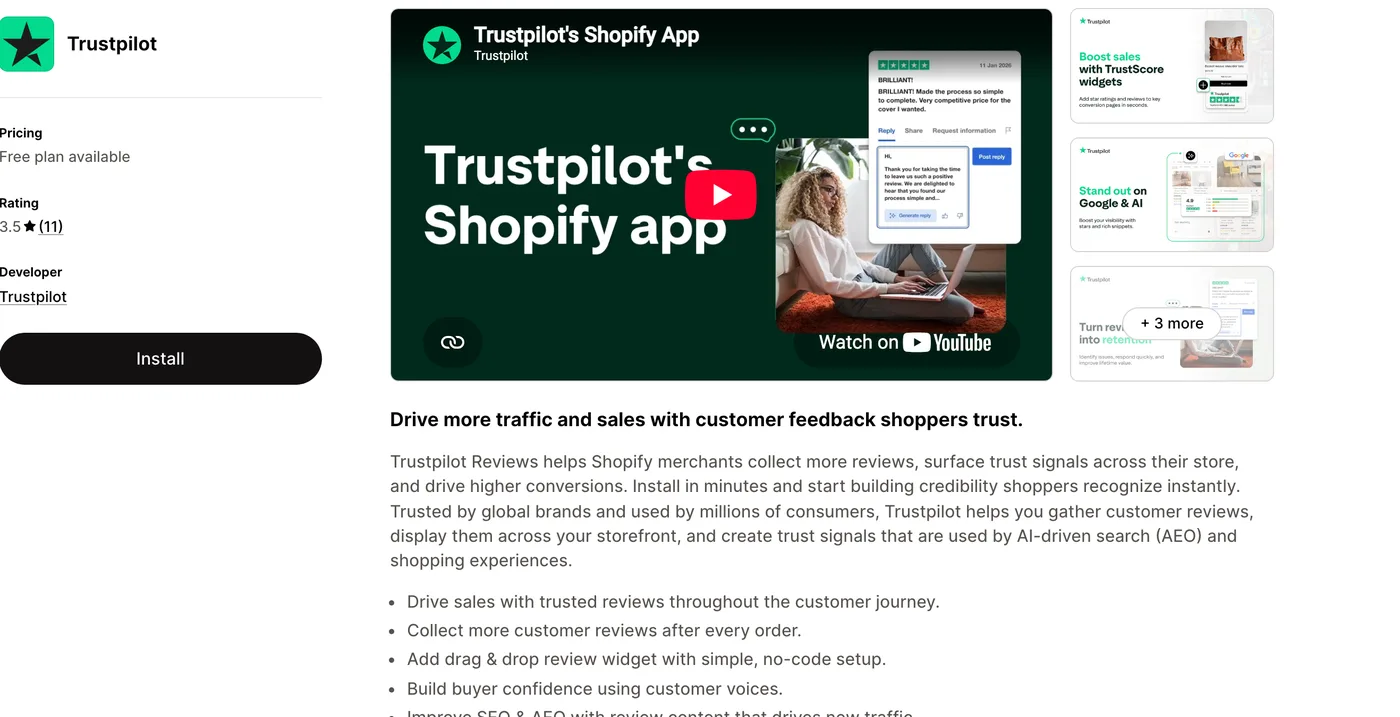
The app does two jobs. First, it collects reviews: after an order is fulfilled, it can automatically email the customer inviting them to review your business on Trustpilot, which steadily grows your public rating. Second, it displays them: a drag-and-drop, no-code widget builder lets you add Trustbox elements, star ratings, testimonials, carousels, grids, and review summaries, anywhere on your store, styled to your theme.
Around those two jobs sit the trust extras. It adds review-based rich snippets that can show star ratings in Google results and feed AI-driven search and shopping experiences, and it connects to other channels like Google, Facebook, Instagram, TikTok, Klaviyo, and Zendesk. The point of all of it is a single, recognizable trust signal that follows the shopper from search to storefront, rather than reviews that only live on one product page.
Trustpilot vs a native Shopify review app
This is the decision most stores actually face. Trustpilot is a company-level, independent trust platform: its reviews are about your business, hosted off your site, and backed by a name shoppers recognize. Native Shopify review apps like Judge.me, Loox, and Yotpo are product-level: they collect a star rating and often a photo or video for each product, shown right under that product, usually at a much lower price.
Neither is strictly better; they solve different problems. If you want a credible overall reputation and a trust badge for a considered purchase, Trustpilot fits. If you want rich, per-product social proof that lifts conversion on the product page, a native app fits, and it costs a fraction as much. Plenty of established brands run both: a native app for product reviews, Trustpilot for the company-level trust mark.
Trustpilot app pricing
Trustpilot’s Shopify app has a free plan, but the useful capacity sits in the paid tiers. The free plan covers a small volume of review invitations and a single widget, enough to test the idea. Paid plans are billed annually and are priced for businesses rather than small shops.
What Trustpilot costs
The Trustpilot app has a free plan with a limited number of review invitations a month and one widget. Its pricing is Free, or from $99/mo, billed annually, with a Starter tier and a higher Plus tier that add more invitations, widgets, users, and domains as you go up. It is priced as a business reputation tool, not a cheap add-on, so weigh it against how much an independent, recognized trust mark is worth to your brand.
Which themes and stores use Trustpilot?
Because we detect both themes and apps, we can see the company Trustpilot keeps. Its most common theme is Shopify’s free Dawn, followed by conversion-built and premium themes like Prestige and Impact. Here are the themes most commonly running a Trustpilot integration.
| Rank | Theme | % of stores |
|---|---|---|
| 1 | Dawn | 13.2% |
| 2 | Prestige | 6.0% |
| 3 | Impact | 5.6% |
| 4 | Horizon | 3.7% |
| 5 | Impulse | 3.4% |
| 6 | Concept | 2.5% |
| 7 | Broadcast | 2.4% |
| 8 | Symmetry | 2.3% |
| 9 | Enterprise | 1.7% |
| 10 | Focal | 1.6% |
On the app side, Trustpilot stores skew toward established brands with full marketing stacks: most also run a major email platform, and many pair it with product-review apps, subscriptions, and support tools. That profile fits the tool. Trustpilot is a reputation layer that established brands add on top of their existing reviews and marketing, not usually a first install for a brand-new store.
Mind the price and the newness
Two things to weigh. First, cost: beyond the free tier, Trustpilot is a four-figure-a-year commitment, so it only makes sense if an independent trust badge genuinely moves your buyers. Second, the app itself is new and carries a modest 3.5 rating from just a handful of reviews, so early users have reported rough edges. Trustpilot the platform is well established, but treat the Shopify app as young, and start on the free plan before you commit.
Is the Trustpilot app worth it?
For the right brand, yes. If you sell considered or higher-ticket products where an outside, verified reputation reassures a hesitant buyer, a recognized Trustpilot badge and company-level reviews can lift trust in a way on-site reviews cannot, and the app is the cleanest way to display them. Established brands that already collect Trustpilot reviews get the most from it.
Where it makes less sense is a small or price-sensitive store, or one whose main need is per-product social proof. The paid tiers are expensive, and a native review app will give you photo and video reviews under each product for far less. Treat Trustpilot as a reputation investment for a brand that has outgrown on-site reviews alone, not a default first pick.
Trustpilot pros and cons
Pros
- A recognizable, independent, third-party trust badge shoppers already know
- Company-level reviews hosted on Trustpilot, not just on your own store
- Free plan to start, plus drag-and-drop Trustbox widgets
- Rich snippets that can put star ratings in Google and AI search results
Cons
- Paid plans are expensive, running into four figures a year
- Trustpilot’s own Shopify app is new, with a modest 3.5 rating from few reviews
- Built for company trust, not per-product photo and video reviews
- Needs a separate Trustpilot account, and value depends on collecting reviews
Trustpilot loads a reviews widget, so speed is a reasonable thing to check. In practice it makes almost no difference: compared fairly against similar stores, the ones running Trustpilot pass Google’s speed test (Core Web Vitals) at about the same rate, roughly 66% versus 64% for comparable stores without it, within a point or two either way, among stores with enough traffic to appear in Google’s Chrome UX Report.
Does Trustpilot slow a store down?
Compared only against stores on the same theme, running the same number of apps and carrying a similar catalogue, stores with Trustpilot installed pass Core Web Vitals 3.9 points higher of the time (3,931 comparable stores across 727 matched groups).
| Comparison | With Trustpilot | Without | Stores compared |
|---|---|---|---|
| Like-for-like stores | 67.7% | 63.9% | 4,075 with · 37,514 without |
| All stores, unmatched | 67.2% | 67.9% | 4,748 with · 54,194 without |
Who should use Trustpilot?
Reach for Trustpilot if your brand benefits from an independent, recognizable trust mark, especially for considered purchases, and you want reviews hosted off your own site to carry more weight. For established brands with the budget, the company-level rating and the widgets that show it across search and storefront are a genuine trust asset, and the free plan lets you test it first.
Skip it, for now, if you are a smaller store, watching costs, or focused on product-page conversion. In those cases a native Shopify review app gives you richer per-product reviews at a fraction of the price. Trustpilot is the right tool once an outside reputation matters to your buyers and you can justify the spend.
Our verdict
Trustpilot is our pick for established brands that want an independent, recognizable trust mark and company-level reviews, not a budget product-review app. Start on the free plan, use the widgets to surface your rating where it counts, and step up to a paid tier only once the trust badge clearly earns its four-figure cost. For per-product social proof on a budget, use a native review app instead.
For the numbers behind this review, see the Trustpilot usage and adoption data from the live Shopify stores we track.
-
What is the Trustpilot Shopify app?
It is Trustpilot’s official app for Shopify. It connects your Trustpilot business account to your store, automatically invites customers to leave a review after an order, and lets you display Trustpilot star ratings and Trustbox widgets across your storefront. It brings your independent Trustpilot reputation onto your Shopify site.
-
Is the Trustpilot app free?
It has a free plan that covers a small number of review invitations a month and a single widget, which is enough to test it. Paid plans are billed annually and priced for businesses, with pricing of Free, or from $99/mo, across a Starter tier and a higher Plus tier for more invitations, widgets, and users.
-
Is Trustpilot better than Judge.me or Loox?
They do different jobs. Trustpilot is a company-level, independent trust platform whose reviews live off your site and carry a recognizable badge. Judge.me and Loox are product-level review apps that add photo and video reviews under each product at a much lower price. Many stores use a native app for product reviews and Trustpilot for the company trust mark.
-
Why does the Trustpilot app only have a 3.5 rating?
Trustpilot’s own Shopify app is relatively new and has only a small number of reviews so far, so the 3.5 rating reflects a handful of early users rather than the platform’s overall reputation. Some early reviewers reported setup and widget issues. Trustpilot the review platform is well established; the Shopify app is younger, so judge it on fit and test the free plan first.
-
Do Trustpilot reviews help SEO?
They can. The app adds review-based rich snippets that let star ratings show up in Google search results and feed AI-driven search and shopping experiences, which can improve click-through. The reviews themselves also add fresh, trust-building content. As always, the effect depends on genuine reviews and correct setup rather than the widget alone.
-
Do you need a Trustpilot account to use the app?
Yes. The Shopify app displays and collects reviews for your Trustpilot business profile, so you set up a Trustpilot account first and then connect it. The free plan lets you start collecting and showing reviews, and you upgrade only when you need more invitations, widgets, or users.
Is Trustpilot worth it for Shopify?
For an established brand that values an independent reputation, yes. Trustpilot’s official Shopify app is the clean way to collect Trustpilot reviews and show its recognizable trust badge and Trustbox widgets across your store, and the reviews carry extra weight because they live on a third-party platform. The catches are real: the paid plans run into four figures a year, and the app itself is new with a modest rating, so start on the free plan. And if your main need is per-product photo and video reviews on a budget, a native Shopify review app is the better fit. To weigh the alternatives, see our guide to the best Shopify apps. And any time you spot a store showing a Trustpilot rating, you can scan it to see how it is set up and what theme and apps it runs.