Yotpo Shopify App Review 2026
Last modified: August 12, 2026
Yotpo began as a product reviews app and grew into a wider marketing platform, but the piece most Shopify stores install is still the reviews app. It collects ratings, photos, and customer videos, shows them on product pages as social proof, and automatically emails customers to ask for a review, feeding star ratings into Google rich snippets along the way. The verdict upfront: the reviews app is genuinely strong and rates 4.8 out of 5, but Yotpo’s real edge is range, since it also connects loyalty, SMS, and subscriptions so a store can run several marketing channels from one account. The honest catch is that it is built for scale, the features people associate with Yotpo sit on paid tiers, and larger plans can mean a sales call and an annual commitment.
If you are an established or scaling brand that wants reviews, loyalty, and messaging under one roof, Yotpo is a serious option and its adoption is growing. If you are a smaller store that just needs reviews under your product titles, a lighter app will do the job for less. The sections below use live detection data to show how widely it is used, what it actually does, what it costs, and where it falls short.
What is Yotpo?
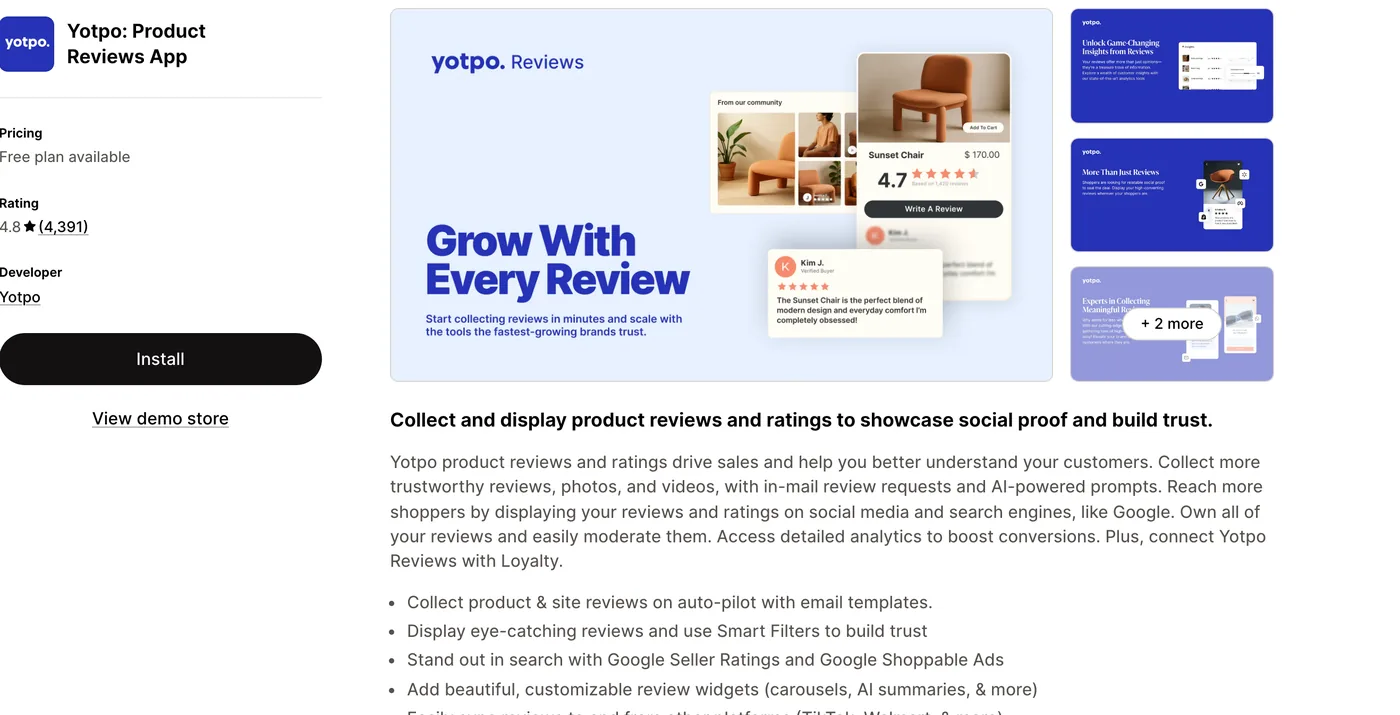
Yotpo is a reviews and marketing platform for Shopify. At its core it collects customer reviews, including ratings, photos, and videos, and displays them on product pages as social proof, with automated request emails doing the asking for you. Beyond reviews it offers loyalty programs, SMS marketing, and subscriptions, so a store can run several channels from one account rather than stitching separate apps together. Here is how widely it is installed across our dataset.
How popular is Yotpo?
Yotpo is one of the most-detected apps on Shopify and one of the leading reviews apps, and unlike some rivals its share is growing rather than slipping. It sits high in the reviews category and appears on a large number of stores, which is notable for a platform priced mainly for paid, scaled use. Momentum is on its side.
Yotpo has slipped from 10.8% to 8.0% of Shopify stores in our dataset over recent months.
Yotpo is a suite, not just a reviews app
The single most important thing to understand about Yotpo is that it is a suite, not one app. You can install and run only the reviews piece, and many stores do exactly that, but the platform is designed so reviews connect to loyalty programs, SMS campaigns, and subscriptions. Reviews feed the loyalty program, loyalty feeds repeat purchases, and messaging ties it together, all from one account.
That range is what sets Yotpo apart from an app that only handles reviews. For a brand running several marketing channels, keeping them in one platform means shared customer data and less app-to-app plumbing. It is also why Yotpo stores run the heaviest app stacks in our dataset and skew to larger, more established brands: these are stores operating a full retention program, not testing a single feature. The flip side is that if you only want reviews, most of that suite is capability you are not using.
Yotpo features
Yotpo’s reviews app is full-featured on its own, and the wider suite adds channels most reviews apps do not touch.
- Photo and video reviews: collect ratings, images, and customer videos, requested automatically after purchase.
- Search and social visibility: Google rich snippets, plus syndication to Google, TikTok, and Walmart.
- AI review tools: AI-written review summaries to surface the strongest feedback.
- Loyalty and referrals: points, rewards, and referral programs that turn reviewers into repeat buyers.
- SMS marketing: text campaigns and automations run from the same platform as reviews.
- Subscriptions: recurring-order tools for stores that sell replenishable products.
Run as a suite, these pieces reinforce each other. Run as a single reviews app, you get a strong reviews tool but leave most of the platform, and much of what you are paying for, on the table.
Does Yotpo help with SEO?
Yes. Like other strong reviews apps, Yotpo adds star-rating markup so your ratings can appear as Google rich snippets, the gold stars and review counts under some search results, which can lift click-through. It also syndicates reviews to Google, TikTok, and Walmart, so the social proof you collect reaches shoppers beyond your own store. For a brand that cares about search and marketplace visibility, that reach is a genuine part of the value.
How much does Yotpo cost?
Yotpo has a free plan that covers the basics, so a smaller store can start collecting and showing reviews at no cost. The catch is that the features people most associate with Yotpo, richer widgets, loyalty, SMS, and subscriptions, sit on paid tiers, and the cost climbs as you add products and channels.
That pricing is the honest sticking point, and it is different from a simple reviews app. Larger plans often mean a sales call and an annual commitment rather than a self-serve monthly fee, so you are pricing a platform, not a single app. Before you commit, work out the full cost of the pieces you will actually use, because the value of Yotpo comes from the suite, and so does the bill. If you only need reviews, that whole-suite pricing is the clearest reason to compare it against a lighter, cheaper option first.
Which themes and apps run with Yotpo?
Because we detect both themes and apps, we can see the company Yotpo keeps. On the theme side it is near-universal, showing up most on Shopify’s free Dawn theme and then across popular premium themes, which reflects how widespread it is rather than any special pairing. Here are the themes most commonly running it.
| Rank | Theme | % of stores |
|---|---|---|
| 1 | Dawn | 13.6% |
| 2 | Impulse | 5.5% |
| 3 | Prestige | 5.4% |
| 4 | Shrine PRO | 4.7% |
| 5 | Impact | 4.5% |
| 6 | Horizon | 2.8% |
| 7 | Broadcast | 2.4% |
| 8 | Symmetry | 1.8% |
| 9 | Focal | 1.7% |
| 10 | Palo Alto | 1.4% |
On the app side, Yotpo almost never runs alone. The vast majority of Yotpo stores also run a major email platform, and many run a second reviews app, subscriptions, analytics, and support tools alongside it, which is why Yotpo stores carry the heaviest app stacks we track. That company confirms the profile: Yotpo is chosen by scaled, marketing-heavy stores, not minimal ones. For the full breakdown of themes, paired apps, and store types, see the live Yotpo usage statistics.
What kinds of stores use Yotpo?
Yotpo’s user base skews large and established. Apparel and accessories leads, followed by health and beauty, food and drink, and home and garden, and some of the biggest direct-to-consumer names run on it. These are stores with sizable catalogs and a dozen or more apps in play, exactly the profile a full marketing suite is built for.
By business model, subscription stores are heavily represented, alongside multichannel sellers, which fits a platform built around loyalty and repeat purchasing. The pattern is clear: Yotpo is the choice of scaling and established brands running a real retention program, and less relevant to a brand-new or single-product store.
Where Yotpo falls short, and who should skip it
The honest downside is that Yotpo is more than most stores need, and priced accordingly. If reviews are all you want, you are buying into a suite and a pricing model built for something larger, and much of it will sit unused. Smaller shops can start on the free plan, but the features that make Yotpo worth choosing are the paid ones, and the move up can involve sales calls and annual commitments rather than a simple monthly toggle.
The other consideration is complexity. A full suite has more to configure and more to pay for, so it rewards a store with the scale and the team to actually run loyalty and SMS alongside reviews. For a lean store, that overhead is a cost of its own. None of this makes Yotpo a weak product, it is a strong one, but it is strong for scaled, multi-channel brands, and overkill for a store that just needs star ratings under its products.
Yotpo adds review and loyalty widgets, so speed is a fair question, but the difference turns out to be negligible. Compared fairly against similar stores, the ones running Yotpo pass Google’s speed test (Core Web Vitals) at about the same rate, roughly 64% versus 64% for comparable stores without it, within a point either way, among stores with enough traffic to appear in Google’s Chrome UX Report.
Does Yotpo slow a store down?
Compared only against stores on the same theme, running the same number of apps and carrying a similar catalogue, stores with Yotpo installed pass Core Web Vitals 1.9 points higher of the time (6,806 comparable stores across 796 matched groups).
| Comparison | With Yotpo | Without | Stores compared |
|---|---|---|---|
| Like-for-like stores | 64.4% | 62.6% | 7,052 with · 33,448 without |
| All stores, unmatched | 63% | 68.7% | 8,517 with · 50,425 without |
Who should use Yotpo?
Yotpo is the right pick if you are an established or scaling brand that wants reviews, loyalty, and messaging under one roof, you have a sizable catalog, and you will actually use more than the reviews piece. For that store, running the channels from one platform with shared customer data is a real advantage, and the strong reviews app anchors the whole thing.
Pass on Yotpo if you are a new or small store, you only need reviews, or you are not ready to pay for and operate a full marketing suite. In that case a lighter reviews app such as a free option gives you ratings, photos, and rich snippets for far less, and you can graduate to Yotpo later if you build out loyalty and messaging as real channels.
-
Is Yotpo free?
Yotpo has a free plan that covers basic reviews, so a smaller store can start at no cost. The features it is best known for, richer widgets, loyalty, SMS, and subscriptions, sit on paid tiers, and the cost climbs as you add products and channels. Larger plans can involve a sales call and an annual commitment, so price the whole suite before you commit.
-
Is Yotpo worth it?
For an established or scaling brand that will use more than reviews, yes. Running reviews, loyalty, and messaging from one platform with shared data is a real advantage, and the reviews app is strong at 4.8 out of 5. It is not worth it for a small store that only needs reviews, where a lighter, cheaper app does the core job without the suite pricing.
-
What is the difference between Yotpo and Judge.me?
Judge.me is a focused reviews app with a generous free plan, ideal for stores that just want ratings and photos affordably. Yotpo is a full marketing suite where reviews connect to loyalty, SMS, and subscriptions, built for larger, scaling brands. Choose Judge.me for simple, low-cost reviews, and Yotpo when you want reviews as part of a wider retention program.
-
What is Yotpo used for?
Most stores install Yotpo for product reviews, collecting ratings, photos, and videos and showing them as social proof with Google rich snippets. Beyond that, Yotpo runs loyalty programs, SMS marketing, and subscriptions from the same account. It is used both as a standalone reviews app and as an all-in-one retention platform, depending on how much of the suite a store turns on.
-
Does Yotpo help with SEO?
Yes. Yotpo adds star-rating markup so your ratings can appear as Google rich snippets in search results, which can lift click-through, and it syndicates reviews to Google, TikTok, and Walmart so your social proof reaches shoppers beyond your store. That search and marketplace visibility is a real part of its value for brands that care about discovery.
-
What size store is Yotpo best for?
Yotpo skews to large and established brands. Its stores run the heaviest app stacks we track and tend to have sizable catalogs and full marketing teams, which fits a platform built around reviews, loyalty, and messaging together. New and small stores can start on the free plan, but the suite and its pricing are built for scaling and enterprise brands rather than lean shops.
Is Yotpo worth it?
For a scaling brand, yes, and its growing adoption reflects that. Yotpo’s reviews app is genuinely strong at 4.8 out of 5, and its real advantage is running reviews, loyalty, SMS, and subscriptions from one account with shared data, which is why the heaviest, most established stores on Shopify choose it. The trade-offs are real: the valuable features sit on paid tiers, the cost scales with your catalog and channels, and larger plans can mean sales calls and annual commitments. Price the whole suite, use more than the reviews piece, and it earns its place; install it for reviews alone and a lighter app will serve you better for less. To see how it fits alongside everything else, browse our guide to the best Shopify apps. And any time you spot a large brand with a polished reviews and loyalty setup, you can scan it to see whether it runs Yotpo and which theme and apps it pairs with.