7 Shopify Marketing Apps 2026
Last modified: October 5, 2026
| # | Image | Name | Price / month | Rating | Adoption |
|---|---|---|---|---|---|
| 1 |
|
Judge.me
|
Free + from $15/mo | (48,699) | 33.4% |
| 2 |
|
Loox
|
Free + from $49.99/mo | (9,835) | 17.3% |
| 3 |
|
ReConvert (Upsell.com)
|
Free + from $9.99/mo | (3,108) | 3.3% |
| 4 |

|
Vitals
|
From $29.99/mo | (2,985) | 1.5% |
| 5 |
|
Omnisend
|
Free + from $16/mo | (3,188) | 5.7% |
| 6 |
|
Klaviyo
|
Free to install + from $15/mo | (3,370) | 33.3% |
| 7 |
|
Rebuy
|
Free + from $25/mo | (853) | 6.2% |
|
Show More
|
|||||
Data first, opinion second: we track usage across 3.5+ million Shopify stores daily, and have since 2017. The stats tell us what merchants actually use; our editors rank the final picks by quality, pricing, and fit.
Judge.me
Ideal for: Collecting reviews as low-cost social proof
Judge.me is the most popular reviews app on Shopify, and reviews are one of the cheapest forms of marketing there is. It collects photo and video reviews through automated post-purchase emails, then displays them on the product page and in a homepage carousel, so the persuasion comes from customers rather than your own copy. It syndicates to Google too, which puts star ratings in search and shopping results.
The draw is value: a generous feature set at a low price, backed by the highest review count in its category. For a store that wants social proof working across the site without a big bill, it is the default choice.
Setup is quick, and the review requests run on their own after each order, so the social proof builds without ongoing work once the flow is live.
Judge.me Highlights:
- Automated photo and video review requests
- Product-page and homepage displays
- Google review syndication for search stars
- Generous features at a low price
- The most-used reviews app on Shopify
Loox
Ideal for: Visual, photo-first review marketing
Loox leans into visual social proof, which is why image-led brands reach for it. It collects photo and video reviews with automated requests and incentives, then shows them in polished galleries and on-site widgets that look like part of the store rather than a bolt-on. It also adds referrals and upsells, so the reviews feed a bit more of the funnel.
It sits a notch above the budget reviews apps on price, and the payoff is presentation. For a fashion, beauty, or lifestyle brand where the photo sells the product, Loox turns customer images into marketing that converts.
The incentive prompts, a small discount for a photo review, tend to raise how many customers reply, which keeps the galleries full and the product pages persuasive over time.
Loox Highlights:
- Photo and video reviews with incentives
- Polished, on-brand galleries
- Referrals and upsells included
- Strong fit for visual, image-led brands
- High rating across many stores
ReConvert (Upsell.com)
Ideal for: Post-purchase upsells that lift order value
ReConvert, now listed as Upsell.com, is marketing aimed at the moment right after checkout. It rebuilds the thank-you page into a tool that runs one-click post-purchase upsells and cross-sells, so you lift order value from customers you already paid to acquire. It also adds surveys and review prompts, turning the confirmation page into a working channel.
For a store spending on ads, the post-purchase slot is some of the cheapest revenue available, since the traffic is already bought and the payment is done. See how many stores run ReConvert in our dataset.
Because the offer targets buyers you have already paid to acquire, the return on that slot is high, and the editable page lets you match the offer to the order rather than showing everyone the same thing.
ReConvert Highlights:
- One-click post-purchase upsells
- Editable thank-you page
- Surveys and review prompts
- A/B testing on offers
- Lifts order value from existing traffic
Vitals
Ideal for: Stores that want many marketing tools in one bill

Vitals bundles a large set of marketing and conversion tools into a single subscription: reviews, upsells, bundles, social proof, currency conversion, and more. Instead of stitching together and paying for several apps, a store runs one, which keeps both the bill and the app load down. That consolidation is the whole pitch, and it is a strong one for a growing store.
The trade-off is depth. A dedicated email or reviews platform goes further than a bundled version. For broad coverage at one price, though, few apps match it, and it holds a high App Store rating across a large review base. Based on live scan data across our dataset of 3,500,000+ Shopify stores, the live snapshot below shows its dataset share and rank, and the full Vitals store data page covers the store types and themes it runs on.
For a store early in its growth, running one app instead of several also means one place to learn and one support contact, which saves time as much as money.
Vitals Highlights:
- Marketing and conversion tools bundled together
- Reviews, upsells, social proof, and more
- One subscription instead of many apps
- Lighter on store load than several apps
- High rating across many stores
Omnisend
Ideal for: Combined email and SMS marketing
Omnisend is email and SMS marketing built for ecommerce, and a strong Klaviyo alternative for stores that want both channels in one place. It runs automated flows for welcome, abandoned cart, and post-purchase, plus campaigns and segmentation, with SMS and push sitting alongside email rather than bolted on. The templates and automation library make it quick to launch.
Pricing scales with your contact list, and the value shows once flows are running and recovering revenue on autopilot. For a store that wants approachable, all-in-one messaging, Omnisend is an easy fit.
The prebuilt flows mean a store can have welcome, cart, and post-purchase messages live in an afternoon, then refine the segments as the contact list grows.
Omnisend Highlights:
- Email, SMS, and push in one tool
- Prebuilt automation flows
- Segmentation and campaigns
- Quick to launch with templates
- A strong Klaviyo alternative
Klaviyo
Ideal for: Data-driven email and SMS at scale
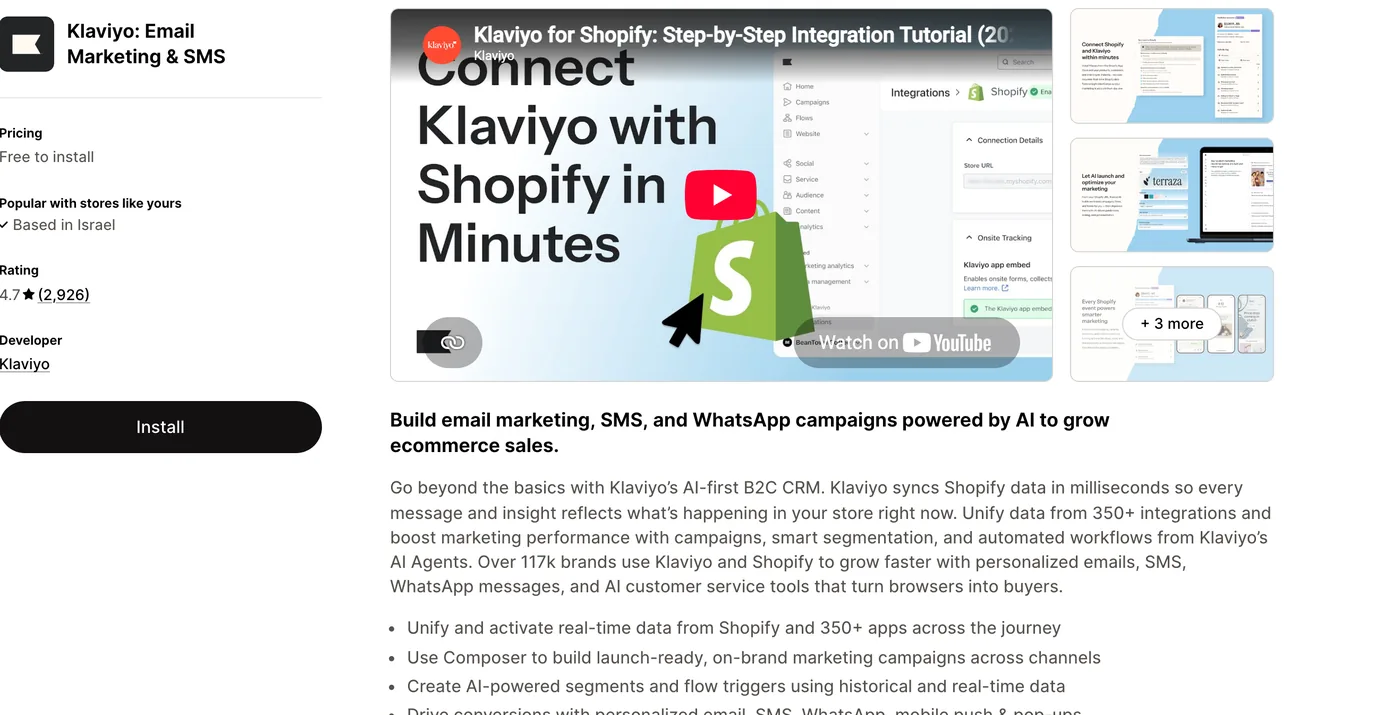
Klaviyo is the email and SMS platform most serious Shopify stores grow into. Its strength is data: it pulls deep store and customer information to segment lists and personalize messages far beyond a name merge, which is why its flows tend to recover more revenue than lighter tools. Abandoned cart, browse abandonment, win-back, and post-purchase flows all run on that data.
The trade-off is cost and complexity: it is a fuller platform than a beginner needs, and pricing climbs with list size. For a store that treats email as a core revenue channel and has the data to feed it, Klaviyo is the standard.
Its benchmarks and reporting also show how your flows compare with similar stores, which helps you spot which message to fix first rather than guessing.
Klaviyo Highlights:
- Deep segmentation from store data
- Personalized email and SMS flows
- Strong revenue-recovery automations
- The platform larger stores grow into
- Pricing scales with list size
Rebuy
Ideal for: Personalized recommendations across the store
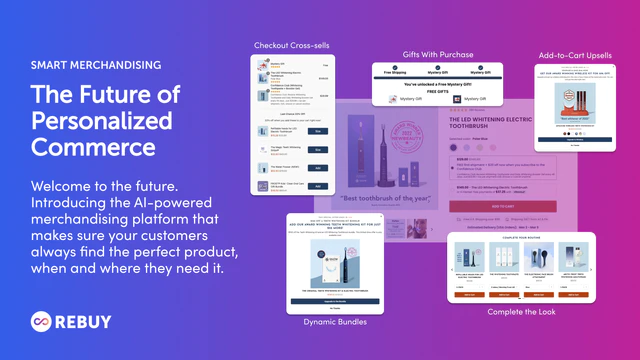
Rebuy is personalization marketing: an engine that uses store data to recommend the right products at the cart, the checkout, the thank-you page, and in search. Instead of a fixed offer, each shopper sees suggestions tuned to their behavior, which lifts order value across the journey rather than at one point. It plugs into the rest of your stack, so the recommendations show up wherever they help.
It is a fuller platform than a single-purpose app, so it suits stores with the traffic to feed the engine and the appetite to tune it. For data-led recommendations everywhere, few tools match it.
Because it reads live store data, the recommendations shift as buying patterns change, so the offers stay current without you rebuilding them by hand.
Rebuy Highlights:
- AI recommendations across the journey
- Personalized rather than fixed offers
- Cart, checkout, thank-you, and search
- Integrates with the rest of your stack
- Suited to higher-traffic stores
-
Do I need a large budget for marketing apps on Shopify?
The cost of marketing apps varies, and there are both free and premium options available. You can choose apps that fit your budget and provide the features you need.
-
Can I use Shopify marketing apps to track the success of my campaigns?
Yes, many marketing apps provide detailed analytics and reporting tools to track the success of your marketing campaigns, such as click-through rates, conversion rates, and ROI.
-
Can I switch or uninstall Shopify marketing apps easily if they don’t meet my expectations?
Yes, you can easily uninstall or switch marketing apps on Shopify. However, be cautious when switching as it may impact data and workflows and ensure a smooth transition by testing new apps.
-
What are the most important marketing apps for a Shopify store?
For most stores the priorities are email, reviews, and a conversion tool. Email, through a platform like Klaviyo or Omnisend, recovers carts and drives repeat sales automatically. A reviews app adds credible social proof on the product page. A post-purchase or personalization tool lifts order value. Start with those jobs before adding niche apps, since they cover the channels that move the most revenue.
-
Do I need separate apps for email, reviews, and upsells?
Not always. An all-in-one like Vitals bundles reviews, upsells, and social proof into one subscription, which is simpler and cheaper for a growing store. Dedicated apps go deeper: a specialist email or reviews platform does more than a bundled version. A common path is to start with an all-in-one, then swap in a dedicated tool for whichever channel becomes central to your marketing.
-
How many marketing apps should a Shopify store run?
Usually two or three, not a drawer full. Each app you add is another subscription and often more scripts loading on the page, which can slow the store and eat into the gains. Pick one app per job that matters, avoid overlap, and remove anything you are not actively using. A focused stack outperforms a large one that is half configured.
Building your marketing stack
Start with the channel that moves the most revenue for your store, usually email, and add from there. Reviews give you cheap, credible proof; a personalization or upsell tool lifts order value; an all-in-one keeps a lean store simple. Match each app to a job you will actually run, and avoid paying for overlapping tools. A focused stack of two or three beats a drawer full of half-used apps.