Warehouse Shopify Theme Review 2026
Last modified: October 1, 2026
Warehouse is a premium Shopify theme from Maestrooo, the studio behind Prestige and Impact, and it exists for one job: running a store with a large product catalog without the storefront falling apart. Where most themes are built around a hero image and a short product list, Warehouse is built around navigation. It leans on deep collection filtering, a full mega menu, predictive search, and dense product grids that stay usable at thousands of SKUs. If you sell auto parts, electronics, tools, hardware, or supply a wholesale channel, it is one of the few Theme Store options designed for your scale. If you sell a handful of image-led products, it is probably more theme than you need.
What separates this review from the marketing copy is the detection data underneath it. ShopThemeDetector tracks which themes real Shopify stores run, how large their catalogs are, and which apps they install. The picture for Warehouse is consistent: the stores using it carry far bigger catalogs than the typical Shopify store, and it ranks near the top of the themes chosen by wholesale and business-to-business sellers. A lot of themes claim to handle big catalogs. The usage data shows Warehouse actually attracts them.
What Is Warehouse, and Who Builds It?
Warehouse is a paid Shopify theme by Maestrooo, the French studio known for Prestige, Impact, and Focal. It targets high-volume catalog stores with tools for search, filtering, and navigation rather than large lifestyle imagery. That focus runs through every layout decision.
Maestrooo also builds Prestige, Impact, and Focal, but Warehouse is the one its usage data sets apart. In our dataset the stores running it carry much deeper catalogs and install more apps than the typical Shopify store, which tells you the studio tuned this theme for a different job than its image-led siblings. The theme ships in 3 preset styles, Warehouse, Wood, and Mesh, so you can start from a look that fits a tech store, a hardware store, or a broad marketplace and adjust from there. It also includes built-in translations for major European languages, which helps if you sell across the EU.
What Apps Do Warehouse Merchants Install?
The apps a store adds tell you what kind of business runs the theme. Here is the real install pattern across Warehouse stores in our dataset.
| Rank | App | % of stores | Category |
|---|---|---|---|
| 1 | Klaviyo | 37.9% | Email Marketing |
| 2 | Judge.me Product Reviews App | 34.8% | Product reviews |
| 3 | Loox ‑ Product Reviews App | 22.7% | Product reviews |
| 4 | Recharge | 19.7% | Subscriptions |
| 5 | Helium Customer Fields | 17.2% | Accounts and login |
| 6 | PageFly ✦ AI Page Builder | 13.1% | Page builder |
| 7 | Yotpo | 12.5% | Product reviews |
| 8 | Swym Wishlist | 12.4% | Wishlists |
| 9 | Trustpilot | 10.9% | Marketing - Other |
| 10 | Shopify Inbox | 9.7% | Support - Other |
The stack reads like an established catalog operation, not an experiment. Klaviyo shows email marketing is treated as a core channel. Judge.me and Loox add review and photo social proof, which matters when a shopper is comparing dozens of similar parts or products. Recharge points to repeat and subscription orders, and Helium Customer Fields is a tell for wholesale and trade accounts, since it handles custom registration and approval flows that B2B sellers need. PageFly appears for merchants building richer landing pages on top of the theme. Taken together, these are proven tools that mature stores rely on.
How Popular Is Warehouse on Shopify?
Most Shopify stores default to a free theme, so any paid theme that reaches this level of adoption has earned it. Here is where Warehouse sits across the stores we track.
Two things stand out beyond the raw ranking. First, the average catalog size on Warehouse stores runs well above the typical Shopify store, which fits a theme designed for depth rather than a short product list. Second, these stores install more apps than average, a sign of established businesses that have layered on tooling as they scaled. This is not a starter theme that people try and abandon.
How Does Warehouse Compare to Other Themes?
Adoption is one thing; where a theme leads is another. These are the standout data points for Warehouse against the wider market.
The wholesale and business-to-business result is the clearest signal of who Warehouse is really for. Among stores serving trade buyers, it is one of the most-chosen themes, which lines up with its filtering, account, and catalog strengths. The heavier-than-average app load reflects the same audience: stores with real operational needs, not hobby shops.
Warehouse Design and Layout
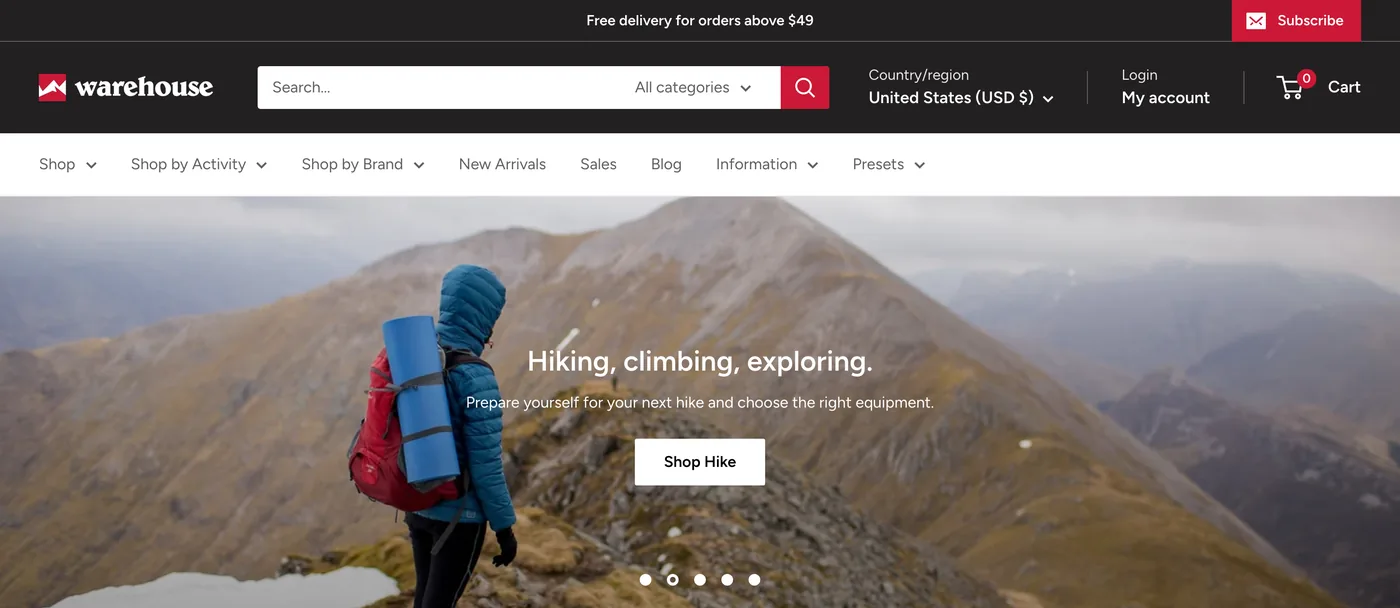
Warehouse puts merchandising first. The homepage is built to route shoppers into categories quickly, and the mega menu can hold a deep structure without feeling cramped. Product filtering is the centerpiece: shoppers can narrow by attribute, use swatch filters for color and material, and sort long result sets, while quick buy and quick view keep them moving without constant page reloads. Cross-sell and recommended-product blocks help lift order value across a wide range.
The tradeoff is visual. Warehouse is deliberately restrained on hero imagery and full-bleed lifestyle photography. That keeps large catalogs fast and legible, but it is the wrong fit for a brand whose selling point is mood and storytelling.
Not for image-led brands
If your store lives on big lifestyle photography, full-width video heroes, and a single flagship product, Warehouse will feel plain. Look at Prestige or Impact instead, which are built to show a brand off rather than move shoppers through a deep catalog.
Warehouse Features Built for Large Catalogs
The feature set is aimed squarely at stores with many products and many categories. The pieces that matter most day to day:
- Advanced product filtering and sorting, including swatch filters for color and material, so shoppers can cut a large collection down to a handful of options.
- Predictive search that surfaces products, collections, and pages as the shopper types, which is essential once a catalog passes a few hundred items.
- A deep mega menu for organizing large category trees without burying pages.
- Quick buy and quick view to add to cart or preview a product without leaving the collection page.
- Cross-selling and recommended products to raise average order value across a wide range.
- A stock counter, in-store pickup, gift wrapping, and a slide-out cart for practical merchandising and fulfillment.
- Product video and image zoom for close inspection, plus built-in EU language translations for cross-border selling.
How Much Does Warehouse Cost?
| Theme | Price |
|---|---|
| Warehouse | $320 |
Warehouse is a one-time purchase of $320, not a monthly subscription. You pay once and keep the theme, with free updates from the developer, so there is no recurring fee eating into margin as your catalog grows. It sits in the premium tier of paid Shopify Theme Store themes. Theme Store pricing can change, so check the listing through the button at the end of this review for the current figure before you buy.
Try it before you buy
You can install Warehouse on an unpublished theme slot and preview it against your own products for free. You only pay when you publish it as your live theme, so test filtering and search on a real slice of your catalog first.
Warehouse Pros and Cons
Pros
- Purpose-built for large catalogs: filtering, swatches, mega menu, predictive search
- Quick buy and quick view keep deep collections fast to shop
- Proven at scale in our data: its stores run deeper catalogs and heavier app stacks than average
- Strongest adoption among wholesale and B2B sellers in our data
- One-time price, no monthly fee
Cons
- Restrained on hero imagery, so weaker for image-led storytelling brands
- More theme than a small catalog or single-product store needs
- A premium cost a small store will not need
- Fewer preset styles than some multipurpose themes
Who Should Use Warehouse?
Choose Warehouse if you run a genuinely large or complex catalog: auto parts, electronics, tools and hardware, industrial supply, or a wholesale operation serving trade buyers. Those are exactly the stores our data shows gravitating to it, and its filtering and account features earn their keep at that scale. For another large-catalog option, sold off the Theme Store by Out of the Sandbox, see our Turbo review. For a store specifically in hardware, tools, or industrial parts, the Athens theme is purpose-built for that niche and worth comparing.
If you want the same large-catalog strengths in a newer, faster, more design-forward theme from the same studio, look at Stretch.
For a theme that leans harder into B2B ordering, with a quick order list and bulk pricing built in, our Hyper review covers a wholesale-first alternative. For a design-led fashion theme with the same large-catalog filtering, our Aurora review covers a premium option.
Look elsewhere if imagery is your selling point. For a luxury or fashion brand that leads with photography, Prestige or Impact from the same studio are the stronger picks. If your catalog is modest and you want a lighter, flexible layout, Focal covers most stores with a lighter, more flexible layout.
Is Warehouse Worth It?
Our verdict
For a store with a deep catalog, Warehouse is one of the safest paid themes on Shopify. The detection data shows it attracts exactly the merchants it was designed for, wholesale and high-volume sellers, and its filtering and search hold up where lighter themes struggle. Skip it only if your brand sells on imagery rather than range.
If your catalog is the hard part of your store, Warehouse is built for your problem in a way few themes are. Weigh it against the rest of the lineup in our complete guide to Shopify theme reviews, and check the live numbers any time on our Warehouse usage statistics page.
-
Who makes the Warehouse Shopify theme?
Warehouse is built by Maestrooo, a French theme studio that also makes Prestige, Impact, and Focal. What sets Warehouse apart is who runs it: in our dataset its stores carry much deeper catalogs than the typical Shopify store, so Maestrooo clearly built it for high-volume sellers rather than image-led brands.
-
Is Warehouse a good theme for a large product catalog?
Yes. It is designed around catalog navigation, with advanced filtering, swatch filters, a deep mega menu, and predictive search that stay usable at thousands of products. Our detection data shows the stores that run Warehouse carry much larger catalogs than the typical Shopify store, which confirms it is built for scale.
-
How much does the Warehouse theme cost?
Warehouse is a one-time purchase of $320 rather than a monthly subscription, so you pay once and keep it with free updates. It sits in the premium tier of paid Shopify Theme Store themes. Because Theme Store prices can change, check the current figure on the listing before buying.
-
What is the difference between Warehouse and Prestige?
Both are Maestrooo themes, but they solve different problems. Warehouse is a merchandising theme for deep catalogs, built around filtering, search, and navigation. Prestige is a brand-builder for image-led and luxury stores that lead with photography and storytelling.
-
Is Warehouse good for wholesale or B2B stores?
It is one of the strongest choices for them. Warehouse ranks among the top themes used by wholesale and business-to-business stores in our dataset. Its filtering, account handling, and catalog depth suit trade buyers, and merchants often pair it with custom-registration and subscription apps that B2B operations rely on.
-
Can I try Warehouse before buying it?
Yes. You can add Warehouse to an unpublished theme slot and preview it against your own products for free. You only pay when you publish it as your live theme, so test search and filtering on a real slice of your catalog first.