Ritual Shopify Theme Review 2026
Last modified: October 1, 2026

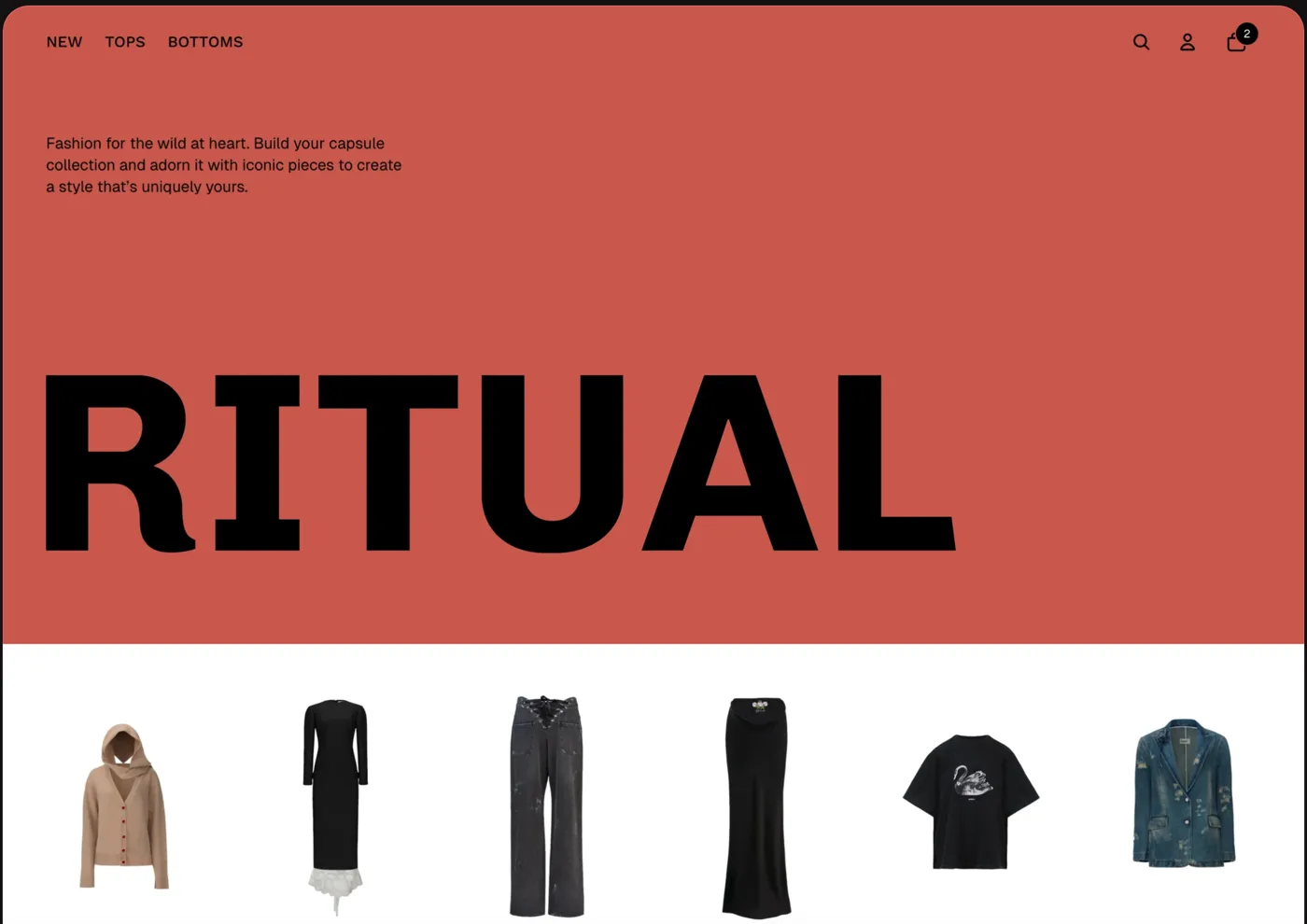
Ritual is a free Shopify theme from the newer Horizon collection, built for fashion brands that want a bold, magazine-style storefront without paying for one. It leans on oversized type, full-bleed imagery, and sharp contrast, the kind of look that reads more like a designer boutique than a starter theme. The verdict upfront: for a free theme, Ritual gives a fashion brand a genuinely high-end frame, and it comes with Shopify’s block system for layout control. The catch is a low Theme Store rating, real-world speed that is fair rather than fast, and a design that only works if your photography can carry it.
If you sell apparel, streetwear, or accessories and you want an editorial, luxury-leaning storefront for nothing, Ritual is one of the stronger free options. If you need a proven, high-speed theme or a design that flatters weak photos, it will feel demanding. The sections below use live detection data from real Ritual stores to show where it fits.
What is the Ritual Shopify theme?
Ritual is a free Online Store 2.0 theme published by Shopify as part of its Horizon collection. Updates arrive through the theme library, with no third-party dependency. It is pitched at fashion and lifestyle brands that want a premium, editorial character, from apparel to accessories and other visual sellers. The default style is bold and magazine-like, with oversized headlines and strong color blocking out of the box.
Because it is a first-party theme, Ritual edits through Shopify’s drag-and-drop customizer with no code required. It also uses Shopify’s nested block system, which lets you rearrange the pieces inside each section, so two Ritual stores can look genuinely different. Here is where Ritual sits across our dataset of live Shopify stores today.
Its overall share is still small, which is normal for a young free theme that has not had long to spread. The direction matters more than the size, and we look at that next.
How popular is Ritual, and is it growing?
Ritual is new, so its total footprint is modest. The useful question is whether adoption is climbing, holding, or slipping. The trend below tracks the share of stores we scan each month that run Ritual.
Ritual has climbed from 0.2% to 0.3% of Shopify stores in our dataset over recent months.
The line has been climbing rather than sitting flat, which is exactly the pattern you want from a recently released theme picking up adopters. One number about how these stores behave stands out.
Ritual stores run a very lean app stack, far below the dataset average. Part of that is the theme, which builds filtering, galleries, and layout control into itself, and part is the audience, since young fashion brands on a free theme tend to keep things simple. Either way, a light app list is one of the biggest levers on real-world speed, which we come to below.
Ritual design and layout
Ritual’s look is its whole reason to exist. It leads with oversized type, full-bleed imagery, and high-contrast color blocking, a bold editorial style that feels more like a fashion magazine than a default store. That flatters brands with a clear visual identity and strong photography, especially in apparel and streetwear, where the image is the product.
The block system is where a free theme like Ritual earns its keep. Shopify’s nested blocks let you move and restyle the pieces inside each section without code, so you can shape the layout around your brand rather than fit into a fixed template. The trade-off is that the style is opinionated. Ritual is loud by design, so it rewards confident art direction and can overwhelm a store with thin or inconsistent imagery.
Ritual features
For a free theme, Ritual is well equipped, with the standard Online Store 2.0 toolkit plus the merchandising a visual brand needs. The built-in tools are part of why its stores run so few extra apps.
- Layout control: Shopify’s nested block system, so you can rearrange each section without touching code.
- Storytelling: video and image banners, zoomable product shots, and modular sections for editorial pages.
- Product presentation: color swatches, flexible image handling, and gallery-first product layouts.
- Standard Online Store 2.0 sections and settings, so tutorials written for Shopify’s free themes apply directly.
- First-party updates through the Shopify theme library, with no separate license or fee.
The gaps tend to be about polish rather than missing tools. Because it is a young theme, some merchants report that updates can overwrite customizations and that new versions occasionally introduce mobile bugs. Neither breaks a store, but both are worth knowing before you build heavily on top of it.
How fast is the Ritual theme?
Ritual’s speed needs a careful read, and the live data shows it. We measure it on real-world Core Web Vitals from live Ritual stores, using Google’s Chrome UX Report field data rather than a lab score. The cards below show the full field, then the same theme filtered to stores running only a few apps.
| Theme | CWV pass rate | Few apps | Median LCP |
|---|---|---|---|
| Impulse | 78.4% | 85.7% | 1.6s |
| Dawn | 71.1% | 79.6% | 1.6s |
| Ritual | 59% | 59.3% | 1.5s |
The pass rate sits below the middle of the pack, and interactivity is the weakest of the three metrics, though load and layout stability both land in Google’s good range. Filtering to lean stores barely moves the number, which suggests the drag is more about the bold, image-heavy design than the apps merchants add. The practical takeaway is to respect the visuals. Compress your images, keep the homepage focused, and avoid heavy autoplay video above the fold, and Ritual will hold up well enough for most fashion stores.
Which apps do Ritual stores use?
The apps a theme’s stores install show what those merchants are trying to do. On Ritual, the stack is lean and points to young brands building trust and reach.
| Rank | App | % of stores | Category |
|---|---|---|---|
| 1 | Judge.me Product Reviews App | 24.0% | Product reviews |
| 2 | Klaviyo | 12.0% | Email Marketing |
| 3 | Loox ‑ Product Reviews App | 6.0% | Product reviews |
| 4 | Shopify Inbox | 5.5% | Support - Other |
| 5 | Instafeed ‑ Instagram Feed | 5.1% | Marketing - Other |
| 6 | Swym Wishlist | 4.1% | Wishlists |
| 7 | Omnisend Email Marketing & SMS | 3.9% | Email Marketing |
| 8 | Recharge | 3.4% | Subscriptions |
| 9 | GemPages Landing Page Builder | 3.4% | Page builder |
| 10 | Gsc Countdown Timer | 3.4% | Countdown timer |
Product reviews sit at the top, as they do for most new brands that need social proof. Email marketing follows close behind, to bring shoppers back. A countdown timer and a wishlist app add light urgency and saving. An Instagram feed app fits the theme’s visual, editorial character. It is a trust-and-reach stack on a light footprint, the kind you would expect from fashion brands using a free theme to look bigger than their app budget.
What kinds of stores use Ritual?
Ritual skews heavily toward fashion. In our classification, apparel and accessories is by far the largest group, with t-shirt and streetwear brands a notable slice, followed by clothing and then health and beauty. That tracks with a theme built for bold, image-led selling.
By business model, subscription, print on demand, and dropshipping brands appear in roughly equal measure, which fits a free theme popular with newer, lean-catalog sellers rather than large established retailers. For the full store-type and category breakdown, including how the mix shifts over time, see the live Ritual usage statistics.
How much does the Ritual theme cost?
Ritual is free. It is made by Shopify and installed straight from the Theme Store as part of the Horizon collection, with no license fee and no separate cost for updates. There is no paid tier for the theme itself. Your real costs are the apps you add and the Shopify plan you run your store on, not the theme.
Why is the Ritual Theme Store rating low?
Ritual holds a low rating on the Shopify Theme Store, which can look surprising next to how sharp the design is. The number measures something different from what our detection data measures, so it is worth reading with context.
Free Shopify themes as a group rate low, and the wider Horizon collection Ritual belongs to sits well under half positive. Two things drive it. First, free themes are the default choice for brand-new owners, so many one-star reviews are really frustration with Shopify, apps, or the learning curve rather than the theme code. Second, some reviews name real issues with Horizon-era themes, mainly updates overwriting customizations and occasional mobile bugs after new versions, which matter a lot to the owners who hit them.
Read the rating as a fair warning about polish and update stability, not as proof the theme is broken. On the metrics we can measure directly, adoption trend and real-world speed, Ritual performs reasonably for a young free theme.
Ritual vs other free and premium themes
If Ritual is close but not right, three themes are worth weighing:
- Tinker is another free Horizon theme, but with a calmer, maker-focused editorial look rather than Ritual’s bold fashion styling. Read the Tinker review.
- Dawn is Shopify’s free default, plainer and more neutral, a safer starting point if Ritual’s loud style does not fit your brand. Read the Dawn review.
- Prestige is the paid step up for brands that want the editorial, luxury look done with more polish and a proven track record. Read the Prestige review.
Who should use Ritual?
Reach for Ritual if you are a fashion or streetwear brand with strong photography and you want a bold, editorial storefront for free. It suits apparel, accessories, and other visual sellers that lead with imagery and want to look premium on a small budget. If you are comfortable working with Shopify’s block system and keeping your app list lean, Ritual gives you a lot of design for nothing.
Pass on Ritual if you need a proven, high-speed theme, run a very large catalog, or do not yet have the photography the design assumes. New stores still finding their visual identity may do better on a plainer free theme first. Before you commit, install the free theme and load it with your own products and images. That is the fastest way to see whether the bold look works for your brand.
-
Who makes the Ritual Shopify theme?
Ritual is made by Shopify and is part of its newer Horizon collection of first-party themes. It is free, installed straight from the Shopify Theme Store, with updates delivered through the theme library and no third-party dependency. Because it is a Shopify theme, it edits through the drag-and-drop customizer with no code needed for most changes.
-
Is the Ritual Shopify theme free?
Yes. Ritual is free to install from the Shopify Theme Store, with lifetime updates and no license fee. There is no paid tier for the theme itself. Your real costs are the apps you add and the Shopify plan you run your store on, not the theme.
-
Why does the Ritual theme have a low rating?
Free Shopify themes rate low as a group, and the wider Horizon collection sits well under half positive. Many one-star reviews are really frustration with Shopify or the learning curve rather than the theme code. Some do name real issues, mainly updates overwriting customizations and occasional mobile bugs. On adoption trend and real-world speed, the metrics we measure directly, Ritual performs reasonably for a young free theme.
-
Is the Ritual Shopify theme fast?
Its real-world speed is fair. Across live Ritual stores in Google’s Chrome UX Report, a below-average share pass Core Web Vitals, with interactivity the weakest of the three metrics, though load and layout stability land in Google’s good range. The bold, image-heavy design is the main drag, so compressing images and keeping the homepage focused matters most.
-
What kinds of stores use the Ritual theme?
Ritual skews heavily to fashion. Apparel and accessories is by far the largest group, with a clear slice of t-shirt and streetwear brands, followed by clothing and health and beauty. By business model, subscription, print on demand, and dropshipping brands appear in roughly equal measure, which fits a free theme popular with newer, lean-catalog sellers.
-
Is Ritual good for a clothing or streetwear store?
Yes, that is its core fit. Ritual’s bold, magazine-style design is built for apparel, streetwear, and accessories brands that lead with strong imagery. It rewards confident photography and a clear visual identity. If your product shots can carry a loud, editorial layout, Ritual gives a clothing brand a premium look for free.
Is Ritual worth installing?
For the right brand, yes. Ritual gives a fashion label a bold, editorial storefront for free, hands you real layout control through Shopify’s block system, and pairs a lean app stack with climbing adoption. The low Theme Store rating is a fair caution about polish and update stability, not a sign of a bad theme, and our live data shows a young theme performing reasonably on the metrics we can measure. If your photography can carry a loud, magazine-style design, Ritual is one of the more striking free options. If it cannot, a plainer theme will serve you better. For the wider picture across Shopify’s free and paid themes, see our Shopify theme reviews guide.