Wokiee Shopify Theme Review 2026
Last modified: September 17, 2026
Wokiee is a premium multipurpose Shopify theme from p-themes, sold on ThemeForest as a one-time purchase rather than a subscription. It is one of the most established paid themes in the Shopify space, built for large, feature-heavy stores that want everything in one package: a deep megamenu, dozens of prebuilt homepage layouts, product pages with swatches and quick view, and merchandising tools like wishlist, compare, and a sticky add-to-cart bar. The framework was rebuilt from the ground up in its version 3 release and is still updated regularly. This review looks past the demo and at the real stores running Wokiee, who they are, the apps they run, and how their storefronts actually perform.
Our detection data shows Wokiee is a theme for serious catalogs. The stores running it carry far more products than the typical Shopify store and lean on a reviews-heavy app stack, the fingerprint of established, sales-focused merchants. Its buyer rating on ThemeForest is high across a large body of reviews, but real-world speed is the piece to weigh: the developer’s own demo passes Core Web Vitals cleanly, while field data from big, app-loaded stores sits lower, so how fast Wokiee feels depends heavily on how much you switch on.
What Is Wokiee?
Wokiee is a paid multipurpose theme built by p-themes and sold on ThemeForest, licensed as a one-time purchase rather than a monthly subscription. It is aimed at merchants who want a single theme that covers almost any store type, with prebuilt demos for fashion, electronics, furniture, auto parts, jewelry, and more. Its calling card is breadth: a deep megamenu, a large set of homepage layouts, multiple product-page templates, and a library of content blocks you assemble without code.
It is also a mature, well-supported product. Wokiee has been on the market for years, it rebuilt its framework in the version 3 release, and it ships regular updates, so you are buying an actively maintained theme rather than an abandoned one. The trade-off is that it lives off the Shopify Theme Store, so there is no one-click Theme Store install or Shopify listing review; you buy the theme file on ThemeForest, upload it, and update it through your ThemeForest account.
What Apps Do Wokiee Merchants Install?
The apps a store runs tell you what kind of business it is. Here is the real install pattern across the Wokiee stores in our dataset.
| Rank | App | % of stores | Category |
|---|---|---|---|
| 1 | Judge.me Product Reviews App | 43.3% | Product reviews |
| 2 | Klaviyo | 19.6% | Email Marketing |
| 3 | Recharge | 15.9% | Subscriptions |
| 4 | Loox ‑ Product Reviews App | 12.6% | Product reviews |
| 5 | PageFly ✦ AI Page Builder | 8.9% | Page builder |
| 6 | Shopify Inbox | 7.8% | Support - Other |
| 7 | Omnisend Email Marketing & SMS | 7.0% | Email Marketing |
| 8 | Instafeed ‑ Instagram Feed | 5.9% | Marketing - Other |
| 9 | Paypal | 5.9% | Checkout - Other |
| 10 | Trustpilot | 5.2% | Marketing - Other |
This is a reviews-led, sales-focused stack. A product review app sits well out in front, with more review and trust tools further down, a sign that Wokiee merchants lean hard on social proof to sell across big catalogs. Around them sit email marketing platforms, a subscription tool, and a page builder, the toolkit of established stores running promotions and repeat-purchase programs rather than a single-product shop. It fits a theme built for range and volume.
How Popular Is Wokiee?
Wokiee is a specialist premium theme rather than a mass-market default, and its adoption reflects that. Here is where it sits across the stores we track.
The number worth watching is catalog size. Wokiee stores carry far more products than the typical store in our dataset, which is the clearest signal of who it is for: larger, more complex ranges that need deep navigation and filtering. Its app count sits around the dataset norm rather than below it, which fits a feature-rich store doing a lot at once rather than a minimalist build.
How Fast Is Wokiee?
Speed is measured from the Chrome UX Report on real stores, not a single lab run, and Wokiee’s data splits into views that tell a nuanced story.
| Theme | CWV pass rate | Few apps | Median LCP |
|---|---|---|---|
| Impulse | 78.3% | 85.5% | 1.6s |
| Dawn | 71.2% | 79.8% | 1.6s |
| wokiee | 52.8% | 56.8% | 2s |
On the developer’s own demo, Wokiee passes Core Web Vitals with a quick largest-contentful-paint and no layout shift, proof the base theme can be fast. Across all real Wokiee stores the pass rate drops, and on lightly-loaded stores it lands in between. That gap is the tell: Wokiee is a heavy, feature-rich theme usually installed on large catalogs with plenty of apps, and that combination, not the base code, is what pulls the field numbers down. Enable only the sections you need and keep your app stack disciplined, and the demo shows what is achievable.
Wokiee Design and Layout
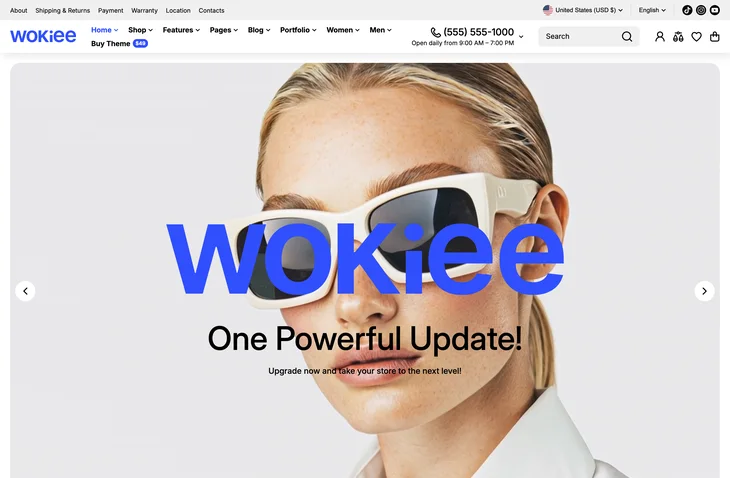
Wokiee’s design is built around a rich, dense storefront. The megamenu is the centerpiece, with room for banners, featured collections, and product grids inside the dropdowns, and it is paired with a large set of homepage layouts and multiple product-page templates so you can match a fashion store, an electronics catalog, or a furniture shop. Merchandising is where it earns its keep: color, size, and material swatches with variant-specific images, quick view, wishlist, compare, a sticky add-to-cart bar, and touches like a before-and-after slider and a lookbook.
The honest note is that all that breadth carries a learning curve. The settings are extensive, and a first build can feel overwhelming if you start from a blank slate, so the sensible path is to import the demo closest to your niche and adjust from there. It also means restraint matters: turning on every block and animation on a large catalog is the fastest way to undo the speed the base theme is capable of. Wokiee rewards merchants who will invest the setup time and prune what they do not use.
Wokiee Features That Matter
Wokiee bundles the tools a large, conversion-focused store actually uses. The pieces that carry the most weight:
- A deep megamenu with banners, collections, and product grids inside the dropdowns.
- Dozens of prebuilt homepage layouts and multiple product-page templates for different niches.
- Variant merchandising with color, size, and material swatches that swap the product image.
- Conversion tools including quick view, sticky add-to-cart, live counters, countdown, and preorder.
- Wishlist and compare built in, reducing the need for separate apps.
- Extra content blocks such as a before-and-after slider, lookbook, and a large icon set.
Start from a demo, then prune
Do not build Wokiee from a blank slate. Import the demo closest to your niche so the megamenu, layouts, and product pages are already wired, then switch off the blocks and animations you do not need. On a large catalog, that pruning is what keeps the storefront as quick as the developer’s demo.
How Much Does Wokiee Cost?
Wokiee is a one-time purchase on ThemeForest, not a subscription, so you pay once and own the license. That price includes future theme updates and a period of author support, and there is no recurring theme fee on top of your Shopify plan and any apps you add.
| Theme | Price |
|---|---|
| Wokiee | $49 |
One-time license, no recurring theme fee
Wokiee’s regular ThemeForest license is a single payment that includes item updates and six months of author support, which you can extend. An extended license only applies if you sell the end product to a client. For a store you run yourself, the regular license is what you need, with no monthly theme charge.
Wokiee Pros and Cons
Pros
- One-time price with no recurring theme fee, and free updates
- Extensive feature set: deep megamenu, many layouts, and a large library of blocks
- High buyer rating on ThemeForest across a large number of reviews
- Strong merchandising, with variant swatches, quick view, wishlist, and compare built in
- The developer’s demo passes Core Web Vitals, so the base theme can be fast
Cons
- Real-store field speed is middling on large, app-heavy catalogs
- A heavy, maximal theme with a steeper learning curve
- Enabling every block can slow a big catalog if you do not manage it
- Author support is time-limited under the standard license
- Off the Shopify Theme Store, so no one-click install or Shopify listing review
Who Should Use Wokiee?
Choose Wokiee if you run a large or growing catalog and want one theme that does almost everything out of the box, from a deep megamenu to swatches, wishlist, and compare, at a one-time price. It rewards merchants who will import a demo and tailor it rather than expecting a finished store on day one. For another premium multipurpose theme in the same tier, our Xtra review covers a close alternative, and our Ecomus review weighs a modern ThemeForest theme with a large demo library, and our Avone review covers the category’s top seller.
Look elsewhere if you want to start lean and simple. A first-party free theme trades Wokiee’s breadth for a lighter, faster foundation, and our Rise review covers a fast, free Shopify-made option for stores that do not need a maximal feature set.
Is Wokiee Worth It?
Our verdict
For a large, feature-hungry store, Wokiee is a strong one-time buy: an established, highly-rated theme with a deep feature set and a demo that proves the base code can be fast. The caveats are real. It is a heavy theme with a learning curve, and on a big, app-loaded catalog you will need to be deliberate about what you switch on to keep it quick. If you want breadth and control at a one-time price, and you will invest the setup time, Wokiee earns its place.
Wokiee is a maximal, one-time-purchase theme for stores that need range and are willing to tune it. See how it compares against the rest of the field in our guide to Shopify theme reviews.
-
Is the Wokiee Shopify theme free or paid?
Wokiee is a paid theme, sold on ThemeForest as a one-time purchase rather than a monthly subscription. The regular license includes future theme updates and a period of author support, and there is no recurring theme fee beyond your Shopify plan and any apps you add.
-
Who makes the Wokiee theme?
Wokiee is built by p-themes and sold on ThemeForest, where it is one of the most established premium Shopify themes. It has been maintained for years and rebuilt its framework in the version 3 release, so it is an actively updated product rather than an abandoned one.
-
Is Wokiee good for large catalogs?
Yes. Our detection data shows Wokiee stores carry far more products than the typical Shopify store, and the theme is built for that scale with a deep megamenu, filtering, and dozens of prebuilt layouts. It is a stronger fit for large or growing ranges than for a single-product shop.
-
Is the Wokiee theme fast?
It depends on how you build it. The developer’s own demo passes Google’s Core Web Vitals with a quick largest-contentful-paint, but real-store field data is middling because Wokiee is usually run on big, app-heavy catalogs. Import a demo, enable only the sections you need, and keep your app stack disciplined to stay close to the demo’s speed.
-
Do I install Wokiee from the Shopify Theme Store?
No. Wokiee is sold on ThemeForest, not the Shopify Theme Store, so there is no one-click Theme Store install. You buy the theme file on ThemeForest, upload it to your store’s theme library, and receive updates through your ThemeForest account.
-
Can Wokiee replace some of the apps I pay for?
Partly. Wokiee bundles features that often need apps, including wishlist, compare, quick view, countdown, and variant swatches, which can trim your app list. Even so, our data shows Wokiee stores still run a healthy app stack, so treat the built-in tools as a starting point rather than a full replacement.