Blockshop Shopify Theme Review 2026
Last modified: September 14, 2026
Blockshop is a premium Shopify theme built for brands that sell with images. Its whole design language is the block: big, tidy grids, full-width hero banners and confident typography that let photography carry the store. That makes it a natural fit for fashion, beauty, lifestyle and design brands, and our detection data shows it running on a small but steady set of live Shopify stores that hold a 96% positive rating from merchants.
The short version: Blockshop looks expensive and is well liked, and it is a paid, one-time purchase aimed at brands that already have strong product photography. It is fast enough for a visual theme, as long as you keep your images in check. This review leans on data from the stores actually running Blockshop, not the Theme Store sales page.
What Is Blockshop?
Blockshop is a paid theme sold on the Shopify Theme Store and built by Troop Themes. It uses flexible sections and blocks, so you can rearrange pages in the theme editor without touching code, and it ships in four presets so you can start from a look close to your brand rather than a blank page.
The design leans editorial. Where a conversion theme piles on widgets, Blockshop gives images room and keeps the interface quiet, which is why it reads as a high-end pick next to premium themes like Prestige.
The tools it leans on are the ones a visual brand actually uses:
- Block and grid layouts with full-width hero banners
- Refined typography controls and glide product image animations
- Marketing pop-ups, video sections and newsletter opt-in forms
- Journal and blog layouts for content-led brands
- Currency converter and multi-column drop-down menus
What Apps Do Blockshop Merchants Install?
The apps a theme’s stores run show who really uses it. Blockshop’s list is an image-led brand’s toolkit, not a discount-driven one.
| Rank | App | % of stores | Category |
|---|---|---|---|
| 1 | Klaviyo | 44% | Email Marketing |
| 2 | Judge.me Product Reviews App | 34.5% | Product reviews |
| 3 | Recharge | 13% | Subscriptions |
| 4 | Loox ‑ Product Reviews App | 13% | Product reviews |
| 5 | Instafeed ‑ Instagram Feed | 12% | Marketing - Other |
| 6 | Yotpo | 11.5% | Product reviews |
| 7 | Swym Wishlist | 10.5% | Wishlists |
| 8 | Omnisend Email Marketing & SMS | 9.5% | Email Marketing |
| 9 | Rebuy Personalization Engine | 8% | Checkout - Other |
| 10 | Triplewhale | 8% | Analytics |
Klaviyo leads for email, backed by reviews through Judge.me and Loox, subscriptions via Recharge, and an Instagram feed through Instafeed. That last one is the tell: Blockshop stores treat social imagery as part of the storefront, which matches a theme built around photography.
How Popular Is Blockshop?
Blockshop runs on 0.2% of the Shopify stores in our detection dataset. That is a focused share rather than a mass-market one, which fits a premium theme chosen by brands that care about how their store looks.
The stores that pick it run a moderate number of apps, which fits a brand that wants a strong base and adds a few specialists on top. You can see the live figures on the Blockshop usage statistics page.
How Fast Is Blockshop?
Speed is the question every image-heavy theme has to answer. Across real Blockshop stores, 68.2% pass Google’s Core Web Vitals, and the rate rises on stores running only a few apps, with quick largest-contentful-paint and no measurable layout shift.
| Theme | CWV pass rate | Few apps | Median LCP |
|---|---|---|---|
| Impulse | 78.3% | 87% | 1.6s |
| Dawn | 70.6% | 79.7% | 1.6s |
| Blockshop | 68.2% | 76.7% | 1.6s |
The honest read is that Blockshop is fast for a photo-first theme, but the speed is partly yours to protect. Big hero images and heavy galleries are the whole point of the design, so compress your images and keep extra apps lean to hold those numbers as your catalog grows.
Blockshop Design and Layout
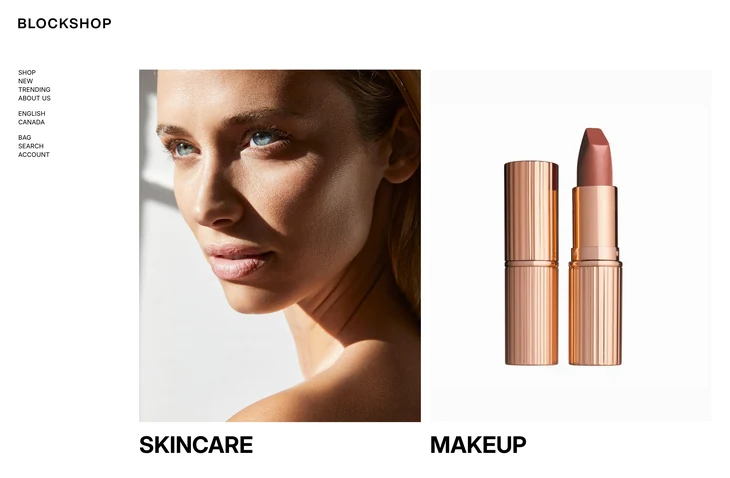
Blockshop’s look is calm and gallery-like. Products sit in clean blocks with plenty of whitespace, navigation stays out of the way, and the typography does a lot of the branding work. On a store with strong photography it looks like a design studio built it.
The flip side is that the design leans on your content. With weak or inconsistent images, all that whitespace turns into empty space, and the editorial feel falls flat. If you want a similarly clean, image-forward look to compare against, Palo Alto sits in the same territory.
Blockshop Features That Matter
Most of Blockshop’s value is in how it presents a brand rather than a pile of conversion widgets. The features that earn their place:
- Block and grid layouts: the core of the theme, for arranging collections and lookbook-style stories.
- Full-width hero banners and video: give campaigns and new drops real presence above the fold.
- Typography and image animation controls: fine-tune the editorial feel without custom code.
- Journal and blog layouts: useful for content-led and brand-building stores.
- Marketing pop-ups and newsletter forms: capture signups without a separate app for the basics.
The caveat is that Blockshop is not a conversion-widget theme. If you want built-in countdowns, upsells and urgency tools, a theme like Motion or a dedicated conversion build will suit you better.
How Much Does Blockshop Cost?
Blockshop is a paid Theme Store theme priced at $420 as a one-time purchase, with lifetime theme updates and support from Troop Themes. Like every Theme Store theme, you can install and build with it for free and only pay once when you publish it to a live store.
How to judge the price
Blockshop sits at the upper end of the one-time Theme Store range. For an established brand with strong photography, paying once for a high-end look can be cheaper than a custom design or a stack of apps. For a small or new store without polished images, a free theme will get you further for now.
Blockshop Pros and Cons
Pros
- Editorial, image-first design that looks high-end out of the box
- Four distinct presets, so you start close to your brand
- Very high merchant rating and lifetime updates from Troop Themes
- Solid real-store speed for a photo-heavy theme
- One-time price with free trialing and Shopify’s theme vetting
Cons
- Leans hard on strong photography, and looks empty without it
- Light on built-in conversion widgets like upsells and countdowns
- One of the pricier one-time Theme Store themes
- Big images mean you have to manage speed as you grow
Who Should Use Blockshop?
Blockshop fits established, design-led brands in fashion, beauty, lifestyle and home, where the product photography is already strong and the store needs to feel like a brand, not a bargain bin. If images are your main selling tool, its layout puts them front and centre.
It is less suited to plain catalog stores, heavy-discount shops or new stores without polished imagery. If that is you, a free theme will do the job, and if you want conversion tools built in, look at a more feature-driven theme instead.
Is Blockshop Worth It?
Our verdict
A strong choice for image-led brands that want an editorial, high-end look and already have the photography to fill it. Less compelling for plain catalogs or stores that need built-in conversion widgets.
Blockshop earns its price for the brands it is built for. The data supports it: merchants rate it highly, its stores are the image-forward, brand-building crowd, and its real-store speed holds up well for a photo-first theme. Buy it when your photography and brand justify the look, and keep your images optimized so it stays fast.
Want to see how it stacks up against the rest? Our Shopify theme reviews guide lines up every theme we have tested, from free Theme Store options to premium builds like this one.
-
Is Blockshop a good Shopify theme?
Blockshop is a strong choice for brands that sell with images, and merchants rate it very highly. Its editorial, block-based layout makes product photography the focus, which suits fashion, beauty and lifestyle stores. It is built by Troop Themes and comes with lifetime updates. It is less suited to plain catalog stores or shops without polished imagery.
-
Who makes the Blockshop Shopify theme?
Blockshop is made by Troop Themes, and it is sold on the Shopify Theme Store, so it goes through Shopify’s own theme review. It comes with lifetime theme updates and support from the developer. That backing, plus a long track record, is part of why its merchant rating stays high.
-
How much does the Blockshop theme cost?
Blockshop is a paid Shopify Theme Store theme sold as a one-time purchase at the upper end of the price range, with lifetime updates. Like every Theme Store theme, you can install and build with it for free and only pay once when you publish it to a live store. Weigh the cost against how strong your brand photography already is.
-
Is Blockshop good for fashion and image-heavy brands?
Yes. Blockshop is built for image-led brands, with block and grid layouts, full-width hero banners and refined typography that put photography first. The apps its stores run, including an Instagram feed, confirm a fashion, beauty and lifestyle audience. Just keep your images optimized so the visual design stays fast.
-
Is the Blockshop theme fast?
It is fast for a photo-heavy theme. A solid share of real Blockshop stores pass Google’s Core Web Vitals, and the rate is higher on stores running only a few apps. Because the design leans on big images, the speed is partly yours to protect: compress images and keep extra apps lean to hold those numbers.
-
What presets does the Blockshop theme have?
Blockshop ships in four presets: Blockshop, Radiance, Stone and Valla. Each has its own colours, typography and demo content, so you can start from a look close to your brand instead of a blank page. You can switch or customize presets in the theme editor after you install it.