Umino Shopify Theme Review
Last modified: September 15, 2026
Umino is a multipurpose Shopify theme sold on ThemeForest and built by Next_Sky, made for merchants who want one theme to cover several store types without paying a developer to build a look from scratch. It runs on Online Store 2.0, ships with more than twenty ready-made homepage styles, and includes native right-to-left support that most Shopify Theme Store options leave out. Across the stores actually running it, Umino holds a 4.91/5 rating from buyers, and our storefront detection finds it on a small but international slice of live Shopify stores.
The short version: Umino is a flexible, one-time purchase for general retail and fashion stores, and it reaches markets other themes ignore. It also sits outside Shopify’s own vetting and update flow, so the trade you make for that flexibility is worth understanding before you buy. This review uses live data from the stores running Umino, not the sales copy on ThemeForest.
What Is Umino?
Umino is a paid Shopify theme sold on ThemeForest and made by Next_Sky, not one of Shopify’s own theme partners. It is an Online Store 2.0 theme, so sections and blocks are editable across every page, and it ships with more than twenty homepage presets covering fashion, electronics, beauty, furniture and general retail, so you can start close to your niche instead of on a blank canvas.
What sets it apart from most Theme Store themes is reach. Umino carries native right-to-left layouts and support for a long list of languages, which is why it turns up in Arabic, Hebrew and other international markets where Shopify’s own theme catalog thins out. The features that stand out are the ones a self-sufficient store leans on:
- More than twenty prebuilt homepage styles across several store types
- Native right-to-left support plus multi-language and Shopify Markets compatibility
- Mega menu, predictive search and collection filtering with colour and size swatches
- Quick view, sticky add-to-cart and a cart drawer to shorten the path to checkout
- Product video, image galleries and a before-and-after slider for richer product pages
- Countdown timers, stock counters and other urgency blocks built in rather than bolted on with apps
What Apps Do Umino Merchants Install?
The apps a theme’s stores run tell you who really uses it. Umino’s list is short, which fits a theme that ships with a lot of its own features.
| Rank | App | % of stores | Category |
|---|---|---|---|
| 1 | Judge.me Product Reviews App | 94% | Product reviews |
| 2 | Loox ‑ Product Reviews App | 18.7% | Product reviews |
| 3 | Klaviyo | 9% | Email Marketing |
| 4 | Recharge | 9% | Subscriptions |
| 5 | Instafeed ‑ Instagram Feed | 7.2% | Marketing - Other |
| 6 | Omnisend Email Marketing & SMS | 6% | Email Marketing |
| 7 | PageFly ✦ AI Page Builder | 5.4% | Page builder |
| 8 | Whatmore Shoppable Videos | 4.8% | Video and livestream |
| 9 | Whatsapp Button | 4.8% | |
| 10 | Shopify Inbox | 4.2% | Support - Other |
Product reviews dominate, with Judge.me on nearly every store and Loox behind it, and retention tools like Klaviyo, Recharge and Omnisend appear far less often than they would on an established-brand theme. The pattern points to newer and international stores that lean on Umino’s built-in urgency and merchandising blocks instead of stacking paid apps on top.
How Popular Is Umino?
Umino runs on 0.1% of the Shopify stores in our detection dataset. That is a niche share rather than a mass-market one, which fits a ThemeForest theme sold outside Shopify’s storefront, and the stores that pick it tend to run fewer apps than average.
Where Umino stands out is reach rather than raw numbers: much of its footprint sits in international markets, including right-to-left stores that most Theme Store themes never touch. You can see the full picture, updated as our data refreshes, on the Umino usage statistics page.
How Fast Is Umino?
Across real Umino stores, 43.6% pass Google’s Core Web Vitals, and the rate climbs on stores running only a few apps. That puts it in the mid-pack for themes we track: quick enough on a lean store, with more room to improve than the fastest Theme Store options.
Across 67 real Umino stores, 43.6% pass Google’s Core Web Vitals (median LCP 2.3s). Filtered to stores running only a few apps, that rises to 48.5%, isolating the theme’s own speed from the apps merchants pile on.
The gap between the developer’s own demo, which passes comfortably, and the field average is the part to watch. It shows the theme’s code is capable of a fast store, but real Umino merchants often lose ground once they add products and heavier homepage sections. Keep the homepage lean and the speed holds up.
Umino Design and Layout
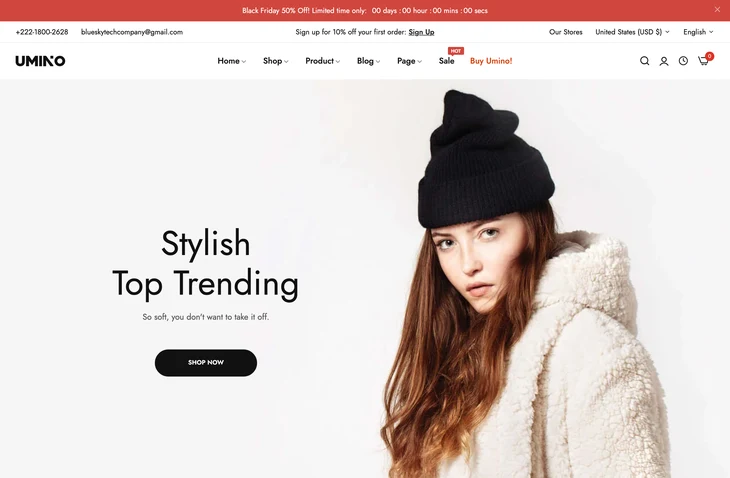
Umino’s design leans modern and image-forward, with large hero banners, generous spacing and product grids built to show off strong photography. The prebuilt presets vary a lot between store types, so the fashion demo and the electronics demo feel like different themes rather than one look recoloured, which is the point of a multipurpose theme.
That flexibility is also the catch. Because the presets differ so much, the version you see in the sales preview is not always the one you get out of the box, and reaching a specific demo’s look can mean importing that preset and adjusting it. Plan to spend time in the theme editor matching the demo you liked rather than expecting it to appear on install.
Umino Features That Matter
Umino lists dozens of features. These are the ones that change how a store actually runs:
- Right-to-left and multi-language support: native RTL layouts and Shopify Markets compatibility open up Arabic, Hebrew and other markets most Theme Store themes skip.
- Preset library: more than twenty homepage styles let one license cover fashion, electronics, beauty or furniture without a rebuild.
- Built-in conversion blocks: countdown timers, stock counters, quick view and sticky add-to-cart reduce the need for extra apps.
- Merchandising tools: mega menu, predictive search and swatch filtering keep a large catalog browsable.
- Rich product pages: product video, galleries and a before-and-after slider suit visual categories like apparel and beauty.
The honest caveat is support and updates. Because Umino lives on ThemeForest, help comes from the developer rather than Shopify, and moving to a newer release is a manual reinstall instead of a one-click update. That is the cost of the flexibility.
How Much Does Umino Cost?
Umino is a paid ThemeForest theme priced at $99 as a one-time purchase. Unlike a Shopify Theme Store theme, there is no free trial: you buy the license upfront and own that version, rather than building for free and paying once you publish.
How to judge the price
A one-time license can work out cheaper than renting a stack of apps if you use Umino’s built-in features instead of adding paid tools for reviews, timers and filtering. Weigh it against a free Theme Store theme you can trial first, and remember a ThemeForest license is non-refundable once you claim it, so test the demo on a development store before you buy.
Umino Pros and Cons
Pros
- One-time license instead of a recurring theme cost
- Native right-to-left and multi-language support for international stores
- More than twenty presets cover several store types from one purchase
- Strong built-in conversion and merchandising blocks reduce app reliance
- High buyer rating on ThemeForest
Cons
- Not on the Shopify Theme Store, so no free trial and no Shopify vetting
- Updates are a manual reinstall, and support runs through the developer
- Field speed trails the fastest Theme Store themes once stores add products
- Presets vary enough that matching a demo takes editor time
Who Should Use Umino?
Umino fits merchants who want a themed look out of the box across fashion, electronics, beauty or general retail, and it is a rare strong option for stores serving right-to-left and other international markets where Theme Store coverage is thin. If you prefer a single license over subscription fees and plan to use the theme’s built-in features rather than a pile of apps, it earns its place. You can weigh it against the rest of the lineup in our guide to Shopify theme reviews.
It is a weaker choice if you want Shopify’s free trial, automatic updates and vetting, or if speed is your top priority on an app-heavy store. In that case compare it with other multipurpose picks like Xtra or Yuva before you commit.
Is Umino Worth It?
Our verdict
Umino is a sensible one-time buy for general retail, fashion and international stores that value flexibility and RTL support over Shopify’s trial-and-update flow. Test the exact preset you want on a development store first, confirm the version is current, and you get a lot of built-in features for a single license. Speed-first or app-heavy stores should compare it with a Theme Store option they can trial for free.
-
Is Umino on the Shopify Theme Store?
No. Umino is sold on ThemeForest and built by Next_Sky, not by one of Shopify’s own theme partners, so you will not find it in the Shopify Theme Store. It still runs on Online Store 2.0 and installs on any Shopify plan, but you buy the license through ThemeForest rather than trialing it inside Shopify.
-
Is Umino a free Shopify theme?
No. Umino is a paid theme with a one-time ThemeForest license rather than a free download. Because it is not a Theme Store theme, there is no free trial period, so you pay upfront and own that version instead of building for free and paying only when you publish.
-
Does Umino support right-to-left languages?
Yes. Native right-to-left support is one of Umino’s main selling points, with layouts built for Arabic, Hebrew and other RTL scripts. Combined with its multi-language and Shopify Markets compatibility, that makes it a practical pick for stores selling into markets most Shopify Theme Store themes do not serve.
-
Is Umino fast enough for a real store?
On a lean store, yes. Umino’s own demo passes Google’s Core Web Vitals comfortably, and stores running only a few apps hold up well. Field data from busier stores sits mid-pack, so keep the homepage sections and app count in check and the speed stays solid.
-
What kind of stores use Umino?
Most Umino stores sell apparel and accessories, with beauty, home goods and jewelry close behind. They tend to run large catalogs and fewer apps than average, and a notable share are international, including right-to-left storefronts, which fits how the theme is built and marketed.
-
How do Umino updates and support work?
Support comes from Next_Sky through ThemeForest rather than from Shopify, and there is no one-click update. Moving to a newer Umino release is a manual reinstall, so factor in that upkeep and confirm the developer is still shipping updates before you buy.