Fashionopolism Shopify Theme Review 2026
Last modified: September 30, 2026
Fashionopolism is a premium Shopify theme from We are Underground, built for fashion, apparel and jewelry stores that want an editorial, lookbook-style storefront rather than a plain product grid. It holds a 96% positive rating from 252 on the Shopify Theme Store, and in our detection data it runs on 0.1% of the 3.5M+ Shopify stores we track, with 72.9% of real stores passing Core Web Vitals.
The verdict upfront: Fashionopolism is a strong pick for a fashion brand that wants a design-led storefront out of the box, and its real-world speed holds up better than its small footprint suggests. Its reach is the editorial layout and the four fashion-tuned presets. The honest limit is that it is a paid, niche theme from a boutique studio, so it carries a smaller community than Shopify’s mass-market themes, and at $200 it asks more upfront than a free theme like Dawn.
What is Fashionopolism?
Fashionopolism is a paid theme from We are Underground, a boutique studio that builds a whole catalog of Shopify themes rather than a single template. That matters: a multi-theme developer tends to reuse a mature, well-tested codebase across releases, so a niche theme like this inherits the same section framework as its siblings. Fashionopolism is the fashion-first entry, with four presets, Fashionopolism, Salon, Horology and Haute, that swap the type, spacing and imagery for apparel, salon, watch and haute-couture stores. The design leans editorial: full-bleed hero slideshows, shop-by-collection tiles, lookbook sections and a press-logo strip, the storytelling layout a fashion brand usually pays a designer to build.
It is a one-time purchase rather than a subscription, which is the norm for Theme Store themes, and it targets a specific kind of store rather than trying to fit everyone. Here is how widely Fashionopolism is detected across Shopify.
View Fashionopolism on the Shopify Theme Store
What apps do Fashionopolism stores run?
Because we detect both themes and the apps on each store, we can see the stack Fashionopolism stores actually build. Reviews and email lead, with Judge.me and Klaviyo the most common, followed by PayPal, an Instagram feed and Loox, and a size-chart app shows up too, which fits an apparel catalog where fit questions drive returns. Here are the apps most often installed alongside it.
| Rank | App | % of stores | Category |
|---|---|---|---|
| 1 | Judge.me Product Reviews App | 33.3% | Product reviews |
| 2 | Klaviyo | 28.1% | Email Marketing |
| 3 | Paypal | 17.5% | Checkout - Other |
| 4 | Instafeed ‑ Instagram Feed | 14.0% | Marketing - Other |
| 5 | Loox ‑ Product Reviews App | 10.5% | Product reviews |
| 6 | Kiwi Size Chart & Recommender | 8.8% | Upsell and cross-sell |
| 7 | Omnisend Email Marketing & SMS | 8.8% | Email Marketing |
| 8 | Swym Wishlist | 8.8% | Wishlists |
| 9 | Recharge | 8.8% | Subscriptions |
| 10 | PageFly ✦ AI Page Builder | 7.9% | Page builder |
That stack is a fashion-store signature: social proof, email capture, shoppable Instagram and sizing help, the tools apparel brands lean on to convert browsers and cut returns. Fashionopolism gives them an editorial frame to sit in.
Fashionopolism design and layout
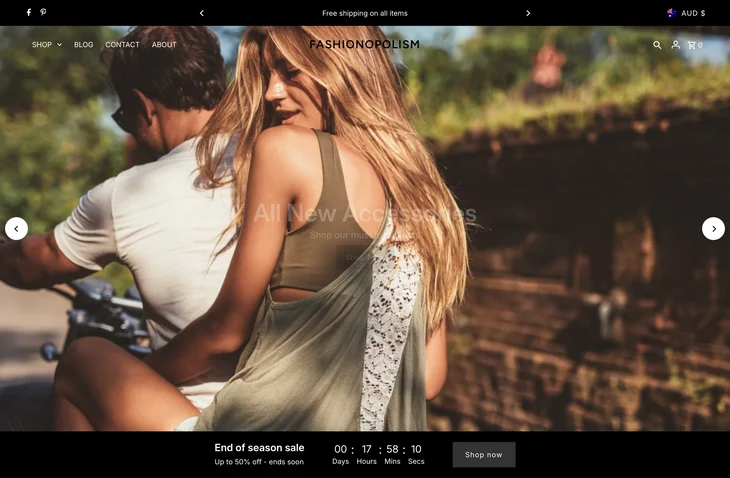
The homepage is built to merchandise a look, not just list products. A full-width hero slideshow runs promotional messages over lifestyle photography, shop-by-collection tiles break the catalog into curated edits, and editorial blocks pair copy with imagery the way a magazine spread would. A press-logo strip and an announcement bar add the social proof and urgency fashion stores rely on. The four presets are more than color swaps: each retunes type, spacing and image treatment for its niche, so Salon reads softer than the sharper Horology watch layout.
On the product page the theme leans into apparel needs: model and size information, a size chart, color and variant swatches, and low-stock urgency all sit within reach of the buy button. It is a design-forward theme, so the trade-off is discipline: the editorial sections reward good photography and can look sparse without it.
How fast is Fashionopolism?
Design-led themes can carry weight, so real-world speed matters more here than a lab score. Across the Shopify stores running it, Fashionopolism passes Core Web Vitals at a solid rate, and on lightly loaded stores, where the theme’s own speed shows through rather than a heavy app stack, it climbs higher. Here is how it compares with two well-known themes on the same real-world data.
| Theme | CWV pass rate | Few apps | Median LCP |
|---|---|---|---|
| Prestige | 78.6% | 85.1% | 1.6s |
| Fashionopolism | 72.9% | 82.8% | 1.7s |
| Dawn | 71.1% | 79.9% | 1.6s |
The read is that Fashionopolism is not a heavy theme dragged down by its visuals: its comparable-cohort pass rate sits close to premium peers, so the storytelling layout does not come at an obvious speed cost, provided the images are optimized and the app stack stays lean.
Fashionopolism features
Editorial homepage sections
Hero slideshow, shop-by-collection tiles, lookbook blocks and a press-logo strip, arranged to merchandise a curated look rather than dump a product grid.
Four fashion presets
Fashionopolism, Salon, Horology and Haute each retune type, spacing and imagery for a different fashion niche, so the starting point already suits apparel, salon, watch or haute-couture stores.
Apparel-focused product pages
Model and size details, a size chart, variant and color swatches, and low-stock urgency sit near the add-to-cart, the specifics apparel shoppers check before buying.
Merchandising and urgency tools
An announcement bar, promotional hero messaging and countdown-style sale banners give a fashion store the seasonal-sale toolkit without a separate app.
Fashionopolism pricing
Fashionopolism is a one-time purchase at $200, with no recurring theme fee after that. That is more upfront than starting on a free theme like Dawn, but it buys a design-led, fashion-specific starting point that would otherwise take a developer’s time to build. For a brand whose storefront look is part of the product, the one-time cost is usually the smaller line item next to photography and inventory.
Fashionopolism pros and cons
Pros
- Editorial, lookbook layout tuned for fashion, apparel and jewelry out of the box
- Four presets that retune the design for different fashion niches
- Apparel-ready product pages: size charts, swatches, model info, urgency
- Solid real-world Core Web Vitals, close to premium peers on comparable stores
- One-time price from a multi-theme studio with a mature codebase
Cons
- Paid theme, so more upfront than a free option like Dawn
- Small footprint and boutique studio mean a smaller community than mainstream themes
- Editorial sections need good photography or they look sparse
- Niche fashion focus is a poor fit for non-apparel catalogs
Who should use Fashionopolism?
Reach for Fashionopolism if you sell fashion, apparel or jewelry and want a design-led storefront that looks styled from day one, especially if you have strong product photography to fill the editorial sections. The presets make it quick to land on a look that suits your niche, and the apparel-focused product pages cover the sizing and variant details that clothing stores need. It suits a brand that treats its storefront as part of the product.
Think twice if you sell outside fashion, where the editorial layout is a mismatch, or if you want the largest possible support community and a free starting point, which is where Shopify’s own themes win. For a comparison, see our reviews of Madrid and Xclusive, two other apparel-leaning themes, and our roundup of Shopify fashion themes.
Our verdict
Fashionopolism earns its place as a fashion-specific theme: the editorial layout, the four niche presets and the apparel-ready product pages give a clothing or jewelry brand a styled starting point, and the real-world speed shows it does not trade performance for looks. The honest caveats are its paid price and small community next to Shopify’s mainstream themes, and the fact that the design needs good photography to shine. If you sell fashion and want a design-led storefront without building one from scratch, it is well worth a look. For the full detection data, see the live Fashionopolism usage statistics, and for more options browse our Shopify theme reviews.
-
How much does the Fashionopolism theme cost?
Fashionopolism is a one-time purchase on the Shopify Theme Store, with no recurring theme fee after that. It is more upfront than a free theme like Dawn, but it buys a fashion-specific, design-led starting point. The price covers all four presets.
-
Who makes the Fashionopolism theme?
It is built by We are Underground, a boutique studio that publishes a full catalog of Shopify themes rather than a single template. A multi-theme developer tends to reuse a mature, well-tested codebase, so Fashionopolism inherits the same section framework as its siblings.
-
Is Fashionopolism good for a fashion or clothing store?
Yes, it is built for exactly that. The editorial layout, four fashion presets and apparel-ready product pages with size charts and swatches suit clothing, apparel and jewelry stores. In our data about two-thirds of Fashionopolism stores sell apparel and accessories.
-
Is Fashionopolism fast?
On real-world Core Web Vitals it passes at a solid rate, and higher on lightly loaded stores where the theme’s own speed shows through. It sits close to premium peers on comparable stores, so the editorial design does not carry an obvious speed penalty, as long as images are optimized.
-
How many presets does Fashionopolism include?
Four: Fashionopolism, Salon, Horology and Haute. Each retunes type, spacing and imagery for a different fashion niche, from apparel to salon, watches and haute couture, so you start closer to a finished look for your category.
-
Is Fashionopolism worth it over a free Shopify theme?
For a fashion brand that wants a styled storefront without building one, usually yes: the design-led layout saves developer time. If you sell outside fashion or want the largest support community and a free start, a mainstream theme like Dawn may fit better.