Origin Shopify Theme Review 2026
Last modified: October 1, 2026
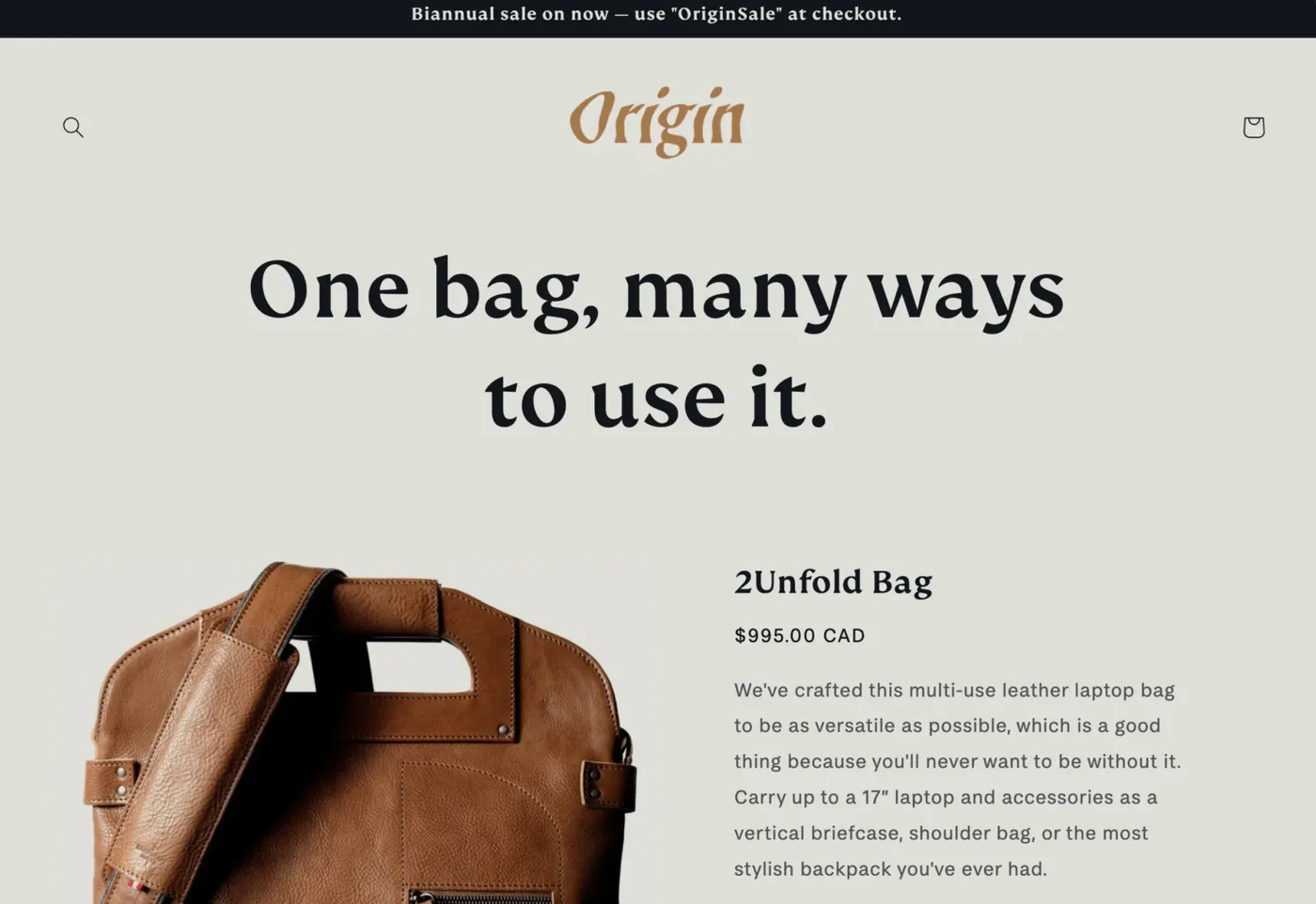
Origin is a free Shopify theme with genuine personality. Most free themes play it safe; Origin does the opposite, pairing a calm, neutral color palette with playful, offbeat typography that feels handmade and a little whimsical rather than corporate. That tone suits makers who sell craft goods, jewelry, accessories, and specialty food. The verdict upfront: Origin makes a small handmade brand look distinctive at no cost, and it is one of the better-rated themes in Shopify’s free lineup. The catch is that it is built for character, not scale, and it only works if your own photography and voice carry it, because the design sets a stage rather than supplying the personality itself.
If you run a small, curated maker brand with strong product photos and a clear voice, and you want a storefront with real character for free, Origin is a genuinely distinctive pick. If you sell mainstream retail, run a large or fast-changing catalog, or want a clean, neutral, mass-market look, it is the wrong fit. The sections below use live detection data to show exactly where it works and where it strains.
What is the Origin Shopify theme?
Origin is a free Online Store 2.0 theme published by Shopify, so updates arrive through the theme library with no third-party dependency. Where most free themes aim for a safe, neutral look, Origin commits to a distinct personality: a calm base palette lifted by playful, offbeat type. The result feels crafted and a little whimsical, which is why it lands with makers selling craft goods, jewelry, accessories, and specialty food rather than mainstream retailers.
Because it is a first-party theme, Origin edits through the drag-and-drop customizer with no code required, and it works with the wide library of Online Store 2.0 tutorials and sections. What it does differently is lead with character, using typography and layout to give ordinary products a one-of-a-kind feel that free themes rarely attempt. Here is where Origin sits across our dataset today.
How popular is Origin?
Origin is a small, characterful theme, and its share of the stores we scan each month has held roughly steady rather than climbing. That is typical for a design with a strong point of view: it appeals intensely to the maker brands it is built for and barely registers with everyone else, so it holds a small, devoted niche rather than spreading across the platform.
Origin has held steady at about 0.1% of Shopify stores in our dataset over recent months.
One number stands out about how Origin stores operate: they run fewer apps than the average Shopify store. Part of that is the theme, which builds galleries, size charts, stock counters, and cross-selling in, and part of it is the audience, since small maker brands tend to keep their setups simple and let the product and photography lead.
Origin design and layout
Origin’s design is where it earns its keep, and it is unusually bold for a free theme. The offbeat typography does much of the work, giving ordinary products a crafted, characterful feel against a calm, neutral backdrop. For a small handmade brand, that tone reads as intentional and distinctive, the kind of look that usually takes a designer or a paid theme to achieve.
The important caveat is that Origin sets a stage; it does not supply the personality on its own. The design leans heavily on your photography, product styling, and copy, so a brand with a clear voice and strong images looks genuinely special on it, while generic stock imagery makes the same layout collapse into noise. It also rewards restraint: a focused, curated range fits its character, and a large or busy catalog quickly outgrows the look.
Origin features
Origin’s feature set is broader than the free price suggests, with tools aimed at how small makers actually sell.
- Product presentation: color swatches, high-resolution galleries, and size charts to show craft in detail.
- Food and drink detail: ingredient and nutrition fields for specialty food sellers.
- Storytelling: blogs to tell the story behind each product, which suits a maker brand.
- Order lift: cross-selling blocks, stock counters, and a slide-out cart to raise each order and add urgency.
- Standard Online Store 2.0 sections and settings, so tutorials and help written for Shopify’s free themes apply directly.
What you do not get is total convenience. Owners most often ask for a sticky add-to-cart button, and deep structural changes hit the usual free-theme ceiling, so plan around a curated catalog rather than a sprawling one.
How fast is the Origin theme?
Origin’s speed needs context. Origin is a newer theme, so there are not yet enough live stores for a stable real-world Core Web Vitals reading; the card below shows the field data as it builds.
| Theme | CWV pass rate | Few apps | Median LCP |
|---|---|---|---|
| Impulse | 78.4% | 85.4% | 1.6s |
| Origin | 78.3% | 76.9% | 1.6s |
| Dawn | 71.2% | 79.9% | 1.6s |
Origin leans on a character-led homepage with expressive type and rich imagery, which is heavier to paint. As more stores adopt it, their real-world Core Web Vitals have been trending upward, which you can see on the live Origin statistics page. The practical takeaway: the theme can be fast in the field, but you have to earn it. Compress your images hard, keep the homepage focused, and run a lean app stack so the character does not cost you speed.
What kinds of stores use Origin?
Origin’s store base reflects its maker focus. Apparel and accessories leads, followed closely by health and beauty, home and garden, and food and drink, a spread that fits craft, jewelry, and specialty-food brands rather than any single mainstream category. The even split across those maker-friendly niches is the signal: this is a theme for small, brand-led producers.
By business model, subscription stores are the largest identifiable group, which suits makers running recurring boxes or refills, ahead of wholesale and multichannel selling. It is a theme for curated, character-led brands rather than high-volume general stores. For the full store-type and category breakdown, including how the mix shifts over time, see the live Origin usage statistics.
Which apps do Origin stores use?
The app stack on Origin stores is fairly lean and tilts toward tools that suit a small maker brand. Reviews apps sit at the top, as they do for most young brands, with email marketing and subscriptions close behind. Here is what we detect most often on live Origin stores.
| Rank | App | % of stores | Category |
|---|---|---|---|
| 1 | Judge.me Product Reviews App | 32.3% | Product reviews |
| 2 | Klaviyo | 19.4% | Email Marketing |
| 3 | Loox ‑ Product Reviews App | 11.5% | Product reviews |
| 4 | Recharge | 11.5% | Subscriptions |
| 5 | PageFly ✦ AI Page Builder | 7.4% | Page builder |
| 6 | Shopify Inbox | 6.5% | Support - Other |
| 7 | Omnisend Email Marketing & SMS | 6.5% | Email Marketing |
| 8 | Triplewhale | 6.0% | Analytics |
| 9 | GemPages Landing Page Builder | 6.0% | Page builder |
| 10 | Yotpo | 6.0% | Product reviews |
The pattern fits a curated maker store: product reviews for credibility, email to bring shoppers back, and subscription tooling for the recurring-order brands the theme attracts. Because Origin builds galleries, cross-selling, and a slide-out cart into the theme, owners reach for fewer add-ons than they would on a barer free theme, which helps keep the average app count down.
How much does Origin cost?
Origin is free. It is made by Shopify and installed straight from the Shopify Theme Store, with no license fee and no separate cost for updates. There is no paid tier for the theme itself. Your real costs are the apps you add and the Shopify plan you run your store on, not the theme.
Origin’s strengths and limits
Origin rates better than most free themes, which is worth noting because it earns that standing on character rather than raw feature count. Its strength is distinctiveness: the offbeat type and calm palette give a small brand a crafted, one-of-a-kind look for nothing, and the merchandising tools cover what a maker sells day to day. For the right store, it delivers something most free themes cannot.
Its limits are real and specific, though. Origin is built for character, not scale, so a large or fast-changing catalog outgrows it quickly. A few conveniences are missing, most notably a sticky add-to-cart button, and deep structural changes run into the normal free-theme ceiling. The biggest risk is expecting the theme to create your brand for you: it sets a characterful stage, but your photos, product styling, and copy have to carry it, and generic imagery undoes the whole effect.
Who should use Origin?
Origin is a strong free choice for a specific kind of store. Reach for it if you are a small or mid-sized maker in jewelry, accessories, craft goods, or specialty food, you have strong product photography and a clear brand voice, and you want a distinctive storefront without paying for a premium theme. It rewards brands that bring their own personality to the table.
Pass on Origin if you are a large or mainstream retailer that wants a clean, neutral, mass-market look, you run a big or fast-changing catalog, or your photography and copy are not ready to carry a character-led design. In those cases a more neutral theme will serve you better. If you do choose Origin, lean into strong images and a clear voice, keep the range curated, and treat the theme as a stage for your brand rather than a substitute for it.
Origin also features in our roundup of free Shopify themes, and if you sell handmade goods, our guide to best Shopify themes is a good companion read.
-
Is the Origin Shopify theme free?
Yes. Origin is a free Online Store 2.0 theme made by Shopify and installed from the Shopify Theme Store. There is no license fee and no charge for updates. Your only real costs are the apps you add and your Shopify plan, not the theme itself.
-
What is the Origin Shopify theme best for?
Origin is built for small makers who want personality. It suits jewelry, accessories, craft goods, and specialty food brands with strong product photography and a clear voice. Its offbeat typography gives ordinary products a crafted feel. It is a poor fit for large or mainstream retailers that want a clean, neutral, mass-market storefront.
-
What are the Origin theme’s main limitations?
Origin is built for character, not scale, so a large or fast-changing catalog outgrows it quickly. Owners most often ask for a sticky add-to-cart button, and deep structural changes hit the usual free-theme ceiling. Its biggest risk is relying on the theme for personality: your photography and copy have to carry the character-led design.
-
Can I use Origin for a large catalog?
It is not the best fit. Origin is designed around a focused, curated range where its character-led layouts look intentional. A large or busy catalog quickly outgrows the look, and the theme lacks some conveniences a big store leans on, like a sticky add-to-cart button. For a big catalog, a more neutral, scalable theme will serve you better.
-
Is Origin a fast Shopify theme?
Its demo store scores modestly on Google PageSpeed because the character-led homepage with expressive type and rich imagery is heavy. Real Origin stores post stronger field Core Web Vitals that have trended upward recently, which you can check on the live stats page. Compress your images and keep the homepage focused to keep an Origin store quick.
-
What types of stores use the Origin theme?
Origin skews to apparel and accessories, followed closely by health and beauty, home and garden, and food and drink, a spread that fits maker and craft brands. By business model, subscription stores are the largest identifiable group. It suits small, curated producers more than large general stores. You can see the full breakdown on the live Origin statistics page.
Is Origin worth installing?
For the right maker, yes, and it stands out among free themes for the character it offers. Origin gives a small handmade brand a distinctive, crafted look for nothing, rates better than most free themes, and packs in the merchandising tools a maker needs day to day. The catch is that its charm is only as strong as your content, so the deciding factor is whether your photography, styling, and voice are ready to carry a character-led design at a curated scale. If they are, Origin is a genuinely distinctive free bargain. For the wider picture across Shopify’s free and paid themes, see our guide to Shopify theme reviews. And any time you spot a maker store you admire, you can scan it to see whether it runs Origin and which apps it pairs with.