Impulse Shopify Theme Review 2026
Last modified: October 1, 2026
Impulse is the $500 flagship from Archetype Themes, and it is built for one kind of store: high-velocity catalogs that sell on promotions, urgency, and deep product discovery. The verdict upfront: Impulse earns its price for apparel, footwear, and accessories brands that run frequent sales across a large catalog and need built-in countdown timers, promotion banners, and a mega menu that can carry hundreds of SKUs. If you sell a small editorial range or a handful of high-ticket pieces, the same money buys more polish elsewhere. This review works from data first, so instead of calling Impulse popular, we can show you who runs it, what those stores install alongside it, and how it holds up on real storefronts.
What is the Impulse Shopify theme?
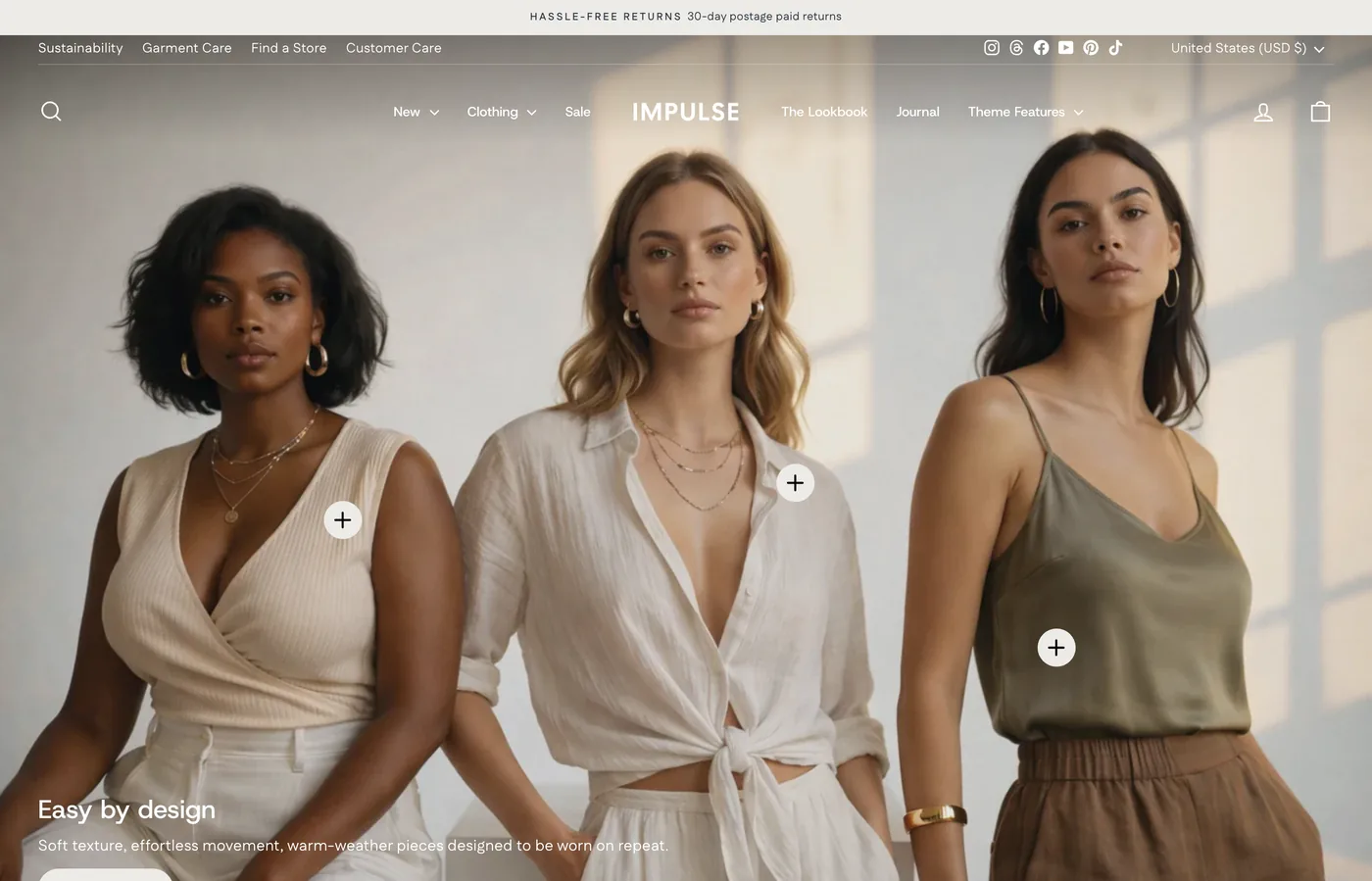
Impulse is a premium Online Store 2.0 theme published by Archetype Themes, the same studio behind Motion and Expanse. It costs $500 as a one-time purchase from the Shopify Theme Store, which is the highest price among the mainstream premium themes, ahead of Prestige, Impact, and Symmetry. That price buys a feature set aimed squarely at conversion: promotion banners, countdown timers, a mega menu, advanced filtering, quick buy, and a slide-out cart, all built in rather than bolted on with apps.
The theme ships with four presets: Impulse, Dune, Terrain, and Apothecary. Unlike a single-look theme, these are genuinely different design directions, so one license can dress a bold streetwear drop or a calmer wellness catalog without a rebuild. Impulse holds a 94 percent positive rating across more than 1,290 reviews, which is a rare combination of scale and satisfaction at this end of the market.
The features that justify the price are the ones aimed at selling, and most of them ship built in rather than as paid apps:
- Promotion banners and countdown timers for sales, drops, and seasonal urgency.
- Mega menu that can carry a deep catalog across many collections.
- Advanced filtering and sorting so shoppers can narrow hundreds of SKUs quickly.
- Quick buy and a slide-out cart to shorten the path to checkout.
- Product recommendations and recently viewed blocks for cross-selling.
- Four design presets covering distinct looks from one license.
The four Impulse presets
Impulse ships as four preset styles, and they are design directions rather than color swaps. You pick one as a starting point and customise from there, so the choice matters less as a cage and more as a head start. Here is what each one is built for.
Impulse
The signature style is the editorial one: refined typography, room for large photography, and a grid that makes products feel considered rather than crammed together. It suits high-end fashion, luxury goods, and premium lifestyle brands where the photo carries the sale and the store needs to feel aspirational. If your product shots are strong, this is the preset that flatters them.
Dune
Dune strips the design back to the product. Wide white space, a plain layout, and minimal decoration push everything except the item itself out of the way. It fits minimalist brands and single-hero catalogs where clarity converts better than styling, and it is the starting point to reach for if the busier signature Impulse look fights what you sell.
Terrain
Terrain is the bold, utilitarian style, and it is the one built hardest for mobile and for deep catalogs. Its compact, thumb-friendly layout is why it shows up on high-velocity gear and outdoor brands, the kind of catalog that Darn Tough, Penny Skateboards, and Liberty Safe run: a lot of SKUs, most of the traffic on a phone. Choose Terrain if you sell rugged, functional products at volume rather than a small curated range.
Apothecary
Apothecary is aimed at wellness, beauty, and natural-goods brands, the kind of store that should feel calm and trustworthy rather than loud. It reads as the gentlest of the four, a better starting point for a skincare line or a supplements catalog than the promotion-forward Impulse default. Begin here when your brand sells on care and credibility rather than urgency.
Is Impulse growing or fading?
Start with the direction of travel. The chart below tracks the share of Shopify stores running Impulse across our monthly scans, so you can see whether the theme is holding its base before you commit $500 to it.
Impulse Adoption Trend
Impulse has climbed from 3.7% to 3.9% of Shopify stores in our dataset over recent months.
Read that line the way you would read any premium theme, not a free default. Most new stores launch on whatever Shopify ships for free and only move up to a paid theme like Impulse once they have revenue and a catalog worth investing in, so a paid theme almost never climbs the way a free one does. What matters here is that Impulse has kept a large, stable base of paying stores rather than bleeding them to newer themes, and it has. You can watch the same figure update on our Impulse stats page.
Who actually runs Impulse?
The next question is who sits behind those installs. The snapshot below pulls Impulse’s live position in our dataset: how common it is, where it ranks against every other theme, and how many apps the typical Impulse store runs.
Impulse Usage Statistics
Impulse usage at a glance, from the Shopify stores in our dataset, refreshed daily.
The ranking is the figure worth sitting with. Impulse is one of the most-used themes on the whole platform, and it earns that spot as a paid theme competing against free defaults that cost nothing, which tells you merchants are choosing it on purpose. The app count points the same way: these are established stores running a full toolset, not weekend experiments. The takeaway for your budget is that Impulse assumes you will bring apps for email and reviews rather than expecting the theme to do everything, so factor that into the true cost before you buy.
Where does Impulse rank among all themes?
The stat card above gives Impulse’s rank as a number. The leaderboard below puts it in context, listing the ten most-used themes across our dataset so you can see what Impulse is up against and which themes sit above and below it.
Most-used Shopify themes
| Rank | Theme | % of stores |
|---|---|---|
| 1 | Dawn | 15.0% |
| 2 | Horizon | 7.9% |
| 3 | Prestige | 4.4% |
| 4 | Impulse | 4.0% |
| 5 | Shrine PRO | 3.3% |
| 6 | Impact | 2.4% |
| 7 | Minimog OS 2.0 | 2.1% |
| 8 | ella | 2.0% |
| 9 | Kalles | 1.8% |
| 10 | Broadcast | 1.7% |
Two things stand out once you read the order. The themes ahead of Impulse are free defaults that ship with every new store, so they win on sheer volume rather than deliberate choice. Among the themes people actually pay for, Impulse sits right at the top, trading places with a couple of other premium themes rather than trailing the pack. For a buyer weighing $500, that is the reassuring read: you are not backing a niche theme with a thin following, you are backing one of the most-adopted paid themes on the platform, which means steady updates, a large user base, and plenty of live stores to learn from.
What kind of stores choose Impulse?
Popularity only helps if the stores behind it look like yours. The cards below pull the standout facts about who runs Impulse, including where it ranks inside specific store types.
Impulse by the Numbers
Data-backed facts about Impulse, computed from the Shopify stores in our dataset.
The store-type split on our Impulse stats page sharpens the picture. The large majority of the Impulse stores we have classified sell apparel and accessories, with fashion sub-categories like dresses, t-shirts, and sandals showing up right behind the headline, and a meaningful share running on a subscription model. That composition is the theme’s whole thesis in one data point: Impulse is built by and for fashion and accessories merchants who move a lot of product, run frequent promotions, and need variant-heavy product pages. If that describes your store, you sit in the theme’s core audience. If you sell a handful of high-ticket pieces or a service, you are on the edge of it, and a different theme may fit better.
What Impulse stores install alongside it
Those apps are not random, and the pattern of them says more about Impulse than any feature list. The table below shows what Impulse stores most commonly add on top of the theme, ranked by how many of them run each one.
| Rank | App | % of stores | Category |
|---|---|---|---|
| 1 | Klaviyo | 50.3% | Email Marketing |
| 2 | Judge.me Product Reviews App | 28.6% | Product reviews |
| 3 | Swatch King | 22.6% | Product variants |
| 4 | Loox ‑ Product Reviews App | 22.4% | Product reviews |
| 5 | Yotpo | 13.3% | Product reviews |
| 6 | Kiwi Size Chart & Recommender | 11.6% | Upsell and cross-sell |
| 7 | Recharge | 11.2% | Subscriptions |
| 8 | Kaching Bundles | 10.6% | Product bundles |
| 9 | Swym Wishlist | 9.5% | Wishlists |
| 10 | Triplewhale | 7.7% | Analytics |
The shape of that list is the real insight, and it is different from an editorial theme like Prestige. Email marketing still sits at the top, but underneath it you see reviews stacked three deep, variant swatch tools, size charts, countdown timers, and bundle apps. That is the toolkit of a store selling apparel and accessories at volume, where shoppers compare colors and sizes, respond to urgency, and get pushed toward a bigger basket. Where a luxury theme’s stores lean on trust and slow storytelling, Impulse stores lean on merchandising and promotion, which is exactly the job the theme was built for. If that is your model, several of these features come built in, and the true cost of Impulse drops below the sticker price.
How Impulse performs on real stores
A conversion theme only earns its keep if the store still loads quickly under a full app stack. Rather than quote a single demo number, the block below shows the Core Web Vitals recorded on hundreds of real Impulse storefronts, which is a fairer read on what you can expect.
| Theme | CWV pass rate | Few apps | Median LCP |
|---|---|---|---|
| Impulse | 78.4% | 85.4% | 1.6s |
| Broadcast | 75.1% | 87.1% | 1.5s |
| Dawn | 71.2% | 79.9% | 1.6s |
The real-world Core Web Vitals from hundreds of live Impulse stores are strong, with the large majority passing Google’s thresholds. That tells you the theme is not the bottleneck. Speed on Impulse is mostly a matter of discipline: sensibly sized images, a controlled homepage, and an app stack you actually use. Load it with autoplay video, oversized carousels, and a dozen marketing scripts and any theme will crawl, but a well-run Impulse store holds up.
What Impulse is genuinely good at
Impulse earns its price in a specific set of jobs, and it does them better than most themes in the Shopify Theme Store.
The first is promotion and urgency. Countdown timers, promotion banners, and sale-focused product blocks all ship in the theme, so a store that runs frequent drops or seasonal sales gets the merchandising toolkit built in rather than stitched together from three or four apps. For a fast-moving catalog, that head start is the whole point.
The second is catalog navigation. The mega menu and advanced filtering are built to carry a deep catalog, so a store with hundreds of SKUs across many collections stays browsable instead of burying products three clicks down. This is where Impulse pulls ahead of editorial themes that flatter twenty hero products but fall apart at scale.
The third is the range of the four presets covered above. Because Impulse, Dune, Terrain, and Apothecary are real design directions and you can move between them from the theme settings, one license covers a bold apparel brand and a calm wellness catalog equally well. That flexibility softens the sting of the $500 price when the alternative is buying two themes.
View Impulse on the Shopify Theme Store
Where Impulse falls short
Impulse is not a general-purpose theme, and it punishes stores that do not need what it does.
The price is the first hurdle. At $500 it is the most expensive of the mainstream premium themes, and that only makes sense above a certain order value and sales velocity. A store still testing whether people will buy is better off proving the business on a free theme first, then moving up once the numbers justify it.
It is also overbuilt for small or editorial catalogs. If you sell a dozen high-ticket pieces where photography carries the sale, the promotion tooling and mega menu sit idle, and a theme like Prestige gives you a more refined editorial look for less. Impulse rewards volume and merchandising, not restraint.
And like most premium themes, getting the most out of it takes time. The feature depth that makes Impulse powerful also means more settings to configure, so a founder who wants a store live by the weekend will find a simpler theme faster to launch.
Impulse vs the alternatives
If you are weighing Impulse against the other premium themes in its class, here is how the numbers line up on price, rating, and who each one suits best. Ratings are the Shopify Theme Store positive-sentiment score with review counts as of July 2026.
| Theme | Price | Rating | Best for |
|---|---|---|---|
| Impulse | $500 | 94% (1,291) | Promotion-led, high-velocity catalogs |
| Prestige | $400 | 91% (859) | Editorial, luxury, high-ticket storytelling |
| Impact | $400 | 85% (197) | Bold, conversion-focused storefronts |
| Symmetry | $420 | 94% (389) | Flexible, filter-heavy premium catalogs |
Impulse is the priciest of the four, but it also carries by far the most reviews, which is worth weighing when a $500 purchase is on the line. Against Prestige, the split is clean: Prestige for editorial, photography-led brands selling fewer high-ticket items, Impulse for busy catalogs that live on sales and variants. Against Impact, Impulse trades a lower price for a deeper merchandising toolkit and a much larger review base. Just below Impulse in adoption sits Shrine PRO, a cheaper conversion theme aimed at dropshipping and DTC stores rather than established catalogs. If none of these fit, our guide to the best Impulse theme alternatives covers cheaper and free options that cover part of the same ground.
Same-studio comparison: Streamline is Archetype’s other flagship, and it pulls the opposite way to Impulse. Where Impulse leans conversion-first, feature-heavy and urgency-driven, Streamline is image-first, editorial and minimal, better for mid-market DTC brands where photography sells rather than promotions.
If your calendar runs on timed drops rather than always-on sales, also look at Release, DigiFist’s premium theme built around countdown-driven launches.
For a lower-priced fashion theme that leans on reviews and cash-on-delivery selling, see our Milano review.
The verdict
Impulse is worth $500 for a specific kind of store: a high-velocity apparel, footwear, or accessories brand that runs frequent promotions across a large catalog and wants the countdown timers, banners, mega menu, and filtering built in rather than rented from apps. Its place among the platform’s most-used themes and its 94 percent rating are not marketing claims, they are what merchants have actually chosen at scale, and the data on who runs it backs that up.
If you are early-stage, price-sensitive, or selling a small editorial range where photography does the work, Impulse is the wrong tool, and Prestige, our Icon review, or a free theme will serve you better until your sales velocity grows into it. For another premium fashion theme, our Aurora review covers a filtering-heavy alternative, and our Boost review covers a faster, conversion-focused option. For the wider Shopify theme picture, see our complete Shopify theme review guide.
-
How much does the Impulse Shopify theme cost?
Impulse costs $500 as a one-time purchase from the Shopify Theme Store, which includes all four presets and free updates. That makes it the most expensive of the mainstream premium themes, ahead of Prestige and Impact at $400 and Symmetry at $420. There is no subscription; you pay once and own the license for that store.
-
Who makes the Impulse theme?
Impulse is built by Archetype Themes, one of the longest-running premium theme studios in the Shopify ecosystem and the same team behind Motion and Expanse. Archetype focuses on conversion-oriented themes for established stores, and Impulse is its promotion-and-merchandising flagship.
-
Is Impulse good for large catalogs?
Yes, large catalogs are where Impulse is strongest. Its mega menu and advanced filtering are built to carry hundreds of SKUs across many collections without burying products, and the built-in promotion tools suit stores that run frequent sales. Editorial themes with fewer navigation features tend to strain at that scale, which is why high-velocity apparel and accessories brands favour Impulse.
-
How many presets does Impulse have?
Impulse ships with four presets: Impulse, Dune, Terrain, and Apothecary. These are genuinely different design directions rather than colour swaps, so one license can style a bold apparel brand or a calmer wellness catalog. You switch between them from the theme settings without rebuilding the store.
-
Is Impulse worth $500?
Impulse is worth $500 when your store sells at volume with a decent order value and relies on promotions, variants, and deep catalog navigation. At that level the built-in countdown timers, banners, and filtering replace several paid apps, so the real cost is lower than the sticker price. If you sell a small high-ticket range or are still testing demand, a cheaper or free theme is the smarter first step.
-
How fast is the Impulse theme?
Real Impulse stores perform well on Core Web Vitals, with the large majority passing Google’s mobile thresholds despite the demo store’s middling lab score. That gap tells you the theme is not the bottleneck; speed depends mostly on your image sizes and app stack. A disciplined Impulse store with sensibly sized images loads quickly, while an overloaded one will not, the same as any theme.