Klaviyo Shopify App Review 2026
Last modified: August 12, 2026
Klaviyo is the most-installed app on Shopify, found on more than one in three stores we scan, and it is the runaway leader in email marketing. It earns that position with a specific strength: it treats Shopify as a live data feed rather than a contact importer, so purchases, cart additions, and browsing behavior flow straight into its segmentation engine and build your audience automatically. The verdict upfront: for a store with repeat purchasers and a real email list, Klaviyo is the strongest retention platform on Shopify, and it holds a 4.7 out of 5 App Store rating. The honest catches are cost, which scales with your list, and the fact that its power is wasted if you never build the flows. It is also worth knowing that its share, while huge, has been slipping lately.
If you are a repeat-purchase, direct-to-consumer brand that lives on email and SMS, Klaviyo is usually the right call and the one to grow into. If you are pre-launch, tiny, or unlikely to configure it properly, you may be paying for infrastructure you will not use. The sections below use live detection data to show how dominant it is, what makes it different, what it costs, and where it falls short.
What is Klaviyo?
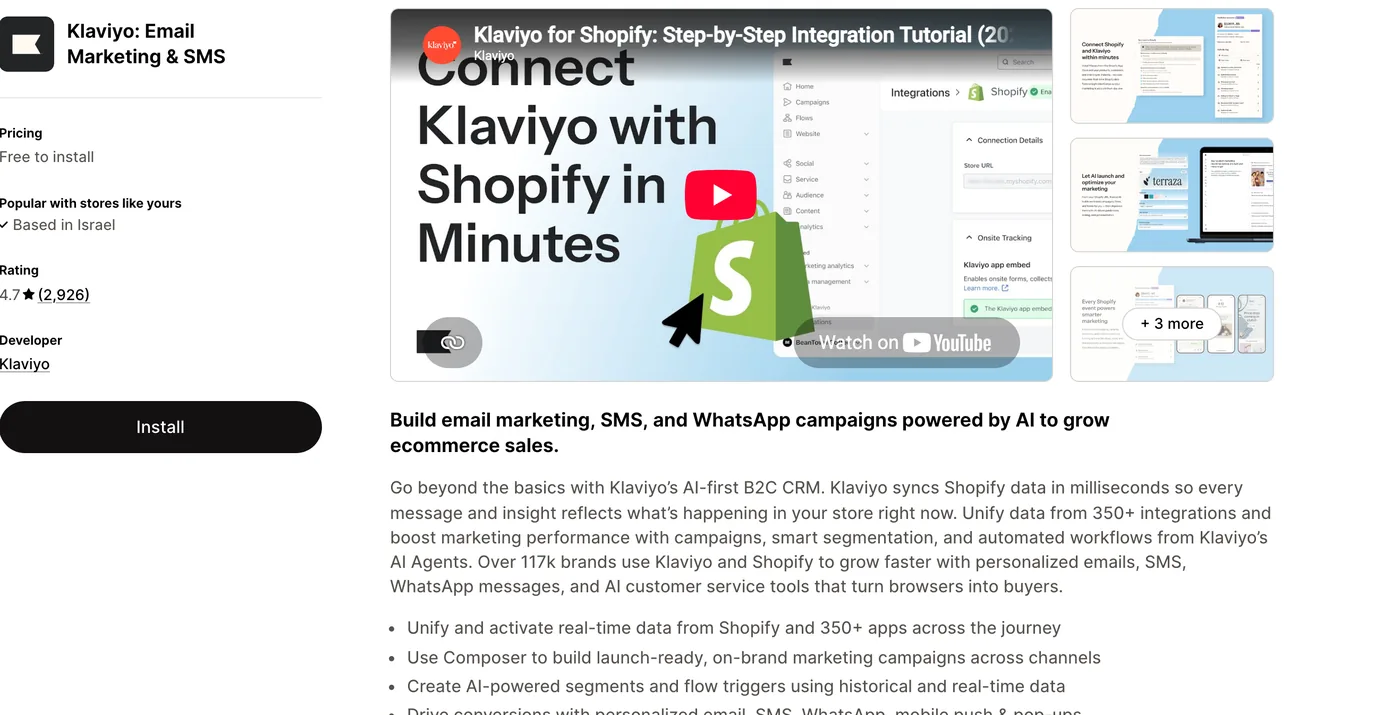
Klaviyo is an email and SMS marketing platform for Shopify. Store owners use it to collect subscribers, segment their audience, and send automated flows and campaigns, from welcome series and abandoned-cart reminders to post-purchase and win-back messages. It also handles SMS, sign-up forms and popups, and reporting that ties messages back to revenue. It is the most-installed app in our dataset, and its nearest email competitor is on a fraction as many stores. Here is how dominant it is.
How popular is Klaviyo?
Klaviyo is not just the leading email app, it is the most-detected app of any kind on Shopify. It is used many times more than the next email marketing app in the ranking, and it also sits near the top of the stack for subscription and multichannel stores. In short, it is the default retention infrastructure for a large slice of serious Shopify merchants.
There is one caveat in the trend, and we will not hide it. Klaviyo’s share of the stores we scan each month has slipped rather than grown recently, which is a meaningful move for an app of this size. It is still dominant, but the direction is worth watching, most likely a sign that cost-conscious merchants are testing cheaper alternatives.
Klaviyo has slipped from 41.3% to 36.1% of Shopify stores in our dataset over recent months.
What makes Klaviyo different?
Most email apps import your contacts and let you send to them. Klaviyo does something more useful: it plugs into Shopify as a live data feed. Purchase events, cart additions, browsing behavior, and product-level interest all flow directly into its segmentation engine with no manual wiring beyond the initial connection.
The practical result is that audience-building happens automatically, off real customer behavior rather than form fills. You can target people who bought a specific product, who browsed but did not buy, or who have not ordered in ninety days, and trigger messages off those signals. That depth is why Klaviyo stores tend to run heavier app stacks than the average store, sitting alongside reviews, support, analytics, and subscription tools. These are not stores testing an idea, they are stores running a retention operation.
Klaviyo features
Klaviyo bundles a full retention toolkit rather than just a newsletter sender, which is a big part of why serious stores standardize on it.
- Email and SMS: run both channels from one audience, so a customer is not messaged twice for the same event.
- Behavioral segmentation: build segments off live Shopify signals like purchases, cart activity, and browsing.
- Automated flows: welcome, abandoned cart, post-purchase, win-back, and back-in-stock sequences that run on their own.
- Sign-up forms and popups: capture subscribers on-site and feed them straight into flows.
- Reporting tied to revenue: see what each flow and campaign actually earns, not just opens and clicks.
- Predictive data: estimated lifetime value and next-order timing to sharpen targeting.
The toolkit is deep, which is its strength and its trap: the value only appears once the flows are built. An account with no flows configured is an expensive contact list.
How much does Klaviyo cost?
Klaviyo is free to install and includes a free tier for a small list, so you can set it up and start building flows before you pay anything. Once you grow past the free allowance, pricing is usage-based and scales with the size of your contact list and how you use email and SMS.
That model is the honest sticking point. Klaviyo can get expensive as your list grows, and the bill rises whether or not your flows are earning their keep. The way to make it pay is to treat the list as an asset you actively work, not a number you let inflate. Build and maintain the core flows, prune inactive contacts, and the returns justify the cost. Install it, let the list balloon, and never send a considered campaign, and it becomes one of the priciest apps on your bill for no reason.
Which themes and apps run with Klaviyo?
Because we detect both themes and apps, we can see the company Klaviyo keeps. On the theme side it is genuinely universal, showing up most on Shopify’s free Dawn theme and then across the popular premium themes, which reflects how widespread it is rather than any special pairing. Here are the themes most commonly running it.
| Rank | Theme | % of stores |
|---|---|---|
| 1 | Dawn | 13.3% |
| 2 | Prestige | 6.2% |
| 3 | Impulse | 6.1% |
| 4 | Impact | 4.0% |
| 5 | Horizon | 3.7% |
| 6 | Broadcast | 2.9% |
| 7 | Shrine PRO | 2.9% |
| 8 | Symmetry | 2.2% |
| 9 | Focal | 1.7% |
| 10 | Concept | 1.6% |
On the app side, Klaviyo rarely runs alone. The stores that use it most often also run a reviews app for social proof, a subscriptions tool, customer support software, and analytics, the full retention stack. That is the tell that Klaviyo is chosen by stores treating email as a core channel rather than an afterthought. For the full breakdown of themes, paired apps, and store types, see the live Klaviyo usage statistics.
What kinds of stores use Klaviyo?
Klaviyo’s user base is concentrated, not spread evenly across Shopify. Apparel and accessories alone accounts for around half the Klaviyo stores we classify, followed by health and beauty and then food and drink, all categories built on repeat buying. Some of the biggest direct-to-consumer beauty and lifestyle brands run on it.
By business model, subscription stores are heavily represented, alongside multichannel sellers, which fits an app built around lifecycle messaging and retention. The pattern is clear: Klaviyo is the default for high-repeat, direct-to-consumer, email-dependent merchants, and less relevant for a one-off-purchase or very small store.
Where Klaviyo falls short
The honest downsides are cost and complexity, not capability. Klaviyo is powerful, but that power sits behind a usage-based bill that grows with your list, so a large, poorly worked list can cost real money for little return. Under-configured accounts are common, where a merchant installs Klaviyo, never builds the flows, and pays for infrastructure they are not using. The app does not hold your hand into value; you have to go and get it.
The slipping adoption trend fits this picture. For merchants who never operationalized it, or who have grown cost-sensitive, cheaper email apps become tempting. None of this means Klaviyo is the wrong choice, it means it is the wrong choice for stores that will not use it properly. Go in planning the flows and the list hygiene, not just the install.
One worry with any marketing app is speed, since it is easy to assume that adding another tool slows a store down. For Klaviyo the data says otherwise. Compared fairly against similar stores on the same theme and with a similar number of products and apps, the ones running Klaviyo actually pass Google’s Core Web Vitals speed test more often, not less: about 72% versus 61% for comparable stores without it (among stores large enough to appear in Google’s Chrome UX Report). Klaviyo itself is not the bottleneck.
Does Klaviyo slow a store down?
Compared only against stores on the same theme, running the same number of apps and carrying a similar catalogue, stores with Klaviyo installed pass Core Web Vitals 11.8 points higher of the time (20,817 comparable stores across 1,181 matched groups).
| Comparison | With Klaviyo | Without | Stores compared |
|---|---|---|---|
| Like-for-like stores | 71.3% | 59.6% | 21,942 with · 25,485 without |
| All stores, unmatched | 70.3% | 65.7% | 26,369 with · 32,573 without |
Who should use Klaviyo?
Klaviyo is the right pick if you are a repeat-purchase, direct-to-consumer brand with a real and growing email list, especially in apparel, health and beauty, or subscriptions, and you are ready to build proper flows. For that store, no other Shopify email app matches its depth of Shopify-native segmentation, and the returns comfortably justify the cost.
Pass, or at least wait, if you are pre-launch, still under a few hundred subscribers, or not going to configure it beyond the install. In that case, start on the free tier and grow into it, but plan the flows before you start paying for the list. A cheaper, simpler email app may serve a very small or one-off-purchase store better until retention becomes a real lever. At the other extreme, a large brand where SMS is the primary channel may prefer a dedicated SMS-first platform like Attentive.
-
What is the difference between Klaviyo and Omnisend?
Both platforms handle email and SMS with Shopify integration, but they differ in depth and pricing. Klaviyo is more data-heavy: its segmentation engine and predictive analytics are built for stores with established lists that need precise behavioral targeting. Omnisend is faster to set up and stays more affordable at mid-size list counts. For stores that want email and SMS working together without Klaviyo’s complexity or pricing at scale, Omnisend is the more practical choice.
-
Is Klaviyo free?
Klaviyo is free to install and includes a free tier for a small contact list, so you can build flows before you pay. Beyond the free allowance, pricing is usage-based and scales with your list size and email and SMS volume. It can get expensive as your list grows, so it pays to keep the list active and pruned rather than just large.
-
Is Klaviyo worth the price?
For a repeat-purchase store with a real email list, yes. Its Shopify-native segmentation turns live customer behavior into automated flows that drive revenue, and the returns usually justify the cost. It is not worth it for a store that installs it and never builds flows, since the bill still scales with the list. The value comes from using it, not owning it.
-
What makes Klaviyo different from other email apps?
Most email apps import contacts and let you send to them. Klaviyo plugs into Shopify as a live data feed, so purchases, cart activity, and browsing flow into its segmentation engine automatically. That lets you target and trigger messages off real behavior rather than form fills, which is why it is the default for retention-focused stores.
-
Is Klaviyo good for a new or small store?
It can be, if you install it early and grow into it. On the free tier you can set up core flows before you pay, which is smart. But if you are pre-launch, under a few hundred subscribers, or not going to configure it, a simpler and cheaper email app may serve you better until retention becomes a real channel for your store.
-
Which stores use Klaviyo most?
Klaviyo skews heavily to apparel and accessories, which makes up around half its stores, followed by health and beauty and food and drink. By business model, subscription and multichannel stores are well represented. It is the default for repeat-purchase, direct-to-consumer, email-dependent brands rather than one-off-purchase or very small stores. You can see the full breakdown on the live Klaviyo statistics page.
Is Klaviyo worth it?
For the store it is built for, yes, and it is the strongest retention platform on Shopify. Its live-data segmentation turns real customer behavior into automated email and SMS, which is why the most email-dependent brands on the platform standardize on it and rate it 4.7 out of 5. The trade-offs are real: the bill scales with your list, and the power is wasted if you never build the flows, which is why its share is slipping among merchants who never operationalized it. Treat the list as an asset you actively work and Klaviyo pays for itself; treat it as a set-and-forget install and it becomes an expensive line item. If that price is a stretch, a more affordable alternative like Omnisend covers email and SMS for less. To see how it fits alongside everything else, browse our guide to the best Shopify apps. And any time you spot a brand with sharp email marketing, you can scan it to see whether it runs Klaviyo and which theme and apps it pairs with.