Icon Shopify Theme Review 2026
Last modified: September 16, 2026
Icon is a paid Shopify theme from We Are Underground, sold on the Shopify Theme Store and built with fashion and apparel brands in mind. It leans editorial, with generous type, full-width imagery, and lookbook-style layouts that suit clothing, accessories, and lifestyle labels more than dense, spec-heavy catalogs. It ships as a pack of named preset styles under a single license, so a boho swimwear label and a minimal accessories brand can each start from a look that fits. It comes as a one-time purchase, and it rates strongly with the buyers who have used it. If you sell a focused range and you want a polished, image-forward storefront with the safety of a first-party theme, Icon is aimed at you.
This review leans on our detection data for the real stores running Icon, not just the demo. That data shows who actually installs the theme, the apps they run beside it, and how their storefronts perform for shoppers. It lines up with the market We Are Underground built for: Icon stores skew heavily toward apparel and accessories, they carry small, focused catalogs rather than sprawling ones, a real share sell on subscription, and they run a serious marketing stack, the fingerprint of established brands rather than first-week shops.
View Icon on the Shopify Theme Store
What Is Icon?
Icon is a paid Shopify theme from We Are Underground, sold through the Shopify Theme Store. It is built on Online Store 2.0, so you get flexible drag-into-place sections and a one-time price rather than a monthly fee. Where a general multipurpose theme tries to fit every kind of store, Icon commits to a look: editorial fashion, with room for large imagery, considered typography, and lookbook layouts. Its preset styles carry names like Dolce, Yves, Louis, and Vivienne, a nod to the fashion houses, and each varies the personality while sharing the same image-forward bones.
Buying on the Theme Store matters here. Icon installs in one click, updates through Shopify’s managed path, and has passed Shopify’s theme review, so you get the vetting and support flow a first-party theme carries. It also rates strongly with the people who bought it, at 94% positive across 369 reviews at the time of writing. At the premium end of the market, that track record and safety are part of what your money buys, alongside a design made for a specific kind of brand rather than a catch-all template.
What Apps Do Icon Merchants Install?
The apps a store runs tell you what kind of business it is. Here is the real install pattern across the Icon stores in our dataset.
| Rank | App | % of stores | Category |
|---|---|---|---|
| 1 | Klaviyo | 43.9% | Email Marketing |
| 2 | Judge.me Product Reviews App | 23.9% | Product reviews |
| 3 | Rebuy Personalization Engine | 20% | Checkout - Other |
| 4 | Paypal | 16.9% | Checkout - Other |
| 5 | Trustpilot | 15.4% | Marketing - Other |
| 6 | Loox ‑ Product Reviews App | 13.9% | Product reviews |
| 7 | Rebuy Smart Cart | 13.1% | Upsell and cross-sell |
| 8 | Kiwi Size Chart & Recommender | 12.3% | Upsell and cross-sell |
| 9 | Privy ‑ Email, SMS & Pop Ups | 11.5% | Email marketing |
| 10 | Triplewhale | 11.5% | Analytics |
This is a direct-to-consumer fashion stack. An email marketing platform sits on top by a wide margin, so these brands are built to capture shoppers and sell to them again. Product review apps follow close behind, which is what you would expect from clothing and accessories stores that lean on social proof and fit confidence. Below them sit a personalization and upsell engine, a payment option, a review-led trust tool, and a size chart, the mix that established apparel brands run rather than first-time shops. It fits the polished, image-forward stores that gravitate to Icon.
How Popular Is Icon?
Icon is a specialist premium theme rather than a mass-market default, and its adoption reflects that. Here is where it sits across the stores we track.
The detail worth watching is category and catalog size. Icon stores lean heavily toward apparel and accessories, with clothing and dresses close behind, exactly the audience We Are Underground designed for. They also tend to carry smaller catalogs than the average store, which fits a theme built around imagery and a clear point of view rather than deep filtering. A meaningful share bill on a recurring subscription, the pattern you see from fashion and beauty brands with repeat buyers.
How Fast Is Icon?
Speed is measured here from the Chrome UX Report on real stores, not a single lab run.
Across 60 real Icon stores, 78.3% pass Google’s Core Web Vitals (median LCP 1.6s). Filtered to stores running only a few apps, that rises to 80%, isolating the theme’s own speed from the apps merchants pile on.
These are solid field numbers for an image-heavy theme, and they improve once you filter to lightly-loaded stores, where the pass rate climbs and load times tighten. That tells you the theme’s own code is quick, and most of what slows any Icon store down is the apps and heavy imagery stacked on top rather than the theme itself. Median load time and interaction delay both sit in Google’s good range. For a fashion theme that leans on big photography, that is the result you want: speed you can protect with compressed images, not a constant fight.
Icon Design and Layout
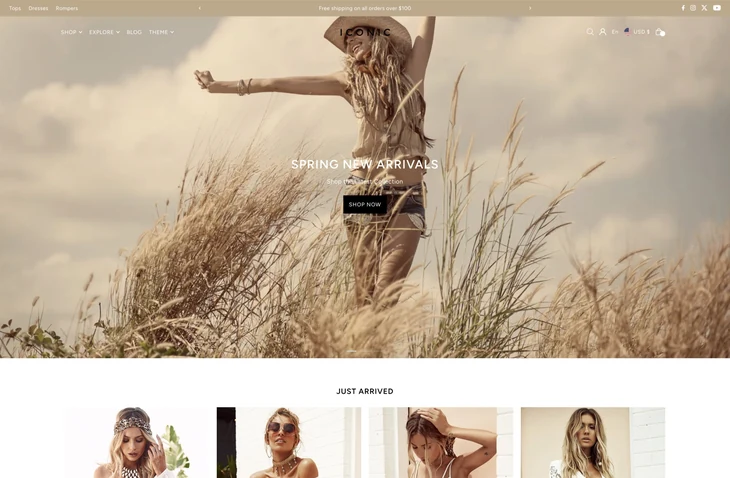
Icon commits to an editorial, image-forward look. Full-width hero imagery, generous whitespace, and lookbook-style sections put photography first, which is why it lands with clothing, swimwear, and accessories brands that sell on how a product looks and feels. The preset styles shift the personality, softer and bohemian in one, cleaner and minimal in another, while keeping the same fashion-forward structure, so one license covers several brand identities.
The honest note is that an image-led theme rewards good photography and exposes weak photography just as clearly. Icon assumes you have a strong set of images and a clear point of view. If your catalog is shot inconsistently, that shows immediately on a layout this visual. The upside is that the theme gives you room to lead with imagery without the page feeling cluttered, as long as you keep your sections disciplined and test on a phone.
Icon Features That Matter
Icon bundles the merchandising tools a fashion store actually reaches for, on top of its editorial design. The pieces that carry the most weight:
- A large library of prebuilt sections, so you can build homepage, collection, and product layouts without code.
- Mega menu, enhanced search, and infinite scroll, to keep large lookbooks easy to browse.
- Color swatches, image galleries, and product videos, for rich, visual product pages.
- Size charts and quick buy, to cut friction on apparel purchases.
- Countdown timers, promo popups, and back-in-stock alerts, for drops and campaigns.
- Cart customization and a slide-out cart, for a smooth path to checkout.
- Customer accounts, which suit repeat fashion buyers.
- EU translations across several languages, to widen reach.
A strong fit for image-led fashion brands
If you sell clothing, swimwear, or accessories and you lead with photography, Icon is worth a close look. Its editorial layouts, color swatches, and product video support are built for visual merchandising, and its real-world speed leaves headroom for the rich imagery those brands rely on, provided you compress your photos and keep apps lean.
How Much Does Icon Cost?
Icon is a one-time purchase on the Shopify Theme Store, not a subscription, and it sits at the premium end of the market. The price covers the full theme with all of its preset styles and features, a free trial to build on before you commit, and Shopify’s managed install and update path. There is no monthly fee, though the upfront cost is higher than most themes on the marketplace.
| Theme | Price |
|---|---|
| Icon | $250 |
One-time, and you can trial it first
Icon is a single upfront payment rather than a monthly theme, and the Theme Store lets you build on it during a free trial before you buy. Because it is a first-party theme, the price also covers Shopify’s vetting and managed updates. Confirm the current figure on the Theme Store before you commit.
Icon Pros and Cons
Pros
- Editorial, image-forward design built for fashion and apparel
- Several preset styles under a single one-time license
- Strong real-world Core Web Vitals for an image-heavy theme
- Strongly positive buyer rating on the Shopify Theme Store
- First-party theme: one-click install, Shopify vetting, and managed updates
Cons
- One of the pricier themes on the Theme Store
- Its editorial focus rewards strong photography and a tight catalog
- Less suited to large, spec-heavy ranges that need deep filtering
- A modest install base means fewer third-party tutorials to lean on
Who Should Use Icon?
Choose Icon if you run a focused fashion, apparel, or lifestyle brand with strong photography and you want a polished, editorial storefront backed by a Theme Store purchase. It rewards small, curated catalogs and brands that lead on imagery and story. For a premium theme built for large, image-rich fashion stores, our Prestige review weighs the closest editorial pick, and our Impulse review covers a popular, flexible option with strong merchandising tools. For a shop-the-look fashion theme with hotspots and outfit-building, our Blum review weighs a close alternative.
Look elsewhere if you run a large, sprawling catalog or your budget is tight. A general multipurpose theme such as the one in our Symmetry review will handle a big product range with less styling work, and a free theme will get you launched for nothing, though without the editorial polish Icon is built around.
View Icon on the Shopify Theme Store
Is Icon Worth It?
Our verdict
For a focused fashion, apparel, or lifestyle brand that leads with photography and wants a polished storefront with the safety of a Theme Store purchase, Icon is an easy recommendation: its editorial design is built for visual merchandising, its real-world speed holds up for an image-heavy theme, and buyers rate it strongly. The trade-offs are the premium price and an editorial focus that fits curated catalogs better than sprawling general stores. If brand feel, imagery, and a tight product range describe your shop, it earns its cost.
Icon is a polished, image-led theme with a clear audience. Weigh it against the rest of the lineup in our guide to Shopify theme reviews, and check the live numbers any time on our Icon usage statistics page.
-
How much does the Icon Shopify theme cost?
Icon is a one-time purchase on the Shopify Theme Store rather than a monthly subscription, and it sits at the premium end of the marketplace. One license covers the full theme and all of its preset styles, and you can build on it during a free trial before you buy. Prices can change, so confirm the current figure on the Theme Store before you commit.
-
Who makes the Icon Shopify theme?
Icon is built by We Are Underground, a Shopify Theme Store partner. It is a first-party Theme Store theme, so it installs in one click, updates through Shopify’s managed path, and has passed Shopify’s theme review. That vetting and support flow is part of what separates it from off-marketplace themes.
-
Is Icon a good Shopify theme for clothing stores?
Yes. Icon is built around editorial, image-forward layouts, and our detection data shows its real store base leans heavily toward apparel and accessories. It rewards brands with strong photography and a focused catalog. If your product range is large and spec-heavy, a multipurpose theme built around filtering will suit you better.
-
Is the Icon Shopify theme fast?
On real stores in the Chrome UX Report, most Icon storefronts pass Google’s Core Web Vitals, and lightly-loaded stores pass at an even higher rate. Median load time and interaction delay both sit in Google’s good range. As with any image-heavy theme, keeping photos compressed and apps lean is what protects that speed.
-
What preset styles does Icon include?
Icon ships as a pack of preset styles under one license, with names that nod to fashion houses, such as Dolce, Yves, Louis, and Vivienne. Each preset varies the personality, from softer and bohemian to cleaner and minimal, while sharing the same image-forward structure. One purchase lets you switch between them as your brand evolves.
-
Is Icon worth it compared with a free Shopify theme?
It depends on your priorities. A free theme like Dawn will launch you for nothing and handle a broad range of stores. Icon charges a premium for an editorial design tuned to fashion, several preset looks, and merchandising built for apparel, plus the polish that image-led brands rely on. If photography and brand feel drive your sales, the upgrade can pay for itself.