Habitat Shopify Theme Review 2026
Last modified: October 1, 2026
Habitat is a premium Shopify theme from Fuel Themes built for stores that want their product photography to carry the page. It ships with five preset designs and a warm, editorial look aimed at home, decor, lifestyle, and apparel brands. The real question with any paid theme is whether it stays quick once a real merchant loads it with apps and images. That is where Habitat separates itself from most feature-heavy themes: the live data we track shows it holding a high Core Web Vitals pass rate even on stores running more apps than average. This review pulls that detection data together with a close look at the design, features, pricing, and the trade-offs, so you can tell whether Habitat fits your catalog before you spend on it.
What Is the Habitat Shopify Theme?
Habitat is a premium theme built and supported by Fuel Themes, a studio that has sold Shopify and WordPress themes for years. It costs $360 as a one-time purchase on the Shopify Theme Store, with no monthly charge. The theme is organized around five presets, Habitat, Merino, Veloce, Pebl, and Strukt, that share one calm, typography-forward design language while shifting the mood from clean and minimal to warmer and more editorial. Fuel pitches it as “the natural environment for your products,” and the design backs that up: the interface stays quiet so photography and product copy lead.
View Habitat on the Shopify Theme Store
Which Apps Do Habitat Stores Run?
The apps a theme’s merchants install tell you what the theme leaves to add-ons. On the Habitat stores we detect, email marketing and product reviews lead the stack.
| Rank | App | % of stores | Category |
|---|---|---|---|
| 1 | Klaviyo | 45.4% | Email Marketing |
| 2 | Judge.me Product Reviews App | 37.0% | Product reviews |
| 3 | Loox ‑ Product Reviews App | 15.7% | Product reviews |
| 4 | Recharge | 12.0% | Subscriptions |
| 5 | Yotpo | 11.1% | Product reviews |
| 6 | Trustpilot | 10.2% | Marketing - Other |
| 7 | Shogun ‑ Landing Page Builder | 8.3% | Page builder |
| 8 | PageFly ✦ AI Page Builder | 8.3% | Page builder |
| 9 | Swym Wishlist | 8.3% | Wishlists |
| 10 | Omnisend Email Marketing & SMS | 6.5% | Email Marketing |
Klaviyo and review apps like Judge.me and Loox show up most, which fits a catalog-led, photography-heavy theme. Page builders such as Shogun and PageFly appear often enough to suggest Habitat stores extend the theme with custom landing pages rather than switching themes, and the presence of Recharge points to brands moving into subscriptions.
Habitat by the Numbers
Here is what live detection shows across the Habitat stores in our dataset.
The second figure is the interesting one. Habitat stores run more apps than the typical Shopify store, and the theme still passes Core Web Vitals at a high rate. A heavier app load usually drags real-world speed down, so holding the line on it is a point in the theme’s favor rather than a quirk of lightly loaded demo stores.
Is Habitat Gaining or Losing Stores?
Habitat has held steady at about 0.1% of Shopify stores in our dataset over recent months.
Adoption has held steady rather than spiking, which is normal for a premium paid theme with a focused audience. It is not chasing the volume a free theme like Dawn pulls in; it serves a narrower set of stores that want its specific look, and the trend line reflects that steady, deliberate pace.
How Fast Is the Habitat Theme?
Speed is the strongest part of Habitat’s case, and it reads most clearly against other premium themes rather than in isolation.
| Theme | CWV pass rate | Few apps | Median LCP |
|---|---|---|---|
| Habitat | 84.3% | 83.9% | 1.5s |
| Prestige | 78.5% | 85% | 1.6s |
| Impulse | 78.2% | 85.6% | 1.6s |
Measured against two of the most installed premium themes, Prestige and Impulse, Habitat leads on the share of real stores passing Core Web Vitals. These are Chrome User Experience Report field numbers from live storefronts, not lab scores, so they reflect how the theme actually performs for shoppers on real connections and devices. For a feature-rich premium theme, clearing that bar in the real world is the harder half of the pitch, and it is what earns Habitat a place next to the themes people reach for when speed is the priority.
Habitat Design and Layout
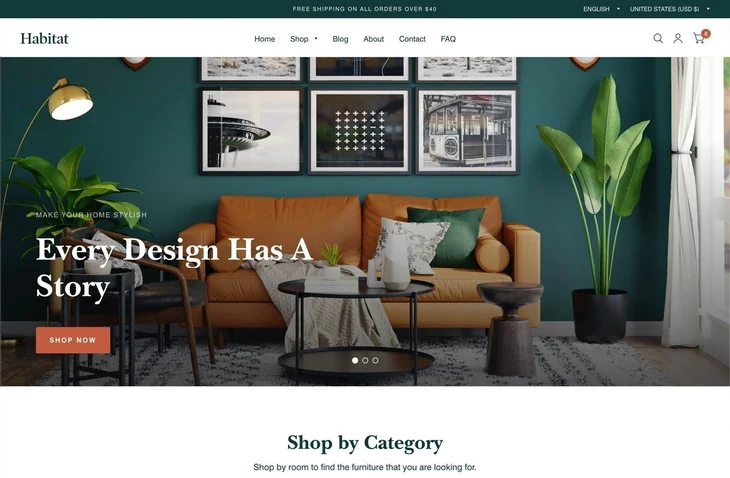
Habitat’s homepage leads with a full-width hero and a shop-by-category grid, the layout you see across most of its demo stores. The look is editorial: generous whitespace, a serif display face for headings, and muted, natural color palettes that let product imagery set the tone. Nothing on the page shouts, which is the point for a home or lifestyle brand selling on mood as much as on specs.
Across the five presets the structure stays the same while the palette and type pairing change, so you can land on a design that reads as yours without rebuilding the page from scratch. Section-based editing means you drag homepage and landing blocks into place and preview as you go, with no code needed for the standard layouts. The one thing to check before buying is how the hero and collection grid feel with your own photography rather than Fuel’s polished demo images, since the theme leans heavily on image quality.
Habitat Features
A deep library of sections
Habitat ships with dozens of custom sections for building homepage and landing-page layouts without touching code. That depth is what lets a focused catalog do most of its merchandising through the theme itself, before any apps enter the picture.
Built-in merchandising and shopping tools
The theme covers most of what a growing store needs out of the box, so you install fewer apps to reach a complete storefront:
- Quick view and a slide-out cart for faster browsing
- Cross-selling and promo tiles to lift average order value
- Color and swatch filters plus a mega menu for larger ranges
- Lookbooks and shop-the-look sections for visual merchandising
- Product tabs, product videos, and size charts on the product page
Presets and translations
Five presets give you distinct starting points, and the theme includes EU translations in five languages, which saves setup time if you sell across European markets. Each preset is a full design rather than a color swap, so the choice shapes typography and section styling, not just the palette.
Habitat Pricing
Habitat is a one-time purchase of $360 on the Shopify Theme Store. That is a single license fee, not a subscription, and it includes Fuel Themes’ updates and support. At the premium end of the Theme Store, the price sits alongside themes like Prestige and Impulse, so you are not paying for a bargain; you are paying for the preset library, the section depth, and a developer who supports the theme directly. Weigh that against a free official theme if your budget is tight, but factor in the build time those themes ask for in return.
Habitat Pros and Cons
Pros
- Real-world speed ahead of premium rivals Prestige and Impulse
- Five full presets for a fast, polished build
- Strong Theme Store rating from its user base
- Dozens of sections and built-in merchandising tools reduce app reliance
- Editorial design tuned for photography-led home, decor, and lifestyle stores
Cons
- Premium one-time price, well above free official themes
- Smaller developer footprint means fewer third-party tutorials and forum answers
- Modest review base, so the high rating rests on a small sample
- Less suited to very large faceted-search catalogs or flash-sale-driven stores
Who Should Use Habitat?
Habitat suits a mid-size, visually driven store that wants a polished front end without a long build. It is a natural fit for a home, decor, lifestyle, or apparel brand with roughly a dozen to a few hundred products, a clear visual identity, and a plan to merchandise through sections and lookbooks rather than a large app stack. If you would rather start from a finished preset than wire a theme from scratch, it saves real time.
It gives back less if your store leans on faceted search across a very large catalog, lives on constant flash promotions, or you want a theme with a big third-party ecosystem behind it. If you like the premium, versatile angle but want to compare before deciding, the Modular theme sits in a similar price band with a different set of trade-offs.
Our Verdict on Habitat
Habitat earns its place by doing the hard thing for a premium theme: staying fast on real stores. It leads premium rivals on Core Web Vitals, carries a strong Theme Store rating, and gives photography-led brands a polished starting point across five presets. The honest caveats are its price and its smaller footprint, which means fewer tutorials, a thinner community, and a modest review base, so you lean more on Fuel Themes’ own support when you hit a question.
If you run a home, decor, lifestyle, or apparel store and want a fast, editorial theme without a long build, Habitat is a credible pick. Load a demo with your own photography first, and send Fuel a pre-sale question to judge their support before you buy. You can compare it with other options in our Shopify theme reviews guide, and the live adoption, speed, and app data behind this review sits on our Habitat theme statistics page.
-
Who makes the Habitat Shopify theme?
Habitat is built and supported by Fuel Themes, a studio that has sold Shopify and WordPress themes for years. It is a premium Theme Store product, so Fuel handles updates and support directly rather than leaving it to a marketplace. That direct line matters on a smaller theme, since you rely on the developer more than on a large community.
-
How much does the Habitat theme cost?
Habitat is a one-time purchase on the Shopify Theme Store rather than a subscription. It sits at the premium end of Shopify’s paid themes, so you pay a single upfront license fee with no recurring charge. The fee includes the full preset library, updates, and Fuel Themes’ support.
-
Is the Habitat Shopify theme fast?
Yes. On the real stores we detect, Habitat passes Google’s Core Web Vitals at a higher rate than most premium themes, including Prestige and Impulse. These are Chrome User Experience Report field numbers from live storefronts, not lab tests, so they reflect what shoppers actually experience. Its speed holds up even on stores running more apps than average.
-
What type of store is Habitat suited to?
Habitat fits mid-size, visually driven stores in home, decor, lifestyle, and apparel. It rewards brands with a clear visual identity and a focused catalog that merchandise through sections and lookbooks rather than a large app stack. Stores that lean on faceted search across very large catalogs, or on constant flash sales, are a weaker match.
-
How many presets does Habitat include?
Habitat ships with five presets: Habitat, Merino, Veloce, Pebl, and Strukt. Each is a full design rather than a color swap, so your choice shapes typography and section styling as well as the palette. That lets you land on a look that reads as your own without rebuilding the theme from scratch.
-
Does Habitat work for large catalogs?
Habitat is built for focused catalogs, roughly a dozen to a few hundred products, where photography and sections do the merchandising. A very large store that depends on faceted search and heavy filtering may find it limiting and could be served better by a theme designed around large inventories. For a curated range, the built-in filters and collection layouts are enough.