Heritage Shopify Theme Review 2026
Last modified: September 24, 2026

Heritage is a free, Shopify-built theme from the Horizon collection, made for brands that sell through a story rather than a wall of products. It leans editorial, with long hero sections, roomy spacing, and asymmetrical galleries that give a brand space to explain itself before it asks for the sale. On the Shopify Theme Store it holds a 54% positive rating from 13 reviews, a mixed signal worth weighing against the theme’s strengths before you install.
The verdict upfront: Heritage suits a founder-led store with strong photography and a small catalog, and it is a weak choice for a large, spec-heavy catalog where shoppers compare details. Because it is one of Shopify’s own free themes, its updates and admin polish track Shopify’s roadmap directly, which is a real safety net for a solo founder. The trade-off is feature depth, since the merchandising extras that paid themes bundle are lighter here and often need an app.
What Is the Heritage Shopify Theme?
Heritage is a free theme published by Shopify on its own Theme Store, part of the newer Horizon collection that introduced nested theme blocks and a more flexible section model. It is aimed at merchants who want an editorial storefront that reads like a brand’s own site instead of a generic catalog. Jewelry and accessories, apparel, food and drink, and home goods with a real point of view are its natural home.
Because Heritage is Shopify’s own theme, you get it at no cost and Shopify maintains it directly, so security fixes and Online Store 2.0 features arrive on Shopify’s schedule rather than a third-party developer’s. That is reassuring for a small team that does not want to depend on an outside vendor. It also means the feature set is deliberately narrower than most paid themes with the same editorial look.
View Heritage on the Shopify Theme Store
What Apps Do Heritage Merchants Run?
Because ShopThemeDetector scans live stores, we can see the apps Heritage merchants actually install, not the ones a feature list suggests. The pattern says a lot about who picks this theme.
| Rank | App | % of stores | Category |
|---|---|---|---|
| 1 | Judge.me Product Reviews App | 36.5% | Product reviews |
| 2 | Klaviyo | 17.5% | Email Marketing |
| 3 | Loox ‑ Product Reviews App | 9.5% | Product reviews |
| 4 | Recharge | 7.9% | Subscriptions |
| 5 | Shopify Inbox | 7.9% | Support - Other |
| 6 | Gsc Countdown Timer | 5.6% | Countdown timer |
| 7 | Rebuy Personalization Engine | 5.6% | Checkout - Other |
| 8 | Instafeed ‑ Instagram Feed | 4.8% | Marketing - Other |
| 9 | Simprosys Google Shopping Feed | 4.8% | Marketplaces |
| 10 | Yotpo | 4% | Product reviews |
Product reviews and email lead the list, which fits a brand-first audience: Judge.me and Loox for the social proof editorial stores lean on, and Klaviyo for lifecycle email. Subscriptions and a personalization engine show up too, a sign that Heritage stores tend to build repeat purchases around a small, curated range. If you already plan to run this kind of stack, Heritage will sit comfortably beside it.
Heritage by the Numbers
Adoption is the honest part of any theme review, and Heritage is not a mass-market default. Our live detection data shows where it sits.
A small share of the 3.5M+ Shopify stores we track run Heritage, and those stores carry fewer apps on average than the typical store. That leaner profile fits an editorial theme with a small catalog, where the design does the selling and there is less need to bolt on extra tools. Low adoption is not a mark against the theme, it simply means Heritage is a deliberate choice rather than the default everyone lands on.
Is Heritage Gaining Ground?
A theme’s direction matters as much as its current share, so here is how Heritage’s footprint has moved month over month.
Heritage has held steady at about 0.1% of Shopify stores in our dataset over recent months.
Heritage has held a steady share of the stores we scan in recent months. For a free theme that competes with Shopify’s own Dawn as a starting point, holding ground is a reasonable outcome, and it tells you the theme is being kept and used rather than swapped out soon after install.
How Fast Is the Heritage Theme?
Speed here is real-world Core Web Vitals from Chrome’s field data across live Heritage stores, not a lab score from one test page. It reflects the theme and the kind of stores running it.
| Theme | CWV pass rate | Few apps | Median LCP |
|---|---|---|---|
| Craft | 83.3% | 85.6% | 1.4s |
| Heritage | 72.4% | 81.8% | 1.7s |
| Dawn | 70.9% | 79.6% | 1.6s |
Heritage’s field results are solid for an image-led editorial theme, and they improve further on stores running only a few apps, which isolates the theme’s own code from app bloat. Most live Heritage stores clear Google’s thresholds and the median largest-contentful-paint sits in the good range. Your own result will still hinge on image sizes and how many apps you add, but the theme is not working against you on performance.
Heritage Design and Layout
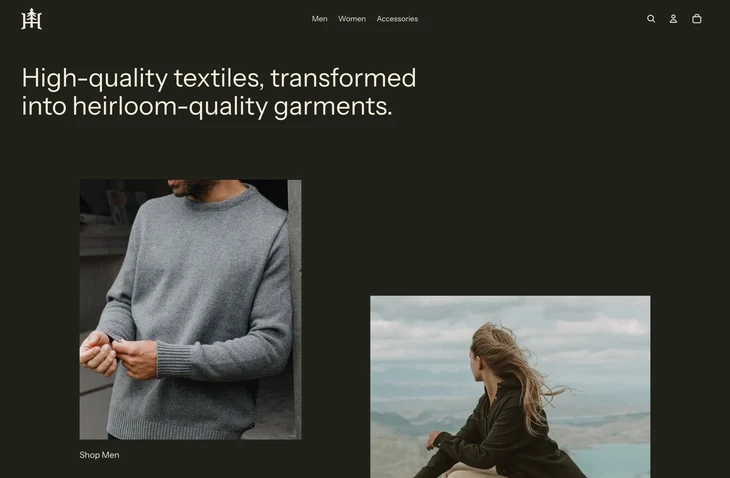
Heritage’s homepage is built around a full-bleed hero and stacked, image-led sections that read like a lookbook. The default look pairs a quiet serif with generous whitespace on a dark canvas, so photography carries the design instead of borders and boxes. It is a layout that flatters strong imagery and exposes weak imagery, the trade-off with any editorial theme.
The Horizon foundation shows up in how the page is built. Sections and nested blocks are drag-and-drop, so you can rearrange a hero, a gallery, and a featured collection without touching code. Asymmetrical, organic galleries are part of the design language, which is what gives Heritage its magazine feel, though it also means a store with thin product photography will look sparse until the imagery catches up.
Heritage Features Worth Knowing
Horizon theme blocks
Heritage inherits Shopify’s Horizon block model, where sections hold nested blocks you can add, reorder, and style in the editor. For a small team without a developer, that is the difference between shaping a page in an afternoon and waiting on custom code. It also keeps the door open to Shopify’s newer section features as they roll out.
Editorial storytelling sections
The theme ships immersive galleries and long-form sections designed to let a brand voice lead. These are the tools an editorial store uses to show a product in context, styled and shot, rather than as a lone cutout on white. They reward real copy and real photography, so plan your content before you install.
Tactile product pages
Heritage’s product pages are built to highlight texture, color, and craftsmanship, which suits apparel, jewelry, and small-batch goods where the material is part of the pitch. Expect the essentials done cleanly rather than a dense merchandising toolkit, and budget an app for advanced filtering or multi-attribute swatches if your range needs them.
Cart, checkout, and the basics
The theme covers the standard cart-and-checkout flow, and this is where some Theme Store reviewers have flagged problems, including a reported cart-drawer bug on certain interactions. It is the main reason the rating reads mixed, so preview the cart behavior with your own products before you commit, and keep an eye on Shopify’s updates since Shopify maintains the theme directly.
Heritage Pricing
Heritage is Free, with no one-time fee and no subscription, because it is one of Shopify’s own themes. That makes it a low-risk starting point: you can install it, preview it with real content, and switch away at no cost if it does not fit.
The real budget with a free theme is the app stack, not the theme. Reviews, email, and any subscriptions or advanced merchandising you need will each carry their own cost, and Heritage expects you to add them. Weigh that against a paid editorial theme, which bundles more of those conveniences into a single up-front price. For a lean, story-first store, the free base plus a few chosen apps is usually the better deal.
Heritage Pros and Cons
Pros
- Free, and built and maintained by Shopify, so updates and security fixes track Shopify’s roadmap
- Editorial, photography-first layouts with a distinctive dark, magazine feel
- Horizon theme blocks make sections drag-and-drop, with no code needed
- Solid real-world Core Web Vitals, and stronger still on lightly-loaded stores
- Leaner app footprint than average, which keeps the base fast
Cons
- Mixed Theme Store rating tied to specific bug reports, including a cart-drawer issue
- Lighter merchandising toolkit, so dense filtering and swatches often need an app
- Editorial sections look empty without strong, on-brand photography
- Built for small catalogs, so a large, spec-heavy range will feel cramped
- Niche adoption means a smaller community and fewer third-party tutorials
Who Should Use Heritage?
Heritage suits a founder-led brand that sells through identity and imagery: apparel and accessories, jewelry, food and drink with a real story, and home goods with a small, curated range. If your product needs context and styling to sell, Heritage’s editorial layouts do that work, and the free price makes it a low-risk way to launch a brand-first storefront.
If you want an editorial storefront but expect to outgrow a free theme’s feature set, compare Heritage with the Story theme, a paid, storytelling-led option, and the Palo Alto theme. Apparel brands weighing their options should also browse our roundup of Shopify fashion themes, since apparel is where most Heritage stores land.
Heritage is the wrong tool for a large catalog, a spec-driven store where shoppers compare technical details, or a merchant with no photography budget yet. In those cases a denser theme or a dedicated catalog layout will serve you better, and you can always start on Heritage while the brand and imagery come together.
Our Verdict on Heritage
Heritage is a well-judged free theme for the right store: a distinctive editorial base, Horizon’s flexible blocks, and real-world speed that holds up despite the image-heavy design. Its mixed Theme Store rating is worth taking seriously, but it reads as specific, fixable bug reports on a Shopify-maintained theme rather than a verdict on the design, so preview the cart flow and watch for updates.
For how Heritage sits next to other options, see our Shopify theme reviews guide, and for the full detection data behind this review, the Heritage usage statistics page. If your store has the photography and the story to fill it, Heritage is a confident, low-risk, brand-first choice. If it does not yet, that is a content problem to solve first, on Heritage or any editorial theme.
-
Is the Heritage Shopify theme free?
Yes. Heritage is one of Shopify’s own themes, so it is free to install from the Shopify Theme Store with no one-time fee and no subscription. You only pay for your Shopify plan and any apps you add. Because Shopify builds and maintains it, updates and security fixes come directly from Shopify rather than a third-party developer.
-
Who makes the Heritage Shopify theme?
Heritage is made by Shopify and published on Shopify’s own Theme Store as part of its Horizon theme collection. That collection introduced nested theme blocks and a more flexible section editor. Being a first-party theme means its roadmap, admin polish, and support track Shopify itself instead of an outside vendor.
-
What kind of store is Heritage a good fit for?
Heritage fits founder-led, story-first brands with strong photography and a small, curated catalog. Apparel and accessories, jewelry, food and drink, and home goods with a clear point of view all suit its editorial layout. It is a weak fit for large, spec-heavy catalogs where shoppers compare technical details, since the design is built to show fewer products in more depth.
-
Is Heritage a fast Shopify theme?
In Chrome’s real-user field data, most live Heritage stores pass Google’s Core Web Vitals, and the pass rate rises further on stores running only a few apps. That is a solid result for an image-heavy editorial theme. Your own speed will still depend on image sizes and how many apps you install, so keep the app stack lean and compress your photography.
-
Can I customize Heritage without coding?
Yes. Heritage is built on Shopify’s Horizon architecture, so its sections and nested blocks are added, reordered, and styled with drag-and-drop in the theme editor. You can rearrange the hero, galleries, and featured collections without touching code. Deeper design changes or custom features may still call for a developer, but everyday layout edits do not.
-
Why does Heritage have a mixed rating on the Shopify Theme Store?
Its Theme Store rating reads mixed across a small number of reviews, and the negatives center on specific bug reports rather than the design, including a reported cart-drawer issue on certain interactions. Because Shopify maintains the theme, these are the kind of problems that get patched over time. Preview the cart behavior with your own products before you commit.