Recharge Shopify App Review 2026
Last modified: September 16, 2026
Recharge is the 4-most-installed app on Shopify. In our dataset of 3.5 million+ stores, 13.7% run Recharge, a placement that puts it ahead of every other subscription and retention app by a wide margin. Shopify Recharge is a subscriptions app: it turns a one-time purchase into a recurring order, so customers can subscribe to what they reorder and you build repeat revenue that shows up on its own each month.
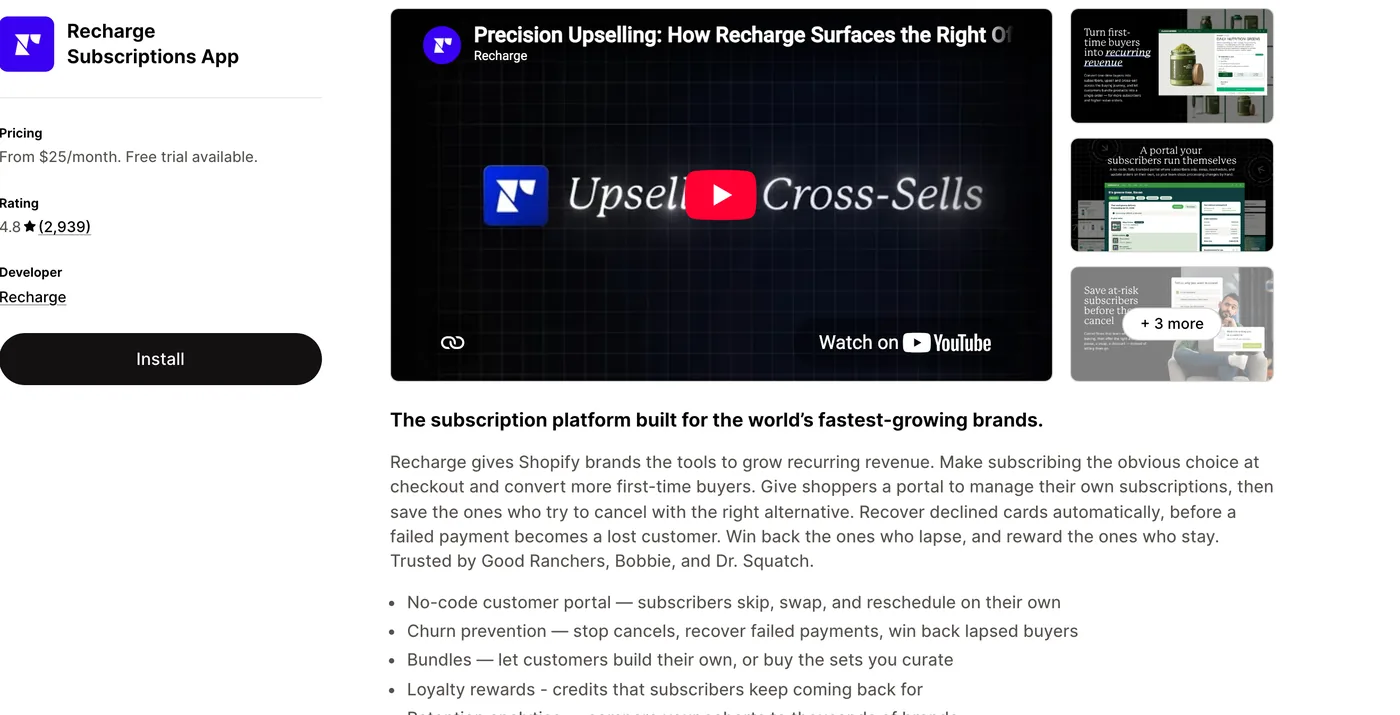
That #4 ranking is the number to weigh first. In most Shopify app categories the leader takes 3 to 5 percent of installs; Recharge sits at 13.7% and holds a 4.8/5 rating across 3,121 reviews, so the market has already picked its subscription tool. The catch is cost. There is no free plan, pricing starts around 25 dollars a month, and Recharge adds a percentage fee on subscription transactions, so it takes a cut of the recurring revenue it helps you earn.
If recurring orders are central to your business, like coffee, supplements, pet food, or household staples, the Recharge app for Shopify is the one most established subscription brands land on and it usually pays for itself. If you only need the occasional subscribe option on a few products, a lighter and cheaper subscription app may be enough. The sections below use live detection data to show how dominant Recharge is, what it does, what it costs, and where it falls short.
What is Recharge?
Recharge is a subscriptions app for Shopify. It lets customers subscribe to products they reorder, turning a one-time sale into a recurring order on a schedule they control. Shoppers manage their own subscriptions through a customer portal, where they can skip, swap, pause, or reschedule an order without emailing you, which cuts support work and keeps subscribers happy. It connects to Shopify checkout and customer accounts, so the subscribe option sits right next to a normal purchase. Here is how widely it is installed across our dataset.
How popular is Recharge?
Recharge does not just lead the subscriptions category, it dominates it. Live detection shows it used many times more than the next subscription app in the ranking, and it is the most-used app of any kind among subscription stores. It is also one of the most-installed apps on all of Shopify. When a store runs subscriptions seriously, it almost always runs Recharge.
One note on the trend: Recharge’s monthly detection has slipped rather than grown lately, which is worth watching for a category leader. It remains overwhelmingly dominant, but newer, cheaper subscription apps have appeared, and some cost-sensitive stores may be testing them, especially given Recharge’s transaction-fee pricing.
Recharge has slipped from 16.7% to 9.7% of Shopify stores in our dataset over recent months.
What does Recharge do?
At its core, Recharge handles recurring billing: it charges subscribers on schedule and creates the repeat orders automatically. Around that core it adds the tools that actually keep a subscription business alive, which is where it separates from a basic subscribe button.
The subscriber portal lets customers manage their own plans, so they skip, swap, pause, or reschedule instead of canceling or emailing support. Automatic retries recover failed payments when a card declines, which quietly saves a meaningful slice of revenue. Cancellation-reduction prompts, product bundles, and retention analytics round it out, giving you both the levers to reduce churn and the data to see how your subscriber base is growing. Together these are why established subscription brands standardize on it.
Recharge features
Recharge is built specifically for subscriptions, and its feature set reflects that focus rather than trying to be a general marketing app.
- Recurring billing: automatic scheduled charges and repeat orders, tied into Shopify checkout.
- Customer portal: subscribers skip, swap, pause, or reschedule their own orders without contacting you.
- Failed-payment recovery: automatic retries when a card declines, to recover otherwise-lost revenue.
- Churn tools: cancellation-reduction prompts to keep subscribers on board longer.
- Bundles: let customers subscribe to a curated set of products in one plan.
- Retention analytics: track subscriber growth, churn, and lifetime value.
What you will not find is email marketing, reviews, or general store tools. Recharge does subscriptions, and expects you to pair it with the other apps in your stack, which is exactly what its users do.
How much does Recharge cost?
Recharge has no free plan. Pricing starts around 25 dollars a month, and on top of the monthly fee it charges a percentage on subscription transactions, so your cost scales with the recurring revenue it processes. In other words, Recharge takes a cut of the subscriptions it helps you run.
That model is the honest sticking point, and it changes the maths compared with a flat-fee app. Recharge pays off once your recurring revenue is real, because the tools that retain subscribers and recover failed payments earn back more than the fee. It does not pay off on day one, or for a store with only a handful of subscribers, where the monthly minimum and the transaction cut outweigh the returns. Before you commit, price it against your expected subscription volume, not your hopes for it.
Which themes and apps run with Recharge?
Because we detect both themes and apps, we can see the company Recharge keeps. On the theme side it is near-universal, showing up most on Shopify’s free Dawn theme and then across popular premium themes, which reflects how widespread it is rather than any special pairing. Here are the themes most commonly running it.
| Rank | Theme | % of stores |
|---|---|---|
| 1 | Dawn | 15.5% |
| 2 | Horizon | 5.1% |
| 3 | Prestige | 4.4% |
| 4 | Shrine PRO | 3.5% |
| 5 | Impulse | 3.3% |
| 6 | Elixir | 3.1% |
| 7 | Impact | 3.0% |
| 8 | Minimog OS 2.0 | 1.9% |
| 9 | Kalles | 1.9% |
| 10 | ella | 1.8% |
On the app side, Recharge sits at the center of a full retention stack. Most Recharge stores also run a reviews app, a major email platform, and page builders, and they carry heavier app stacks than the average store. That company is telling: Recharge is chosen by stores operating a real repeat-purchase program, not by minimal ones. For the full breakdown of themes, paired apps, and store types, see the live Recharge usage statistics.
What kinds of stores use Recharge?
By definition, Recharge stores are subscription stores, and they cluster in the categories where repeat orders are natural. Health and beauty leads, followed closely by apparel and accessories, food and drink, and home and garden, the categories behind supplements, skincare refills, coffee, and household staples. Some of the biggest direct-to-consumer names run on it.
These stores skew large and established, with sizable catalogs and around ten apps in play, which fits a platform built to run a serious subscription operation. The pattern is clear: Recharge is the choice of scaling and established brands where recurring revenue is a core channel, and less relevant to a brand-new or occasional-subscription store.
Where Recharge falls short, and who should skip it
The honest downsides are cost and focus. On cost, the no-free-plan start and the percentage transaction fee mean Recharge only makes sense once subscriptions are a real revenue stream, so a small store dipping a toe into subscriptions pays more than the feature returns. On focus, Recharge is a subscriptions specialist, not a general marketing app, so you are adding a dedicated tool and a dedicated bill for one job.
Who should skip it: a store that only wants an occasional subscribe option on a few products, or one still validating whether subscriptions will work at all. In those cases a lighter, cheaper subscription app gives you the basic subscribe-and-save without the platform pricing, and you can graduate to Recharge once recurring revenue proves out. None of this makes Recharge a weak product, it is the category leader, but it is built and priced for stores where subscriptions are central, not incidental.
On the storefront, Recharge mainly adds a subscription widget to product pages. Checkout and the customer portal run on Recharge’s side. The comparison below shows whether that costs any speed. It matches stores running Recharge against similar stores without it, using real-user Core Web Vitals data from Google’s Chrome UX Report.
Does Recharge slow a store down?
Compared only against stores on the same theme, running the same number of apps and carrying a similar catalogue, stores with Recharge installed pass Core Web Vitals 1.4 points lower of the time (8,066 comparable stores across 985 matched groups).
| Comparison | With Recharge | Without | Stores compared |
|---|---|---|---|
| Like-for-like stores | 60.7% | 62.2% | 8,608 with · 35,929 without |
| All stores, unmatched | 60.2% | 69.4% | 9,777 with · 49,165 without |
Who should use Recharge?
Recharge is the right pick if you are an established or scaling brand where recurring orders are a core part of the business, especially in supplements, skincare, coffee, or household staples, and you have the subscriber volume to justify the fee. For that store, no other Shopify subscription app matches its depth of portal, recovery, and retention tools, and the returns comfortably cover the cost.
Pass on Recharge if you are just starting out, only need the occasional subscribe option, or are not yet sure subscriptions will be a real channel for you. In that case a simpler, cheaper subscription app gives you the basics without a monthly minimum and a transaction cut, and Recharge will still be there when your recurring revenue grows into it.
Recharge does not exist in a vacuum. To see how it compares with the alternatives, browse our guide to Shopify subscription apps, or the wider recurring payment apps if installments and recurring invoices matter to your store.
Subscription stores also have to answer for returns. Our Loop review covers the returns and exchanges app most-installed on Recharge stores, worth reading alongside this one if churn from bad returns is a live problem for you.
-
Is Recharge free?
No. Recharge has no free plan. Pricing starts around 25 dollars a month, and it adds a percentage fee on subscription transactions, so the cost scales with the recurring revenue it processes. Because of that, it pays off once subscriptions are a real revenue stream rather than on day one, so price it against your expected subscription volume first.
-
How much does Recharge cost?
Recharge starts around 25 dollars a month, with no free plan, and charges a percentage on subscription transactions on top of the monthly fee. That means your bill grows with your subscription revenue. It is worth it once the tools that retain subscribers and recover failed payments earn back more than the fee, which happens when recurring orders are a genuine channel.
-
What is Recharge used for?
Recharge is used to run product subscriptions on Shopify. It turns one-time purchases into recurring orders, gives customers a portal to skip, swap, pause, or reschedule, recovers failed payments automatically, and provides bundles and retention analytics. It is a subscriptions specialist rather than a general marketing app, so stores pair it with their reviews, email, and other tools.
-
Is Recharge worth it?
For an established brand where recurring orders are central, yes. Its portal, failed-payment recovery, and retention tools are the most complete in the category, and the returns cover its fee once subscription revenue is real. It is not worth it for a store that only wants an occasional subscribe option, where the monthly minimum and transaction cut outweigh the benefit.
-
What is the best alternative to Recharge?
Recharge is the dominant subscriptions app by a wide margin, and lighter alternatives like Seal Subscriptions or other subscribe-and-save apps are cheaper and simpler, which suits smaller stores or those just testing subscriptions. They lack Recharge’s depth of portal, recovery, and analytics, so most established subscription brands still choose Recharge once recurring revenue matters.
-
What kinds of stores use Recharge?
Recharge stores are subscription stores, concentrated in categories with natural repeat orders: health and beauty, apparel, food and drink, and home and garden, think supplements, skincare, coffee, and household staples. They tend to be larger, established brands with sizable catalogs and full app stacks. You can see the full breakdown on the live Recharge statistics page.
Is Recharge worth it?
For a real subscription business, yes, and it is the clear category leader. Recharge’s subscriber portal, failed-payment recovery, bundles, and retention analytics are more complete than the alternatives, which is why the most established repeat-order brands on Shopify run it and rate it 4.8 out of 5. The trade-off is its pricing: there is no free plan, it starts around 25 dollars a month, and the percentage transaction fee means it takes a share of your recurring revenue, so it pays off once subscriptions are a real channel and not before. Price it against your expected subscription volume, and if recurring orders are central to your store, it earns its place. To see how it fits alongside everything else, browse our guide to the best Shopify apps. And any time you spot a brand running a slick subscribe-and-save, you can scan it to see whether it runs Recharge and which theme and apps it pairs with.