Stiletto Shopify Theme Review 2026
Last modified: October 1, 2026
Stiletto is a premium Shopify theme from Fluorescent Design, built for brands that sell on the strength of their photography. Think fashion, jewelry, accessories, and upscale food and drink, where a clean, editorial layout does more selling than any feature list. It ships with 5 presets, so a minimalist label and a colorful boutique can both start from a look that already fits. If your product images are your strongest asset and you want built-in merchandising tools rather than a bare starting point, Stiletto is aimed at you. If you sell a tiny catalog or a purely utilitarian product, a lighter theme will get you live faster for less.
This review is backed by our detection data on the real stores running Stiletto, not just the demo. That data shows who actually picks this theme, what apps they run alongside it, and how their storefronts perform for real shoppers. It is a more honest read than a marketing page, and it points to a clear pattern: Stiletto is a merchandising-heavy theme that image-led brands reach for as their catalog grows.
What Is Stiletto?
Stiletto is a paid Shopify theme from Fluorescent Design Inc., a studio known for polished, editorial storefronts. It sells on the Shopify Theme Store as a one-time purchase, which means official Theme Store support, a free trial to test it on your own products, and a public review history you can read before you buy. The look is fashion-forward: large imagery, generous whitespace, and typography that flatters lifestyle and product photography.
The theme ships with 5 presets, named Stiletto, Luster, Linen, Glimmer, and Tapestry. Each is the same theme dressed in a different mood, so a modern label, a boho boutique, and an upscale food brand can each start from a design that already suits them and adjust from there. That preset range is one reason Stiletto turns up across apparel, jewelry, beauty, and specialty food stores rather than one narrow niche.
What Apps Do Stiletto Merchants Install?
The apps a store runs tell you what kind of business it is. Here is the real install pattern across the Stiletto stores in our dataset.
| Rank | App | % of stores | Category |
|---|---|---|---|
| 1 | Klaviyo | 54.2% | Email Marketing |
| 2 | Judge.me Product Reviews App | 33.8% | Product reviews |
| 3 | Loox ‑ Product Reviews App | 20.1% | Product reviews |
| 4 | Shop Pay | 17.3% | Payment options - Other |
| 5 | Instafeed ‑ Instagram Feed | 17.2% | Marketing - Other |
| 6 | Yotpo | 15.1% | Product reviews |
| 7 | Swym Wishlist | 12.2% | Wishlists |
| 8 | Recharge | 11.7% | Subscriptions |
| 9 | Triplewhale | 11.1% | Analytics |
| 10 | Gorgias | 10.5% | Support - Other |
The stack reads like a growing retail brand rather than a test store. Email marketing leads, which fits merchants who treat their list as a core sales channel from day one. Product-review apps cluster right behind it, because image-led shops live and die on social proof next to the photography. Further down you find wishlists, subscriptions, and support tooling, the marks of stores building repeat customers rather than chasing a single impulse sale. Notably, Stiletto stores lean on fewer campaign apps than you might expect, because the theme already bakes in countdown timers, free-shipping bars, and promo popups.
How Popular Is Stiletto?
Stiletto is a specialist premium theme, not a mass-market default, and its adoption reflects that. Here is where it sits across the stores we track.
Two numbers behind the rank matter more than the rank itself. Stiletto stores carry larger-than-average catalogs and run more apps than the typical store, which lines up with the merchandising tools built into the theme: mega menus, enhanced search, and filtering exist because these merchants have a lot of products to organize. This is a theme chosen by brands with real inventory and a real marketing operation, not by someone spinning up a one-product test.
How Stiletto Compares
Beyond raw adoption, two things stand out when you measure Stiletto against the wider field of themes we track.
The first is speed. Stiletto ranks among the fastest themes in our dataset by the share of its real stores passing Google’s Core Web Vitals, which is unusual for a design this image-heavy. The second is app load: its stores run more apps than average, a sign of established merchants rather than beginners. Fast and app-heavy is a hard combination to pull off, and it suggests the theme’s code holds up even when merchants pile features on top.
Speed is worth a closer look, because a fashion theme built on large imagery can easily feel slow. Here is how Stiletto’s real stores perform in the field, measured from the Chrome UX Report rather than a single lab test.
| Theme | CWV pass rate | Few apps | Median LCP |
|---|---|---|---|
| Stiletto | 79.4% | 85.4% | 1.7s |
| Impulse | 78.4% | 85.4% | 1.6s |
| Dawn | 71.2% | 79.9% | 1.6s |
The field data is genuinely strong. Filtered down to stores running only a few apps, the pass rate climbs higher still, which isolates the theme’s own speed from the app bloat merchants add. In plain terms: Stiletto is not paying for its editorial looks with a slow storefront, and that is a real point in its favor for image-first brands who usually have to choose between the two.
Stiletto’s Design and Presets
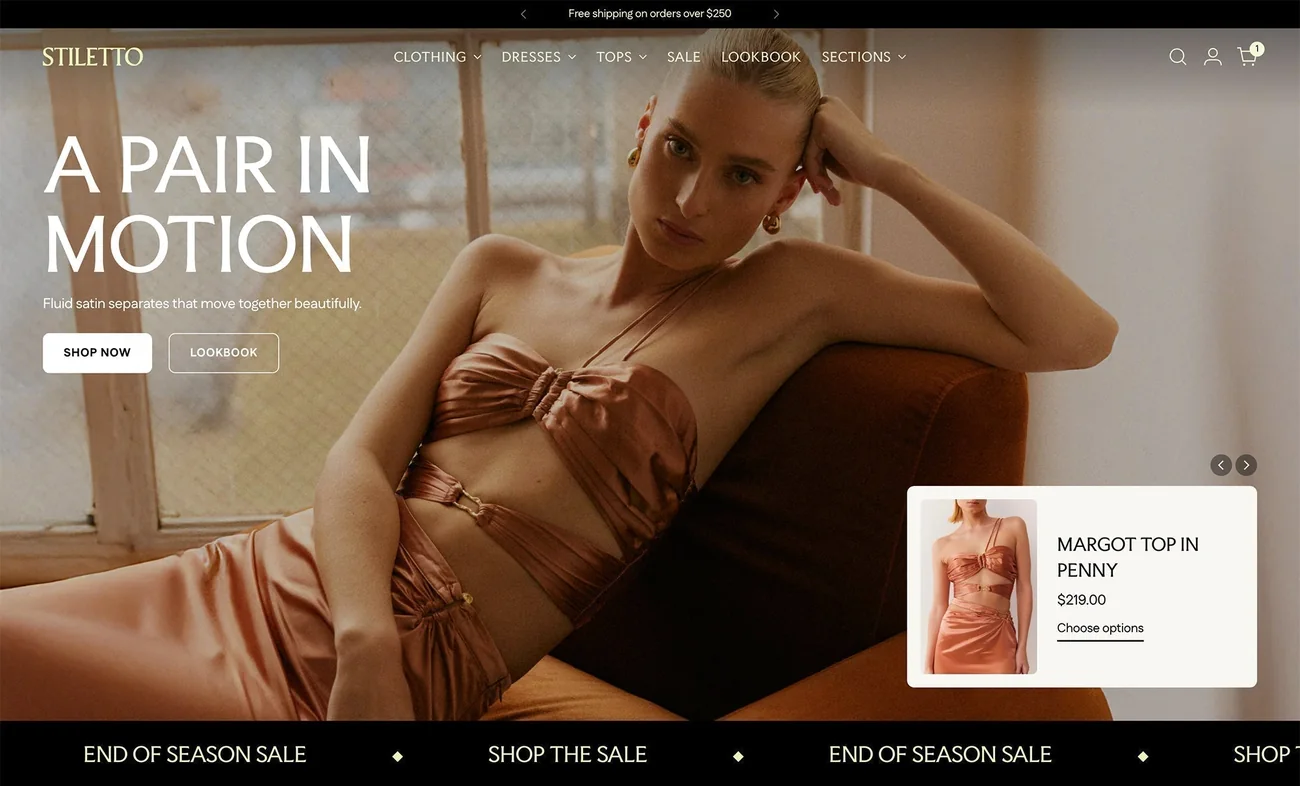
Stiletto’s design language is editorial. Layouts give photography room to breathe, product grids stay clean, and the type choices lean upscale rather than busy. The 5 presets are the fastest way to see its range: Stiletto and Luster read modern and fashion-led, Linen is softer and more natural, Glimmer leans bright and playful, and Tapestry is richer and more textured. You pick the closest starting point and shape it from there.
The honest note is that the presets are a starting point, not a finished store. The demo looks polished because it is filled with professional photography and carefully arranged sections. To get the same result you will spend real time in the editor and, more importantly, on your own images. A theme this presentation-led rewards good photography and punishes weak photography, so budget for both the layout work and the shoot.
The demo sets a high bar
Stiletto’s demo looks expensive because of the photography and the layout work behind it, not the preset alone. If your product images are not strong yet, the theme will expose that. Plan for a photography pass and some editor time before you expect your store to match the demo.
Stiletto Features That Matter
Stiletto leans hard into merchandising and conversion, which is what lets its stores run a leaner app stack. The features that carry the most weight:
- Mega menus and enhanced search to keep a large catalog browsable, which matters because Stiletto stores tend to carry a lot of products.
- Image hotspots, lookbooks, and before-and-after sliders to tell a visual story right on the product page.
- Product videos for brands that want motion alongside stills.
- Cart upsells and a sticky buy button to lift order value and keep the buy action in reach as shoppers scroll.
- Free-shipping bars, countdown timers, and promo popups so most campaign mechanics work without extra apps.
How Much Does Stiletto Cost?
Stiletto is a one-time purchase on the Shopify Theme Store, not a subscription, and it sits toward the premium end of the range. You pay once and own the theme, with no monthly fee, and the purchase includes the 5 presets, free updates, and Fluorescent Design’s support. Because it is sold through Shopify, you can install it on a development store and test it against your own products before you pay.
| Theme | Price |
|---|---|
| Stiletto | $380 |
One-time, at the premium end
Stiletto is a single payment rather than a subscription, which works out friendlier than a monthly theme once you count a few years of use. It does sit toward the top of Theme Store pricing, so try it on a development store first and confirm the current figure on the listing before you buy.
Stiletto Pros and Cons
Pros
- Polished, editorial design that makes product photography look expensive
- Built-in merchandising and upsell tools reduce how many apps you need
- Strong real-world Core Web Vitals despite the image-heavy layout
- 5 presets cover fashion, boutique, beauty, and specialty food
- One-time Theme Store price with a free trial and official support
Cons
- Premium price at the higher end of the Theme Store
- A real setup curve, with plenty of editor time before it looks like the demo
- Rewards strong photography and exposes weak photography
- Overkill for tiny catalogs or purely utilitarian products
Who Should Use Stiletto?
Choose Stiletto if you run an image-led brand with a growing catalog and you value presentation and built-in tools over a bare, minimal base. Jewelry, accessories, apparel, beauty, and design-forward food and drink are its natural home. If you are weighing other premium themes from the same studio, our Testament review covers a photography-led boutique theme at a lower price, and the Envy review looks at a multi-preset theme that spans similar niches.
Look elsewhere if your catalog is tiny, your brand is purely utilitarian, or you want the simplest possible starting point. A lighter theme will get you live faster and for less. For a higher-end, more minimalist alternative aimed at established fashion brands, compare it with our Prestige review, or our Reformation review for a more feature-packed fashion option.
Is Stiletto Worth It?
Our verdict
For an image-led brand with real inventory, Stiletto is a strong buy: it makes photography look expensive, its built-in merchandising cuts your app bill, and its real stores stay fast despite the heavy visuals. The trade-offs are the premium price and a genuine setup curve. Skip it if your catalog is tiny, your brand is utilitarian, or you want a minimal base you can ship in an afternoon.
Stiletto earns its place for brands that lead with images and want the merchandising built in rather than bolted on. Weigh it against the rest of the lineup in our complete guide to Shopify theme reviews, and check the live numbers any time on our Stiletto usage statistics page.
-
Who makes the Stiletto Shopify theme?
Stiletto is built by Fluorescent Design Inc., a studio that specializes in polished, editorial storefronts. It is sold on the Shopify Theme Store as a one-time purchase, so it comes with official Theme Store support and a free trial you can run on your own products.
-
How much does the Stiletto theme cost?
Stiletto is a one-time purchase on the Shopify Theme Store, with no monthly fee, and it sits toward the premium end of the range. The price includes the theme, its 5 presets, free updates, and developer support. You can confirm the current figure on the Shopify Theme Store listing before you buy.
-
Is Stiletto good for fashion and jewelry stores?
Yes. Stiletto is built for image-led retail, and in our detection data its stores skew heavily toward apparel, accessories, jewelry, and beauty. The editorial layouts and large imagery are designed to put product photography at the center of the sale, which suits those categories well.
-
Is the Stiletto Shopify theme fast?
For an image-heavy theme, yes. Stiletto ranks among the fastest themes in our dataset by the share of its real stores passing Google’s Core Web Vitals, and stores running only a few apps do even better. The live figures are on our Stiletto usage statistics page, refreshed daily.
-
What presets does Stiletto include?
Stiletto ships with 5 presets: Stiletto, Luster, Linen, Glimmer, and Tapestry. Each is the same theme with a different mood, from modern and fashion-led to soft, bright, or richly textured, so you can pick the closest starting point and adjust from there.
-
Does a Stiletto store need a lot of apps?
Less than you might expect. Stiletto builds in mega menus, enhanced search, cart upsells, countdown timers, free-shipping bars, and promo popups, so much of what other stores add through apps is already there. In our data its merchants still run a healthy app stack, but a lot of it is email, reviews, and subscriptions rather than basic merchandising.