Postscript SMS Marketing Review, Tested 2026
Last modified: September 16, 2026
Postscript is an SMS and MMS marketing platform built specifically for Shopify. It handles the text-message side of a store’s marketing: collecting subscribers through popups and keywords, sending campaigns for launches and sales, and running automated flows like abandoned cart, welcome and back-in-stock, all segmented with your Shopify customer and order data. In our detection data it is one of the most-used SMS apps on Shopify, and the stores that run it are established, app-heavy brands rather than new shops. The verdict upfront: for a US store with real SMS volume, Postscript is a serious, capable choice, and it pairs naturally with an email tool. The honest catch is cost and reach. Pricing is usage-based with a monthly minimum, the bill climbs with every message, and the platform is built around US toll-free numbers and carrier rules.
If you are a growing US brand that wants SMS as a genuine revenue channel alongside email, Postscript earns its place, and most of its stores run it next to Klaviyo for exactly that split. If you are small, international, or just want email and SMS in one simpler tool, a combined platform like Omnisend or Klaviyo’s own SMS will cover you with less overhead. The sections below use live detection data to show how widely Postscript is used, what it does, what it costs, and the kind of store it fits.
What is Postscript?
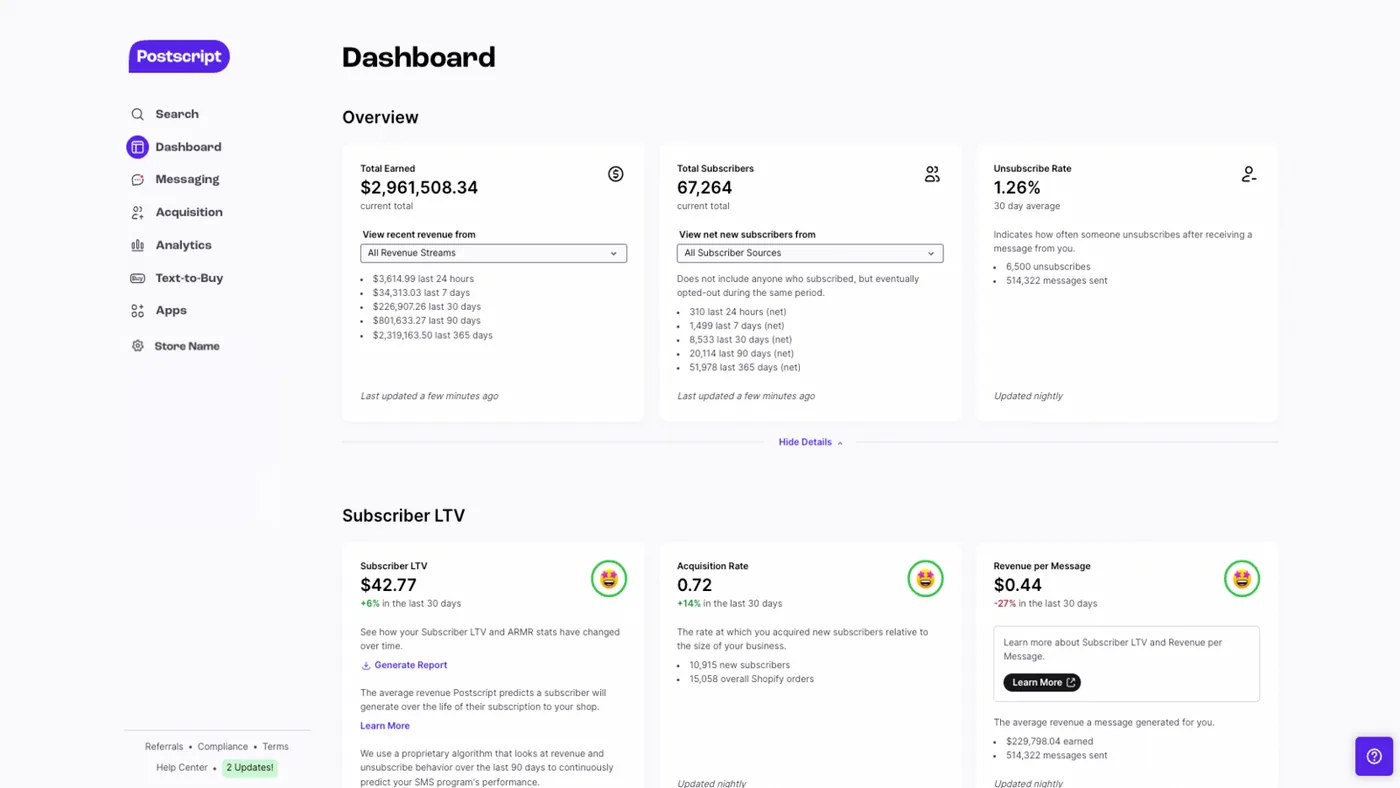
Postscript is an SMS and MMS marketing platform made for Shopify. It gives a store one place to build a text-message subscriber list, send broadcast campaigns, and run automated flows triggered by shopper behaviour. Because it is built for Shopify, it syncs customer and order data, so a message can be segmented and personalised rather than blasted to everyone. On the acquisition side it collects subscribers through popups, keywords and checkout opt-ins; on the sending side it handles campaigns, two-way conversations, compliance, and an AI layer that helps draft and target messages. It holds a 4.7 out of 5 rating from more than 1,200 reviews on the Shopify App Store. Here is how widely it is installed across our dataset.
How popular is Postscript?
Postscript sits among the leaders of the SMS category. Live detection makes it a top-five SMS marketing app, used about 3.1 times as often as the next tool in the ranking. The stores that run it carry heavier app stacks than average, a sign of established, marketing-mature brands. One number stands out: almost four in five Postscript stores also run Klaviyo, which tells you how the tool is actually used, as the SMS specialist beside an email platform rather than a do-everything suite.
One trend is worth flagging. Postscript’s share of stores has eased back over recent months rather than grown. That fits a market where email platforms like Klaviyo have folded in their own SMS and a wave of cheaper texting tools has appeared, which pulls at the entry level even as Postscript stays strong among serious senders.
Postscript has slipped from 3.4% to 2.2% of Shopify stores in our dataset over recent months.
What does Postscript do?
Four things. First, list growth: popups, keywords and checkout opt-ins that turn visitors into SMS subscribers with proper consent. Second, campaigns: scheduled broadcast texts for launches, sales and restocks, with A/B testing and segmentation. Third, automation: flows that fire on behaviour, abandoned cart, welcome, back-in-stock and post-purchase, which is where most of the recurring revenue comes from. Fourth, the operational layer, two-way conversations, compliance tooling for US texting rules, deliverability, and reporting that ties messages back to revenue.
The point of all of it is a direct, high-open-rate channel that sits closer to the customer than email. Used well, SMS drives quick, measurable revenue; used carelessly, it burns the list and the budget, which is why segmentation and automation matter more here than raw send volume.
Is Postscript worth it?
For a US store with real SMS volume, yes. When you have a list worth messaging and flows worth automating, Postscript is a capable, Shopify-native way to run the channel, and the revenue reporting makes it easy to see whether it pays. This is why it skews toward established brands rather than new stores.
Where it stops making sense is at low volume or outside the US. The usage-based pricing means a small list rarely justifies the monthly minimum, and the platform’s toll-free-number and compliance model is built around US texting. If SMS is not yet a real channel for you, the spend is hard to earn back.
What Postscript costs
Postscript is free to install but not free to use. Plans carry a monthly minimum spend, then charge per message sent, SMS and MMS at different rates, plus carrier fees, so the real bill scales with how much you text. Higher tiers add support, onboarding and custom integrations rather than cheaper messages. Budget it against the revenue SMS actually brings in, and watch the minimum spend if your list is small, since a recurring theme in reviews is bills arriving larger than expected.
Which themes and apps run with Postscript?
Because we detect both themes and apps, we can see the company Postscript keeps. Its most common theme is Shopify’s free Dawn, followed by conversion-built premium themes like Impulse and Prestige. Here are the themes most often running it.
| Rank | Theme | % of stores |
|---|---|---|
| 1 | Dawn | 15.1% |
| 2 | Horizon | 4.9% |
| 3 | Prestige | 4.9% |
| 4 | Impulse | 4.9% |
| 5 | Impact | 2.8% |
| 6 | Shrine PRO | 2.5% |
| 7 | Broadcast | 2.3% |
| 8 | Palo Alto | 2.3% |
| 9 | Symmetry | 1.6% |
| 10 | Essentials | 1.5% |
The app side is the real tell. Almost every Postscript store runs Klaviyo for email, and most pair it with reviews apps like Loox or Yotpo and a personalisation or upsell tool. That is a mature marketing stack, which is why Postscript stores carry well above the average app count. Postscript is the SMS piece brands add once the rest of the stack is in place. For the full breakdown of themes, paired apps and store types, see the live Postscript usage statistics.
What kinds of stores use Postscript?
Postscript stores skew toward established US direct-to-consumer brands with steady order volume, including a strong showing from subscription businesses where a timely text drives reorders. These are operations with a real marketing budget and a list large enough to justify a dedicated SMS tool, not weekend shops. The profile matches the heavy app stacks and the category position: SMS is a channel these brands add to squeeze more from an audience they already have.
Mind the minimum and the meter
Postscript is usage-based, so the cost is only as predictable as your send volume. The most common complaint in recent reviews is billing, a monthly minimum charged whether or not you send, and totals that climb faster than expected. Before you commit, size the plan to your list and your revenue per send, set the compliance and opt-in settings carefully, and treat SMS as a channel to run deliberately rather than blast.
Postscript pros and cons
Pros
- A dedicated, Shopify-native SMS platform with deep automation and segmentation
- Strong campaign, flow and subscriber-growth tooling with revenue reporting
- Pairs cleanly with an email tool like Klaviyo for a full email-plus-SMS stack
- Widely adopted by established US DTC brands, a sign of real staying power
Cons
- Usage-based pricing with a monthly minimum that gets expensive at volume
- Billing surprises are a recurring theme in recent reviews
- Built around US toll-free numbers and rules, so weaker for international stores
- Overkill for small stores or anyone without a real SMS list yet
SMS marketing runs mostly off the store, so it is fair to ask whether it touches performance at all. In practice the effect is small, and what the data shows is mostly about the stores themselves: compared fairly against similar stores, the ones running Postscript actually pass Google’s speed test (Core Web Vitals) more often, about 67% versus 60%, because established brands that invest in SMS also tend to invest in a faster storefront.
Does Postscript slow a store down?
Compared only against stores on the same theme, running the same number of apps and carrying a similar catalogue, stores with Postscript installed pass Core Web Vitals 8.1 points higher of the time (1,168 comparable stores across 318 matched groups).
| Comparison | With Postscript | Without | Stores compared |
|---|---|---|---|
| Like-for-like stores | 68.3% | 60.3% | 1,202 with · 31,253 without |
| All stores, unmatched | 65.9% | 67.9% | 1,464 with · 57,478 without |
Who should use Postscript?
Reach for Postscript if you are a US-based, growing brand ready to treat SMS as a real revenue channel, especially a subscription or DTC store with a list worth messaging and flows worth automating. Run it next to an email platform, lean on the automation, and hold it to its revenue reporting.
Skip it, for now, if your store is small, your list is thin, or most of your customers are outside the US. A combined email-and-SMS tool will cover light texting with less cost and less setup, and you can move to a dedicated platform like Postscript the day SMS becomes a channel worth running on its own.
Our verdict
Postscript is our pick for established US brands that want SMS run properly, as an automated, measurable revenue channel beside their email. Size the plan to your list, mind the usage-based bill, and it earns its place. For a small or international store, a combined email-and-SMS tool is the cheaper, simpler start.
-
What is Postscript used for?
Postscript is an SMS and MMS marketing platform for Shopify. Stores use it to grow a text-subscriber list, send campaigns for launches and sales, and run automated flows like abandoned cart, welcome and back-in-stock, all segmented with Shopify customer and order data.
-
Is Postscript free?
No. Postscript is free to install but charges for use: plans carry a monthly minimum spend, then a per-message rate for SMS and MMS plus carrier fees. New stores get a trial credit, but the ongoing cost scales with how much you send.
-
How much does Postscript cost?
Postscript is usage-based. You pay a monthly minimum plus per-message rates that differ for SMS and MMS, on top of carrier fees, and higher tiers add support and onboarding rather than cheaper messages. Size the plan to your list and revenue per send, because the bill grows with volume.
-
Postscript vs Klaviyo, do I need both?
Many stores run both. Klaviyo is primarily an email platform with its own SMS, while Postscript is a dedicated SMS specialist. In our data almost four in five Postscript stores also run Klaviyo, using Postscript for text and Klaviyo for email. Smaller stores often start with one combined tool and add a specialist later.
-
Does Postscript work outside the US?
It is built mainly around US texting, including toll-free numbers, carrier rules and compliance. It can be a weaker fit for stores whose customers are mostly international, where a combined email-and-SMS platform may cover non-US texting more simply.
-
Does Postscript slow down a Shopify store?
Not meaningfully. SMS marketing runs mostly off the storefront. In our data, stores using Postscript actually pass Google’s Core Web Vitals more often than comparable stores, mainly because established brands that invest in SMS also tend to run faster storefronts.
Is Postscript worth it?
For a US store with real SMS volume, yes. The data shows why it holds a top spot in its category: Postscript is one of the most-used SMS apps in our dataset, used about 3.1 times as often as the next tool, and it is chosen by established, app-heavy brands, almost all of which run it beside Klaviyo for email. The trade is cost and reach. Pricing is usage-based with a monthly minimum, and the platform is built around US texting, so it earns its keep at real volume and struggles to at low volume or overseas. To see how it fits alongside everything else, browse our guide to the best Shopify apps. And any time you get a well-timed text from a store, you can scan it to see whether it is running Postscript and what theme and apps it pairs with.