How To Edit The Home Page On Shopify
Last modified: September 1, 2026

Editing your Shopify homepage is straightforward once you know where to look - and getting it right matters more than most store owners realize. Your homepage is the first impression for new visitors, the page Google ranks first for your brand name, and the page that does the most work for both conversion and SEO. This guide covers how to edit the homepage in the theme editor, how to optimize it for search, and how to take it further with code when the visual editor isn’t enough.
How to Edit the Home Page in Shopify (Step-by-Step)
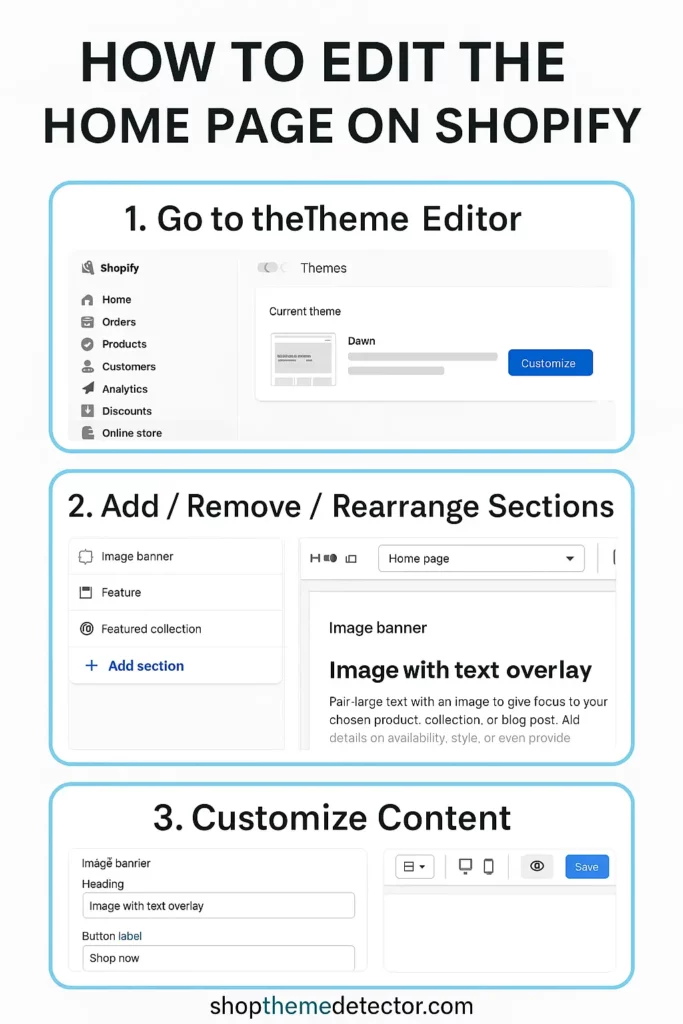
Step 1: Open the Theme Editor
- In your Shopify Admin, go to Online Store > Themes.
- Find your active theme (it’s labeled “Current theme” at the top).
- Click Customize.
This opens the Theme Editor - the visual interface where you control the homepage layout.
Step 2: Add, Remove, or Rearrange Sections
In the left panel, you’ll see all the sections that make up your homepage.
- Click any section (e.g., “Image Banner”, “Featured Collection”) to edit its text, buttons, and images.
- Click Add section to insert new content blocks like a slideshow, newsletter signup, testimonials, or a featured product.
- Drag and drop sections to reorder them.
- Use the eye icon to hide a section without deleting it - useful for seasonal content you’ll bring back later.
Step 3: Customize Each Section’s Content
Every section has its own settings panel:
- Change headings, button text, and button destinations.
- Upload images directly inside the section.
- Pick collections or products dynamically from your store catalog.
Step 4: Preview and Save
- Use the device-toggle at the top of the editor to preview desktop, tablet, and mobile views - always check mobile, since 70%+ of Shopify checkout traffic is mobile.
- Click Save after each round of changes. Saves are non-destructive - you can roll back if needed.
Pro Tips for a High-Converting Homepage
- Use fewer sections, not more. A clean homepage converts better than a cluttered one. Aim for hero, value-prop, featured collection, and one trust block - that’s enough.
- Put a clear call-to-action above the fold. The first screen on mobile is roughly 600px tall. Whatever lives there is what most visitors will see, and only that.
- Avoid carousels with five+ slides. Studies consistently show that visitors mostly engage with the first slide. The other four are wasted bytes that slow the page.
- Don’t stack two competing CTAs side by side. One primary action per screen - the second action is always weaker.
Themes and the Theme Editor - How They Work Together
The overall design of your home page is controlled by your active theme. Themes organize the page into sections, where each section can hold a specific kind of content (text, image, video, product picks, etc.). Most modern themes (anything built on Online Store 2.0) let you add, remove, and reorder sections freely. Older themes have fixed homepage layouts where you can edit content but not structure.
Two parts of every theme are fixed: the header and the footer. They appear on every page, including the homepage, and they can’t be moved. You can customize their content (logo, navigation, social links, footer columns), but their position is locked.
If you want to add a content page beyond the homepage, see our guide on how to create a new page in Shopify - the workflow is similar but uses a different admin area.
Theme Styles (Presets)
Most premium themes ship with multiple style presets - each preset is a different combination of fonts, color schemes, and section defaults that change the overall feel of the store. To switch presets, click Change theme style from the General Settings tab in the theme editor. This is a faster way to test different aesthetic directions than redesigning section by section.
Shopify Homepage SEO: Optimizing for Search
Most homepage tutorials stop at the visual editor. The homepage SEO settings - which control how Google sees and ranks your home page - live in a separate area and are routinely ignored.
Homepage page title. This is the blue clickable headline in Google search results for your home page. To edit it: Online Store > Preferences > Title and meta description. Aim for under 60 characters and include your brand name plus your category (e.g., “Acme Wool - Hand-Knit Merino Sweaters”). Don’t just put your store name - pair it with what you actually sell, because that’s what searchers type.
Homepage meta description. Same Preferences screen. 140-155 characters. Treat it like an ad: a clear value proposition with a reason to click. Most stores leave the auto-generated description in place, which is almost always weaker than a written one.
Hero image alt text. The hero banner is your largest image and your Largest Contentful Paint element for Core Web Vitals. Inside the theme editor, click the hero section, find the image setting, and add descriptive alt text - both for accessibility and image search visibility. “Hand-knit merino wool sweater in oatmeal” beats “homepage banner”.
Mobile experience. Google indexes mobile-first. Whatever your homepage looks like on a phone is what Google ranks. Test the live page on a real phone, not Chrome DevTools - DevTools doesn’t reproduce real touch latency, real network throttling, or real thumb reach.
Speed. Homepage speed disproportionately affects rankings because it’s typically your highest-traffic page and your most-linked-to internal page. Aim for LCP under 2.5s, INP under 200ms, CLS under 0.1 on PageSpeed Insights mobile. The biggest wins are typically removing oversized hero images (compress to WebP, resize to actual display dimensions), removing unused homepage apps, and lazy-loading anything below the fold.
Internal linking from the homepage. The homepage passes the most link authority of any page on your store. Use that authority intentionally: link to your top categories, your highest-margin products, your most-trafficked blog content. Don’t waste homepage links on pages that don’t need the help.
Structured data. Modern Shopify themes include basic Organization and WebSite schema on the homepage automatically. If you sell physical goods, also confirm the homepage exposes Sitelinks search box markup - this often produces a search-bar feature in Google results for branded queries.
Editing Homepage Code (Liquid) Beyond the Theme Editor
The visual theme editor handles 90% of homepage editing. The other 10% - custom layouts, custom sections, conditional logic, third-party API integrations - requires editing theme Liquid files directly.
How to access the code: Online Store > Themes, click the … menu next to your active theme, choose Edit code. This opens a code editor in the browser with the full theme file tree.
Where the homepage lives in code:
templates/index.json- the homepage template that defines which sections appear and their order. Modern Online Store 2.0 themes use JSON; older themes usetemplates/index.liquid.sections/- the individual section files. Each visual section in the theme editor corresponds to a file here.layout/theme.liquid- the wrapper that includes the header and footer on every page, including the homepage.
Best practice: always duplicate your live theme before editing code. Themes > … menu > Duplicate creates an unpublished copy you can edit without risk. Test thoroughly on the duplicate, then publish when ready.
Custom sections. Adding a new custom section is the cleanest way to extend the homepage. Create a new file in sections/ with a unique name, define the section schema (settings, blocks, presets), and the section becomes available in the theme editor’s “Add section” menu. This way the merchant retains visual control while the developer extends what’s possible.
Reverting Changes
Shopify’s rollback feature lets you revert your theme to a previous version. Go to Online Store > Themes > … menu > Theme history. You’ll see saved versions with timestamps. Click any version to preview, then publish it as the live theme if needed. This is your safety net - use it before reaching out to a developer for a fix on something you broke.
-
How often should I update my Shopify homepage?
Regularly updating your homepage, whether monthly or quarterly, with fresh content, new products, and promotions can re-engage past visitors and attract new ones, while ensuring alignment with your brand’s message and goals.
-
Can I revert to a previous version of my homepage if needed?
Yes, Shopify provides a “Rollback” feature that allows you to revert to a previous version of your theme. However, it’s advisable to regularly backup your theme to ensure you can recover specific versions if needed.
-
Can I preview changes before publishing them on Shopify?
Yes, Shopify allows you to preview changes before publishing. Using the theme editor, you can view modifications in real time and ensure everything looks as intended before making it live for your visitors.
-
How do I edit my Shopify homepage SEO settings?
Shopify homepage SEO settings are separate from the visual theme editor. Go to Online Store > Preferences in your Shopify admin to edit the homepage page title (under 60 characters, include your brand and category) and meta description (140-155 characters with a clear value proposition). For the hero image alt text, open the theme editor (Online Store > Themes > Customize), click the hero section, and add descriptive alt text in the image setting. Beyond the basics, focus on homepage speed (LCP under 2.5s on PageSpeed Insights), mobile experience tested on a real phone, and intentional internal links from the homepage to your highest-priority pages, the homepage passes more link authority than any other page on your store.
-
Can I edit Shopify homepage code directly?
Yes: go to Online Store > Themes, click the three-dot menu next to your active theme, and choose Edit code. This opens a code editor in the browser with full access to the theme files. The homepage layout lives in templates/index.json (Online Store 2.0 themes) or templates/index.liquid (older themes), and individual sections are files in the sections/ folder. Always duplicate your live theme before editing code (Themes >… menu > Duplicate creates an unpublished copy), test on the duplicate, and publish only when changes are working. Direct code editing is the right approach when the visual theme editor doesn’t expose what you need: custom layouts, conditional logic, third-party API integrations, or new section types.
Enhancing Your Shopify Homepage
Understanding Theme Sections
Sections are integral parts of your Shopify theme. They allow you to add, reorder, and customize content on your homepage.
Each theme offers unique sections like slideshows, collections, videos, and featured products. Within these sections, you can incorporate various content types, such as products, text, or images. You can also add social media icons to your homepage sections to direct visitors to your social profiles.
Fixed Sections and Their Role
Certain sections, like the theme’s Header and Footer, are fixed. This means you can’t move them around, but you can modify their content to fit your brand’s message. In the footer, you can remove the ‘Powered by Shopify’ text and replace it with social media icons to give your store a more professional and branded look.
Utilizing the Theme Editor
The theme editor is a powerful tool that lets you manage sections. It’s split into two main tabs: Sections and General Settings. The Sections tab displays the content available with your theme, allowing you to customize, add, or rearrange sections.
The General Settings tab, on the other hand, lets you implement global changes like adjusting fonts, text, background colors, and linking your social media accounts. This is where you can set up important branding elements like your logo, favicons, and color scheme when you first set up your Shopify store.
Optimizing Your Homepage Layout
Reordering Sections for Better Flow
The layout of your homepage plays a crucial role in user experience. By adjusting the order of sections, you can guide your visitors through a seamless journey. To do this, use the theme editor’s sidebar menu to drag and rearrange sections.
Undoing Changes for a Fresh Start
Mistakes happen, and that’s okay. The theme editor comes with an Undo button that reverts your most recent change. If you change your mind again, the Redo button is there to help.
Tips for Editing Your Shopify Homepage
Keep It Simple
Simplicity is key. A cluttered homepage can overwhelm visitors. Prioritize essential elements and ensure a clean, user-friendly design.
Mobile Responsiveness
Many shoppers use mobile devices. Ensure your homepage looks and functions well on all screen sizes. Test regularly and adjust as needed.
Consistent Branding
Your homepage is a reflection of your brand. Maintain consistent colors, fonts, and imagery to build trust and recognition. Add your logo to key places like your email templates and Shopify checkout page for a cohesive branded experience.
Use High-Quality Images
Images play a pivotal role in attracting and retaining visitors. Use clear, high-resolution images that resonate with your audience.
Update Regularly
Keep your homepage fresh by updating it regularly. Highlight new products, promotions, or content to keep visitors engaged and returning.
Conclusion: How To Edit The Home Page On Shopify
There are also other options that can be used to edit home pages and set up other pages. For instance, you can use drag and drop page builders on your website. These are useful tools that allow you to completely customize the look of your website while using the color and font schemes of your theme.