Shopify App Store Statistics 2026: 13 Key Numbers
Last modified: October 22, 2026
Shopify App Store statistics give store owners a clearer picture of what they’re walking into when they install their first app, and what’s reasonable to spend over a year. Below are 13 numbers worth knowing in 2026: how many apps actually live in the store, what the average store owner spends each month, how much developers make, and where reviews tend to land. Several of these numbers run against gut feel - most apps cost a few dollars rather than $20, and the average rating sits lower than you’d expect.
What Is the Shopify App Store?
The Shopify App Store is the marketplace where developers list paid and free Shopify apps, and where merchants install them on their stores. It covers email marketing, popups, inventory, reviews, shipping, and almost every other store function that isn’t built into core Shopify.
Apps come from Shopify itself and from independent developers. Most are subscription-based; some are one-off purchases or free with optional paid tiers.
So what are the main statistics that matter? Here they are.
1. About 87% of Merchants Use the Shopify App Store
Adoption is high but not universal. Roughly 87% of Shopify merchants install at least one app from the store. That means about one in eight store owners never use it at all.
Why might that be? Some stores are inactive or test stores. Some use all-in-one themes like Shoptimized or Booster that bake popular app features into the theme itself, so the App Store becomes unnecessary.
There are also ways to install certain tools outside the store. Apps like Vitals can be bought directly from the developer in some cases. So a small slice of stores genuinely operate without ever touching the marketplace.
2. There Are Over 29,000 Apps on the Store and Growing
The exact count is hard to pin down because apps are added and removed every week. Earlier counts pegged it at 6,000 to 8,000; the marketplace has continued to grow since then, with new apps shipping regularly.
The practical consequence: apps occasionally get pulled or unsupported. When that happens, functions can quietly disappear from your store. Keeping apps updated, and watching for “no longer supported” notices, is part of running a Shopify store at scale.
Most updates ship to fix security issues, not features. Skipping them is the most common reason store owners run into avoidable problems.
3. The Average Paid Shopify App Costs About $33 a Month
Most apps are paid. Counting only the apps that charge, the average monthly price is $31.04 and the median cheapest plan is $9.99 (free apps are excluded). That tells you the distribution is heavily skewed: a handful of expensive enterprise apps pull the mean up, while the typical app you install costs less than a coffee.
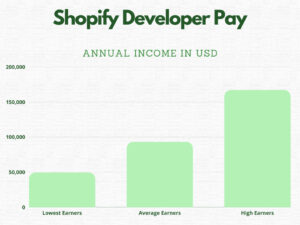
Most apps are built by independent developers, and subscriptions go directly to them. The top 25% of app developers earn around $167,000 a year from their apps.
Shopify, for its part, has reportedly earned about $100 million from app sales (its revenue share is taken on top of what the developer earns).
4. The Average Store Owner Spends $120 a Month on Shopify Apps
At about $120 a month, app spend is a real line item. For a typical store, this sits on top of the Shopify plan and any subscription theme, which means a merchant needs to clear about $200 a month in margin just to cover stack costs before any product margin counts toward profit.
Free trials soften the entry: many apps offer 7 to 30 days free, and a few use price matching to compete on cost.
Pricing varies sharply by category. Inventory management apps have a median of $17.98 but a mean above $100 because of enterprise tools at the top end. Reporting is the cheapest category, averaging around $5.
5. Nearly 62% of Third-Party Apps Will Slow Down Your Store
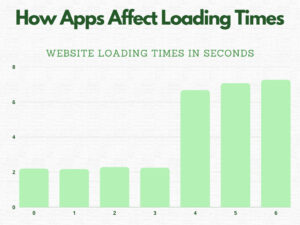
Research from Loox found that most third-party integrations measurably slow Shopify stores. The hit averages around 0.75 seconds per app on social/email integrations.
That doesn’t sound like much, but on Shopify each extra second of load time costs about 5% of revenue. The typical store runs about six apps. The math is brutal: a fully-loaded stack can quietly cost a store up to 30% of its potential revenue.
How? Many apps don’t just inject UI; they call out to their own servers to load popups, images, videos, recommendations, and reviews. Every external call costs time. The fix is selection discipline: install only the apps that pay back their cost in measurable conversion lift, and audit quarterly.
6. Only 1-3% of Users Will Review an App
Reviews matter for app developers, who depend on social proof to grow. The old flat 20% cut is gone. Developers now keep 100% of their first $1 million in gross app revenue earned from January 1, 2025, then pay 15% above that. That first-million threshold is a one-time lifetime total, not a yearly reset, so on a $5 subscription the developer keeps the full amount until their cumulative earnings since that date pass $1 million.
To clear the average developer salary of $93,000 a year from a single $5/month app, a developer needs around 2,000 active subscriptions.
Only 1-3% of merchants leave a review. So one visible review typically represents 33-100 actual installs. A developer aiming for a sustainable income needs roughly 20-60 reviews on an app for it to feel commercially proven. That’s reachable, but it takes time.
7. The Average Developer Earns $93,000 a Year from the Shopify App Store
The Shopify App Store supports a real working economy for developers. The bottom 6% earn $43,000 to $56,000. The average developer earns about $93,000 a year. The top performers clear $173,000 to $186,000.
There are two ways developers earn more. The first is to ship more apps, a portfolio approach where each app cross-promotes the others. The second is alternative revenue: Patreon, premium content, custom development services, or services on top of the free tier of an app.
About 0.18% of all app developers earn more than $1 million a year.
Shopify App Store Developer Revenue Share (Official, 2026)
Shopify App Store developers keep 100% of their first $1,000,000 USD in gross app revenue earned from January 1, 2025, then pay a 15% revenue share on everything above that. Shopify labels this first-million threshold a lifetime total: it is counted once across the life of the Partner account, and earnings from before January 1, 2025 do not count toward it.
This replaced the earlier pandemic-era policy, which exempted the first $1,000,000 of app revenue each year. Shopify rolled that annual exemption back to a single lifetime threshold, so a developer who has already passed the first million no longer resets to the 0% tier at the start of a new year.
| Gross app revenue (lifetime, from Jan 1, 2025) | Shopify’s share | Developer keeps |
|---|---|---|
| First $1,000,000 | 0% | 100% |
| Above $1,000,000 | 15% | 85% |
Two caveats: large developers (those who earned $20 million or more through the App Store in the prior calendar year, or whose company grosses $100 million or more) pay the 15% share on all app revenue with no 0% tier, and all billing carries a separate 2.9% payment processing fee plus any applicable sales tax.
Verified against Shopify’s developer documentation (shopify.dev/docs/apps/launch/distribution/revenue-share) on October 8, 2026.
8. Marketing Apps Generate the Highest Revenue Per Listing
Marketing is the highest-earning category on the store. The average marketing app generates about $19,900 a year. Even so, that means a single-app developer would need roughly five marketing apps in that range to clear the average $93,000 salary.
Store design apps come in second, averaging about $13,500 per year.
Reporting is the lowest-earning category. That’s not necessarily a bad bet: some developers use a free reporting app as a loss-leader, then cross-sell premium apps to users who already trust the brand.
9. There Are 40-90 New Apps Launched Every Week
Between 40 and 90 new apps go live each week. Most struggle out of the gate. Across one tracked batch of 700 new apps over three months, the average earned about $39.72 in first-quarter revenue, and the median was $0.
The launch curve is steep: most apps either find a niche fast or fade.
10. The Average App Rating Is 2.96
The mean app rating is 2.96. The median is 4.2. That gap shows a small number of poorly-rated apps dragging the average down, most apps in the store sit at four stars or higher.
Counterintuitively, free apps rate worse than paid. The average free app sits at 2.38 (mean), 2.7 (median). Paid apps tend to be more polished, supported, and updated, which earns them better ratings.
There are about 579,000 reviews on the store. The average app has roughly 96 reviews, though the long tail varies wildly. Free apps make up just 105,000 of those reviews, so premium apps are roughly twice as likely to get a review, even adjusted for share of listings.
Apps in the merchandising category have the highest average rating at 3.38. Reporting sits at the bottom.
11. Category Mix Has Shifted Toward Sourcing and Store Design
Developers stick to the categories where demand sits. Before June 2021, the top categories were conversion and customer support. Since then, sourcing-and-selling and store design have taken the lead.
Some of that shift is a category-rules change: in June 2021, Shopify allowed apps to be tagged in multiple categories. Apps that span functions can now show up in two or three.
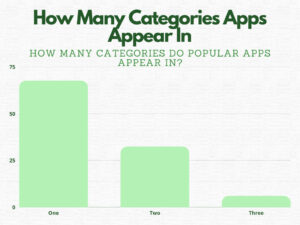
Around 32.4% of apps are now in two or more categories, 6.1% in three. The remaining 67.6% sit in a single category.
12. The Typical App Subscription Lasts 4-6 Months Before Cancellation
Most app subscriptions churn within a few months of installation. Analysis of Shopify Partner data shows the median subscription lasts 4 to 6 months before a merchant either cancels or downgrades to a free plan. The exception is apps tied directly to revenue: review collection apps, subscription billing apps, and email marketing tools see significantly longer retention, often 12+ months, because removing them costs more in lost function than keeping them costs in fees.
This churn rate has a practical implication for developers: the initial install is rarely the hard part. Retaining users past month 3, when the novelty has worn off and the free trial is long over, is where the economics of an app business are actually won or lost.
13. Apps Built for Shopify Plus Merchants Earn 3-5x More Per Listing
Apps that target Shopify Plus merchants, those focused on multi-location inventory, B2B pricing, custom checkout extensibility, or enterprise automation, earn substantially more per listing than general-store apps in the same category. The average Plus-targeted app generates roughly 3 to 5 times the annual revenue of a comparable general-merchant app, driven by higher plan pricing and lower churn (Plus merchants are less likely to cancel apps that integrate deeply with their workflows).
The tradeoff is a smaller total addressable market. There are roughly 50,000 to 60,000 Shopify Plus merchants at any given time, compared to over 2 million merchants on standard plans. A developer targeting Plus accepts lower volume in exchange for higher revenue per subscriber and a customer base that churns at a lower rate.
What These Numbers Mean for Store Owners
Three practical takeaways from these statistics:
- Budget realistically. Plan for $100-$150/month in app spend once your store is fully operational. That’s separate from your Shopify plan and any theme subscription.
- Audit for speed every quarter. With most apps adding measurable load time, the easy money is cutting apps you don’t actively need. A 1-second improvement typically returns 5-7% in conversion.
- Read reviews with the right lens. Only 1-3% of users review apps, so a paid app with 50+ reviews has likely processed thousands of installs. Look at recent reviews (last 90 days) more than overall stars.
-
Is it easy to develop a Shopify app?
Getting a basic Shopify app published requires proficiency with Node.js or another supported language, familiarity with Shopify’s Polaris design system, and an understanding of Shopify’s app billing and authentication APIs. The tooling, including the Shopify CLI and official documentation, is reasonably mature, and the partner portal makes the submission process straightforward. The harder part is finding a gap in the market: with over 29,000 apps already listed, building something useful that isn’t already served by multiple competing apps requires research. First-quarter revenue for newly launched apps averages under $40, and the median is $0, so most apps never gain meaningful traction.
-
What revenue share does Shopify take from app sales?
As of 2025, Shopify takes 0% on a developer’s first $1,000,000 in lifetime gross app revenue (counted from January 1, 2025), then 15% on everything above that threshold. The first-million limit is a one-time lifetime total, not an annual reset. Large developers, those who earned $20 million or more through the App Store in the prior calendar year or whose company grosses $100 million or more, pay the 15% share on all revenue with no 0% tier. All transactions also carry a 2.9% payment processing fee. This replaced the earlier pandemic-era structure that exempted the first $1 million each year.
-
How do you tell the quality of an app on the App Store?
Recent reviews (last 90 days) are more reliable than the overall star rating, which can be inflated by early installs or skewed by an unusual batch of reviews. The number of reviews matters as a signal of install volume: since only 1-3% of users review, a paid app with 50 or more reviews has likely been installed by thousands of merchants. Check for recent developer activity in the changelog, a developer who hasn’t shipped an update in a year may have deprioritized the app. The Shopify App Store also shows whether the app is Built for Shopify certified, which indicates it meets Shopify’s current technical and UX standards.
-
How much should I budget for Shopify apps?
There are numerous budgets that could be considered for buying Shopify apps. For instance, those with low budgets might want to budget about $40 per month. However, the average budget for Shopify apps from the store is $120 per month.
-
How do you keep apps from slowing down your Shopify store?
Start by auditing which apps you actually use. Most stores accumulate apps during the setup phase and never remove the ones that didn’t work out. Each installed app, even one you don’t actively use, can load scripts on your storefront. Remove any app you haven’t actively used in the past 90 days. For apps you keep, look for ones that have earned the Built for Shopify badge: Shopify tests these for performance impact as part of the certification. Run your store through Google PageSpeed Insights before and after any app installation to measure the real load-time cost. The apps most likely to slow stores are those that inject third-party scripts for popups, chat widgets, or video backgrounds.
-
Which types of Shopify apps generate the most revenue for developers?
Marketing apps generate the highest average revenue per listing, at around $19,900 per year. Store design apps come second at roughly $13,500. Reporting apps earn the least but are sometimes used as free entry points into a broader paid product. Apps targeting Shopify Plus merchants, those focused on enterprise automation, B2B pricing, or custom checkout, earn roughly 3 to 5 times more per listing than general-store apps in the same category, though they serve a much smaller total market of around 50,000-60,000 Plus merchants.
Conclusion: Shopify App Store Statistics
The Shopify App Store is a large, active marketplace with real economic stakes for both merchants and developers. Most merchants spend around $120/month on apps, most apps cost less than $10, and most developers earn in the $43,000-$93,000 range annually. The developer revenue share changed in 2025 to a lifetime $1 million threshold rather than an annual reset, which benefits new developers most. For merchants, the numbers argue for two habits: budget accurately for app costs from the start, and audit your stack quarterly for speed and ROI, since most apps add measurable load time and only a fraction of installed apps actively drive revenue.